
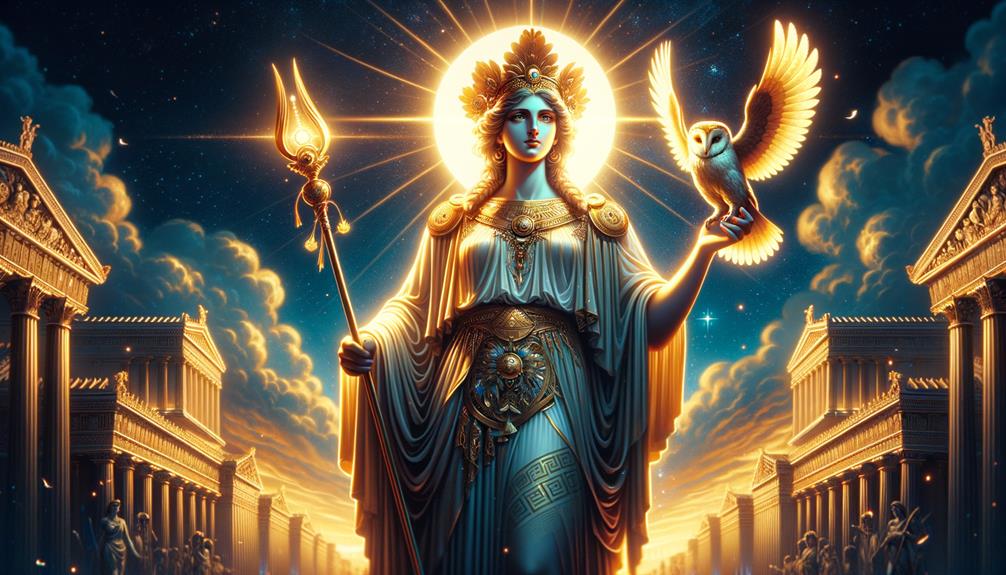
Athena is a goddess of intelligence put into action: protecting a city, planning a difficult return, making useful things, and fighting when a story calls for force. “Goddess of wisdom” is a familiar description, but it can sound more detached and peaceful than the surviving Greek poems suggest.
Her different activities belong together. The craft of a weaver, the judgment of a counselor, and the strategy of a warrior all involve skill, although the consequences of using that skill can be very different.
Born from Zeus, but Metis matters
The famous head-birth should not erase Metis from the story. In Hesiod’s Theogony, lines 886–900, Zeus takes Metis as his first wife. She is pregnant with Athena when he swallows her, following a warning about a future child who might challenge his rule.
Hesiod describes Athena as equal to Zeus in strength and understanding, while the anticipated son would become a ruler over gods and mortals. The swallowing belongs to the poem’s larger concern with succession and the preservation of divine kingship. It is not simply a colorful explanation of a headache.
The Homeric Hymn to Athena, number 28, concentrates on the birth itself. She emerges armed, brandishing a spear; Olympus, earth, and sea respond to her power. The hymn’s emphasis is awe and authority, not the arrival of a quietly contemplative figure.
Athens, Poseidon, and the olive
Athenian tradition made Athena the city’s divine protector through a contest with Poseidon. The Acropolis Museum’s explanation of the Parthenon’s west pediment describes Athena offering an olive tree and Poseidon offering salt water, with the city’s mythical figures judging in her favor.
This is the version relevant to that sculptural setting. Other retellings should be named when they change the gift or the judges. The story explains a sacred relationship between goddess and city; it is not evidence that a historical municipal election between gods took place.
The Parthenon also presented her birth on its east pediment. The museum’s account of the surviving fragments places Zeus and Athena at the center, with the other gods witnessing the event. The two ends of the temple connected her divine origin with her role in Athens.
Craft is part of her power
The Homeric Hymn to Aphrodite, number 5, describes Athena as devoted to warfare and skilled making, including teaching crafts. Hymn 20 pairs her with Hephaestus as a teacher of arts that improve human life. These poems do not divide the divine world into a thoughtful Athena who dislikes conflict and a separate set of practical gods.
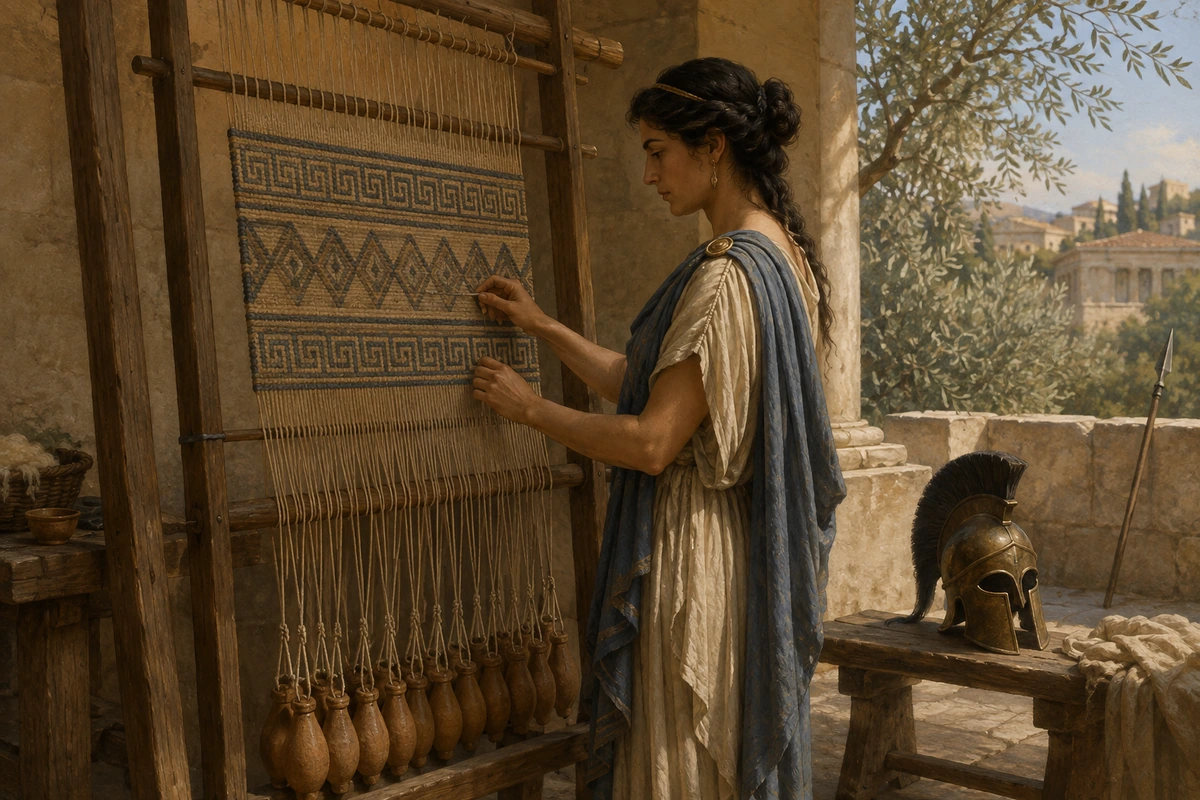
That association helps explain why weaving is more than a decorative attribute. Working thread into an ordered textile makes skill visible. It also offers a useful comparison with the goddess’s ability to arrange a plan from many separate actions, although that comparison is an interpretation, not a fixed ancient definition.
Odysseus and the intelligence of disguise
In Odyssey 13.217–374, Athena approaches Odysseus in disguise after he reaches Ithaca. He answers with an invented story. Rather than treating his deception as an unexpected failure, she recognizes a kindred skill and reveals herself.
Their meeting turns quickly toward practical problems: hiding his treasures, concealing his arrival, and planning against the suitors in his house. Her support does not remove the need for endurance or make his homecoming effortless. It gives him a partner whose intelligence operates through timing, observation, and concealment.
The episode also complicates the modern assumption that wisdom always means openness or gentleness. Within this narrative, Athena admires strategic deception. Readers can recognize that quality without turning every decision she makes into a timeless moral instruction.
Reading Athena across different sources
Hesiod’s account of Metis, the hymns’ praise of martial and practical skill, the Parthenon’s civic imagery, and the Odyssey’s disguised encounters illuminate different aspects of Athena. Together they show why “wisdom” needs concrete examples.
The goddess is not merely the opposite of violence, nor only a symbol of abstract knowledge. She is a powerful participant in stories about cities, survival, skilled work, and the difficult uses of intelligence.