
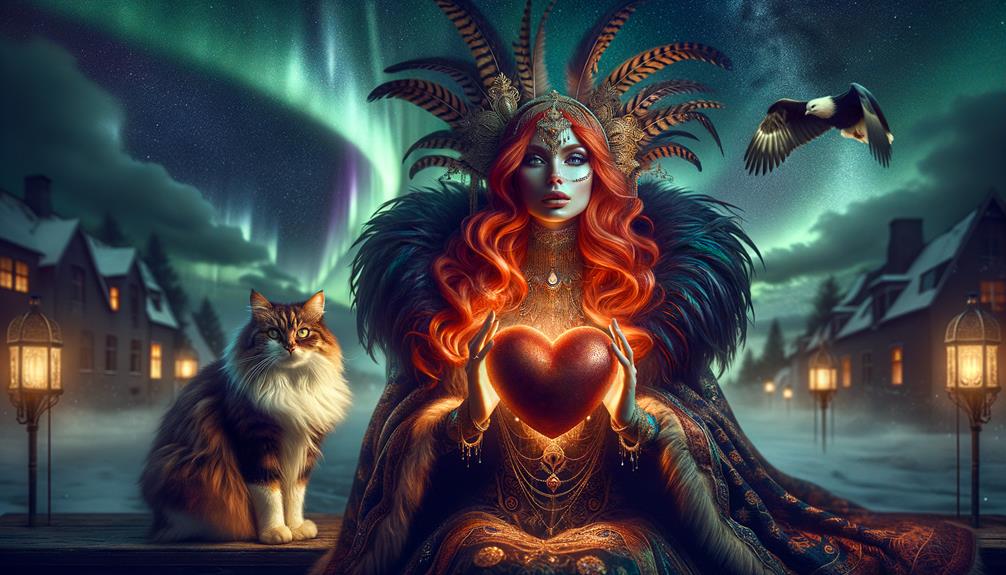
Freyja is a major goddess in Old Norse literature. The sources associate her with desire, fertility, wealth, seiðr magic, precious objects, battle-dead, and lament. Calling her only a love goddess leaves out much of the surviving material.
Freyja in the surviving tradition
Freyja belongs to the Vanir and is the daughter of Njörðr and sister of Freyr. After the conflict between the Æsir and Vanir, she lives among the Æsir. Her hall is Sessrúmnir in Fólkvangr. Grímnismál says that she receives half of those who fall in battle while Odin receives the other half, although the poem does not explain the selection process.
Texts, objects, and evidence
Freyja owns the necklace Brísingamen, rides in a cat-drawn vehicle in Snorri’s account, and can use a falcon-feather form that other gods borrow. Her husband is Óðr, who is often absent; she searches for him and sheds tears described as red gold. Snorri also credits her with teaching seiðr to the Æsir. These details come from separate poems and prose passages rather than one continuous life story.
Key points
- Names: Freyja means Lady. Several poetic names reflect travel, wealth, or family connections.
- Love and fertility: Poems and later prose connect her with desire and relationships, but no source makes these her only concerns.
- War dead: Her share of the fallen complicates the modern image of a purely gentle deity.
- Freyja and Frigg: The two goddesses share some features, yet medieval sources generally present them as distinct. Claims that they were originally one require scholarly argument, not certainty.
How to read the material
The evidence combines poetry, prose written in Christian Iceland, names, and archaeology. Each source has its own date and purpose, so modern labels should remain broad and cautious.