
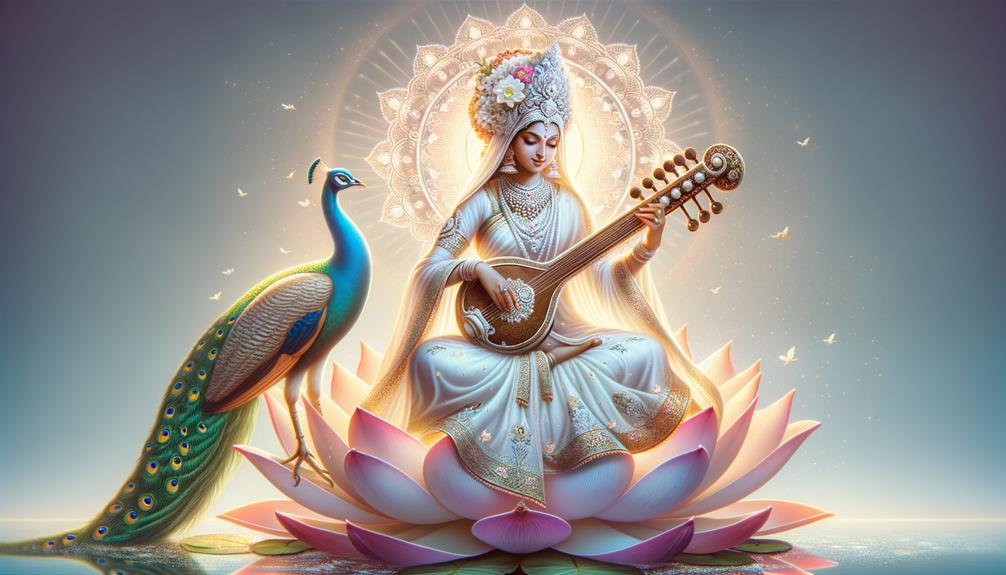
Saraswati is a living goddess of speech, knowledge, learning, music, and artistic creation whose history reaches back to Vedic praise of Sarasvati as river and divine power. She is worshipped across regions and communities, and related forms appear in Jain and Buddhist traditions. No single family chart or image exhausts that history.
Her domains are connected by flow: water, eloquent speech, melody, memory, and disciplined understanding. Students may place books before her, musicians honor her instrument, and devotees ask for clarity at the beginning of study or performance.
From river to speech and knowledge
The Rigveda praises Sarasvati in language that is simultaneously geographical, divine, and poetic. She is a powerful river, a nourishing mother, and a source of inspiration. Later Vedic and post-Vedic traditions increasingly connect Saraswati with Vāc, speech itself, and with the verbal knowledge on which recitation and ritual depend.
It is too simple to imagine a river goddess being replaced overnight by a school goddess. Religious identities accumulate and change through texts, places, rites, images, and theology. Water remains visible in her name and art even when books, language, and music become prominent.
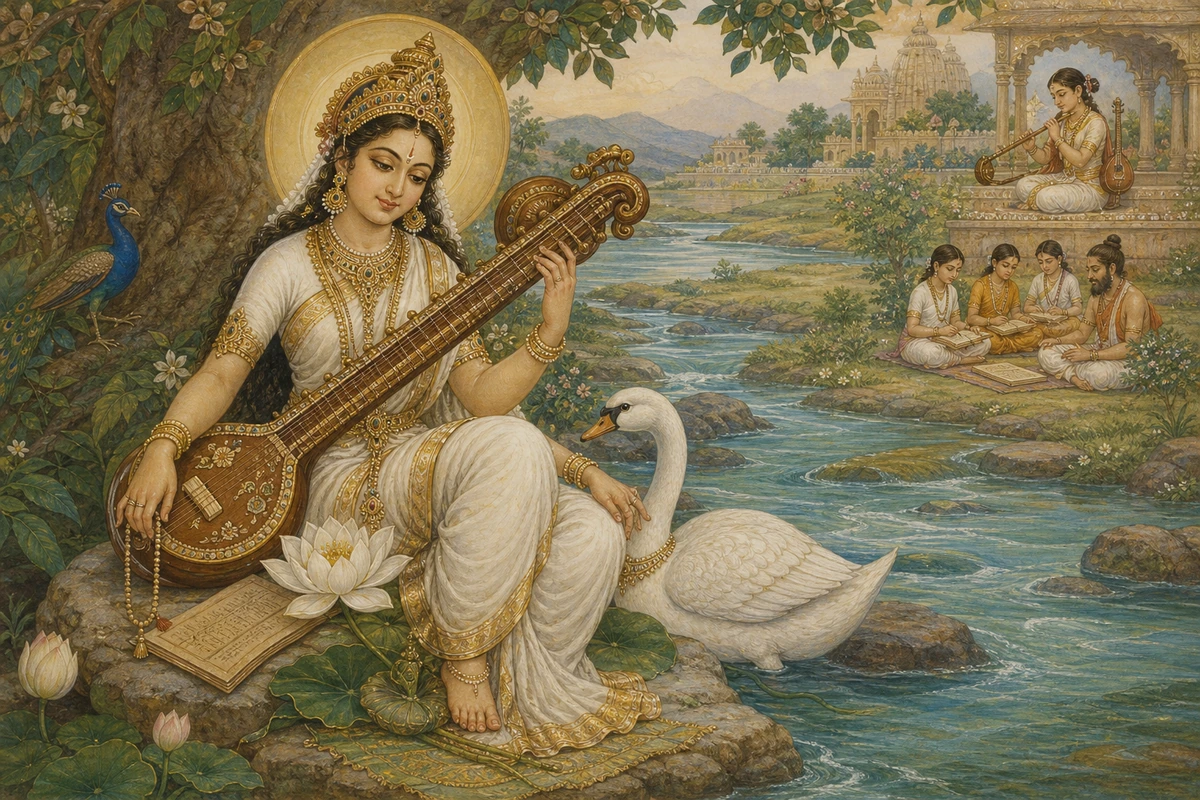
| Attribute | Common meaning | Necessary caution |
|---|---|---|
| Veena | Music, cultivated skill, and harmony | Instrument forms differ across regions and periods |
| Book or manuscript | Learning, scripture, grammar, and memory | Not every historic image includes a modern bound book |
| Mala or prayer beads | Concentration, recitation, and spiritual discipline | Meanings overlap rather than forming a fixed code |
| White lotus and garments | Clarity and purity | Color conventions are not identical everywhere |
| Hamsa or peacock | Discernment, beauty, movement, or local iconographic tradition | One vehicle should not erase the other variants |
Worship and Vasant Panchami
Vasant Panchami is a major Saraswati festival in many parts of South Asia. Yellow or white clothing, offerings, music, and the honoring of books and instruments may feature, but observance is regional. In some communities children begin writing or formal learning in a ceremony of first letters. Schools, households, temples, artists, and cultural associations organize the day differently.
Other calendars place special emphasis on Saraswati during Navaratri or local learning rites. Describing one festival as the sole or universal practice would flatten living diversity.
Relationships are not one genealogy
Saraswati is often linked with Brahma, but texts and regional traditions describe divine relationships in different ways. Other narratives associate her with Vishnu or place her alongside Lakshmi and Parvati in theological groupings. These arrangements express sectarian and symbolic systems rather than one official marriage record.
Her presence beyond Hindu traditions is equally important. Jain images honor Sarasvati as a goddess of learning and sacred knowledge. Buddhist transmission carried related forms across Asia; Japanese Benzaiten ultimately develops from Sarasvati while acquiring new local histories and attributes. “Same goddess” and “completely separate figure” are both too blunt unless the historical transformation is explained.
Learning as sacred practice
Saraswati’s authority makes knowledge more than information. Speech must be clear, music practiced, memory cultivated, and creativity disciplined. This is why her image belongs in libraries, classrooms, performance spaces, and homes as well as temples.
She should therefore not be treated only as a character from a completed mythic past. Devotional relationships, festivals, artistic practice, and education continue to shape how Saraswati is understood.
Accuracy note
This article distinguishes Vedic river and speech histories without claiming a simple replacement, presents iconographic meanings as common rather than universal, and treats Hindu, Jain, and Buddhist Saraswati traditions as related but historically distinct.