
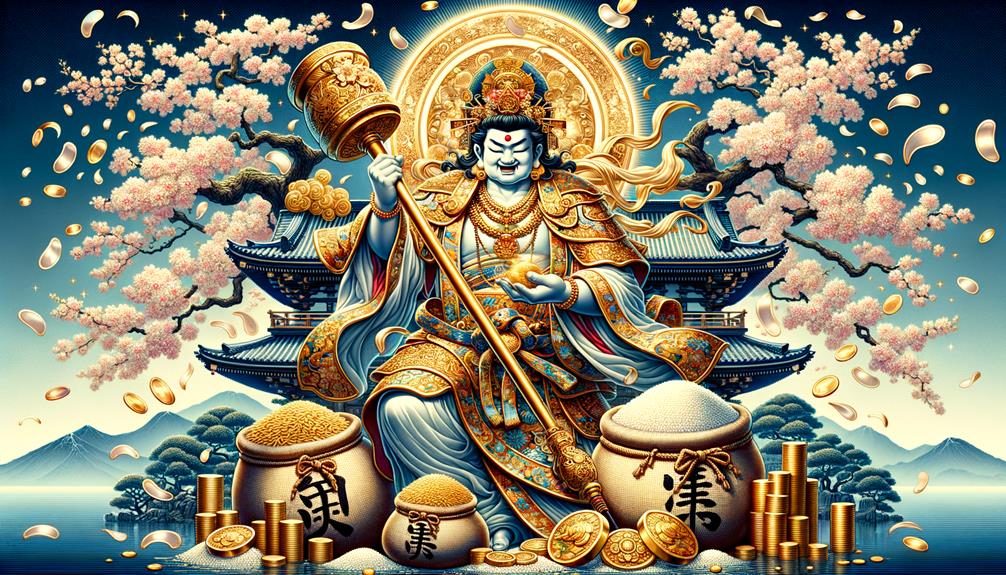
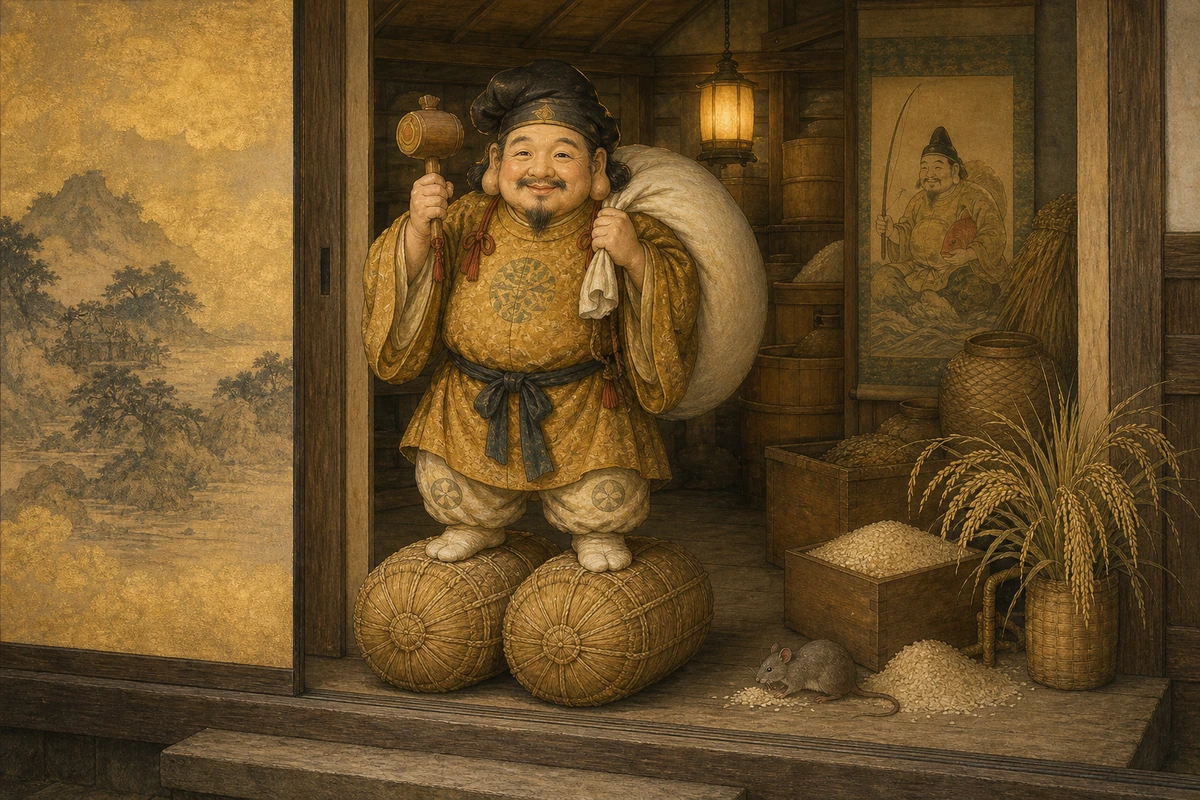
Daikokuten is one of Japan’s Seven Gods of Good Fortune, recognizable by his wooden mallet, bulging sack, rice bales, and genial expression. That familiar figure is the result of centuries of religious change. His name and early identity are connected to the Buddhist deity Mahākāla, while medieval Japanese wordplay linked him with the kami Ōkuninushi. Temple kitchens, household prosperity, rice cultivation, and commerce all contributed to the benevolent Daikoku seen in later art.
Is Daikokuten a Buddhist deity or a Japanese kami?
The most accurate answer is that Daikokuten has participated in both Buddhist and kami worship. His Japanese name, 大黒天, can be understood as “Great Black Deva” and corresponds to Mahākāla, the Sanskrit “Great Black” deity known in several Buddhist traditions. Mahākāla can appear as a fierce protector, sometimes with multiple faces or arms. That fearsome iconography looks very different from the round, smiling fortune god familiar in Japan.
Religious transmission did not simply carry one unchanging image from India to Japan. An account by the seventh-century Buddhist pilgrim Yijing describes a form placed on kitchen pillars in Indian monasteries as a guardian of provisions and good fortune. According to Kokugakuin University’s Encyclopedia of Shinto entry on Daikokuten, the Tendai founder Saichō helped introduce this kitchen-tutelary form to Japan. The association with stored food created a path from monastic protection to rice, household abundance, and prosperity.
How Daikokuten became associated with Ōkuninushi
From the medieval period, Japanese shinbutsu shūgō joined kami and Buddhist figures through networks of correspondence, shared sacred sites, and ritual interpretation. Daikoku became associated with Ōkuninushi partly because the characters in Ōkuninushi’s name 大国, “Great Land,” can also be read Daikoku. The resemblance was a productive wordplay, not proof that the two figures had always been identical.
This identification made it easier for Daikoku to enter local stories and shrine practice while retaining Buddhist associations. It also helped pair him with Ebisu. By the late Muromachi period, Daikoku and Ebisu were counted among the emerging Seven Gods of Good Fortune, or Shichifukujin. In households they could be enshrined near the kitchen or hearth; merchants approached them as protectors of commercial success, and farmers connected them with rice fields and harvest.
| Feature | Common meaning in Japanese Daikokuten imagery | Historical caution |
|---|---|---|
| Wooden mallet | Auspicious power and the production of good fortune | It belongs to the later benevolent iconography, not every form of Mahākāla |
| Treasure sack | Stored provisions, gifts, and abundance | It need not mean a bag of coins or literal unlimited money |
| Rice bales | Food security, agricultural wealth, and the rice economy | Prosperity historically meant sustenance as well as cash |
| Mouse or rat | Often read through grain stores, fertility, and abundance | The animal can also threaten stored food, so the symbolism contains tension |
| Smiling face | The approachable fortune-bringing Japanese form | Earlier and other Mahākāla traditions may be fierce and protective |
What does Daikokuten’s mallet do?
The small wooden mallet is commonly called an uchide no kozuchi, a “tapping” or “striking” mallet associated with producing desired things. Folktales also give such mallets to other figures, so it is not exclusively Daikokuten’s property. In his hands it condenses the idea that prosperity can be brought forth or released.
It is tempting to describe every strike as creating showers of modern currency. Traditional images support a broader reading. Rice, food, stored resources, household continuity, and success in work all belong to Daikokuten’s field. The mallet represents auspicious increase, but worship is not a mechanical contract in which a ritual blow guarantees wealth.
Why does he stand on rice bales?
Rice bales make abundance visible. In premodern Japan, rice was food, a measure of agricultural output, and a foundation of taxation and status. Standing on bales therefore joins nourishment, productive land, and economic security in one image. The treasure sack on Daikokuten’s shoulder reinforces the theme of provisions safely stored and ready to sustain a community.
Mice and rats appear near Daikokuten in some later art. Their presence can suggest that grain is plentiful enough to attract them, and their rapid reproduction can support ideas of increase. Yet real rodents consume stored rice. That ambiguity is more historically interesting than the claim that the animal has one universal, purely positive meaning.
Daikokuten and the Seven Gods of Good Fortune
The Shichifukujin bring together deities of different origins in an especially Japanese auspicious grouping. Lists and identifications developed over time, but the familiar company includes Ebisu, Daikokuten, Bishamonten, Benzaiten, Hotei, Fukurokuju, and Jurōjin. The group became a favorite subject in popular art, New Year customs, pilgrimage, and commercial imagery.
Daikoku and Ebisu form a particularly common pair. Ebisu’s associations with fishing, trade, and good fortune complement Daikoku’s ties to rice, provisions, and the household. A seventeenth- to eighteenth-century Kano-school screen in the Metropolitan Museum of Art shows Daikoku, Ebisu, and Hotei as auspicious figures of wealth and abundance. Such works demonstrate how religious figures also moved through elite painting, popular celebration, and visual culture.
How was Daikokuten worshiped?
There is no single ritual performed identically at every Buddhist temple, Shinto shrine, home, shop, or regional cult site. A Buddhist Daikokuten and a shrine Daikoku may be approached through different liturgies and institutional traditions. Household enshrinement near food preparation, pairing with Ebisu, offerings connected to rice or meals, and prayers for livelihood all appear in the historical record, but they should not be collapsed into one universal script.
This is why generic advice to “clap, bow, and ask for money” is misleading. Clapping is characteristic of many shrine settings, while Buddhist observance follows other forms. Visitors should follow the practice of the actual institution and understand that prosperity deities are embedded in communities of worship rather than functioning as lucky vending machines.
From fierce protector to smiling provider
Daikokuten’s transformation is sometimes summarized as if a frightening Indian god gradually became a cheerful Japanese mascot. The history is richer. Fierce Mahākāla forms continue in Buddhist traditions, and the provision-protecting kitchen form was already an important strand before the familiar Japanese fortune god developed. Japan selected, combined, and reinterpreted those strands through Tendai institutions, esoteric Buddhism, kami-Buddha amalgamation, household cult, and popular art.
The resulting deity can protect a temple kitchen, embody the value of stored grain, join Ōkuninushi through a shared reading of characters, stand beside Ebisu, and promise auspicious livelihood. None of those layers cancels the others.
Daikokuten today
Daikokuten remains visible in temple and shrine worship, New Year imagery, regional festivals, shop decorations, netsuke and statuettes, advertising, manga, and games. Modern designs often emphasize his smiling face and money-bringing mallet, but older associations with rice and the kitchen remind viewers that “wealth” once centered on having enough food, protected stores, and a stable household.
Reading the iconography historically prevents two common errors: calling Daikokuten simply the Japanese name for Shiva, and calling him a timeless Shinto god of cash. He is better understood as a layered Japanese deity whose Buddhist origin, kitchen guardianship, Ōkuninushi association, and place among the Seven Gods of Good Fortune accumulated over centuries.