
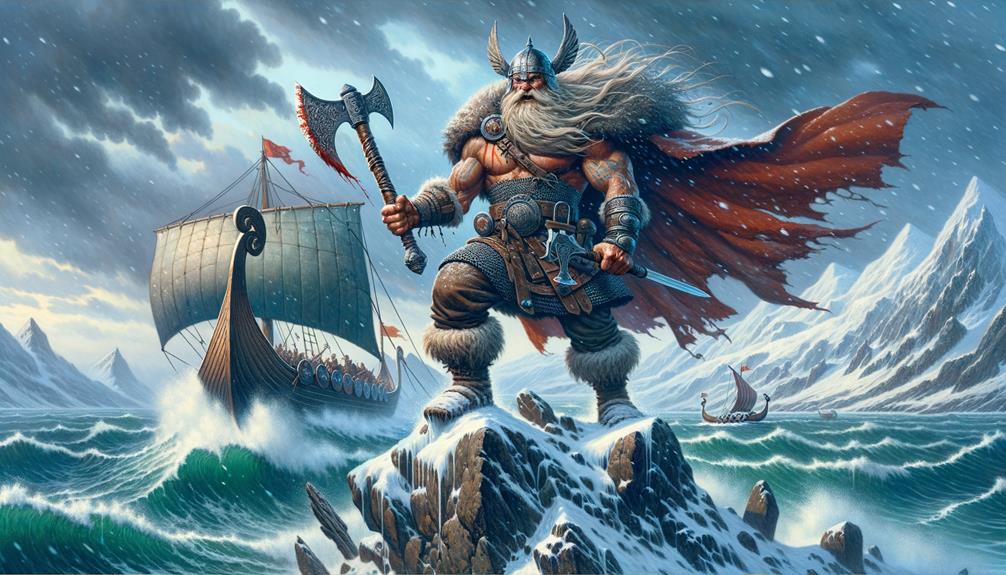
Ragnar Lothbrok is a legendary Viking ruler whose stories connect serpent-slaying, clever courtship, famous sons, and a defiant death. Medieval authors place him in the world of ninth-century Scandinavian warfare, but their accounts do not establish that one historical person performed all his attributed deeds. The safest starting point is to separate the saga hero from the historical events later attached to his name.
Where the Ragnar stories come from
The principal narratives include the Icelandic Ragnars saga loðbrókar and The Tale of Ragnar’s Sons, alongside Saxo Grammaticus’s Latin Gesta Danorum. These are medieval works written long after the age in which their adventures take place. They overlap, but their marriages, genealogies, and political settings are not interchangeable.
The physical manuscripts add another layer. The University of Copenhagen describes a manuscript copied around 1400 that brings together the Saga of the Völsungs, Ragnar’s saga, and his attributed death-song. A manuscript’s copying date is not necessarily the date when every story in it was first composed. It is evidence for how those stories were preserved and connected. See the university’s guide to Ragnar in the sagas.
The serpent and the shaggy trousers
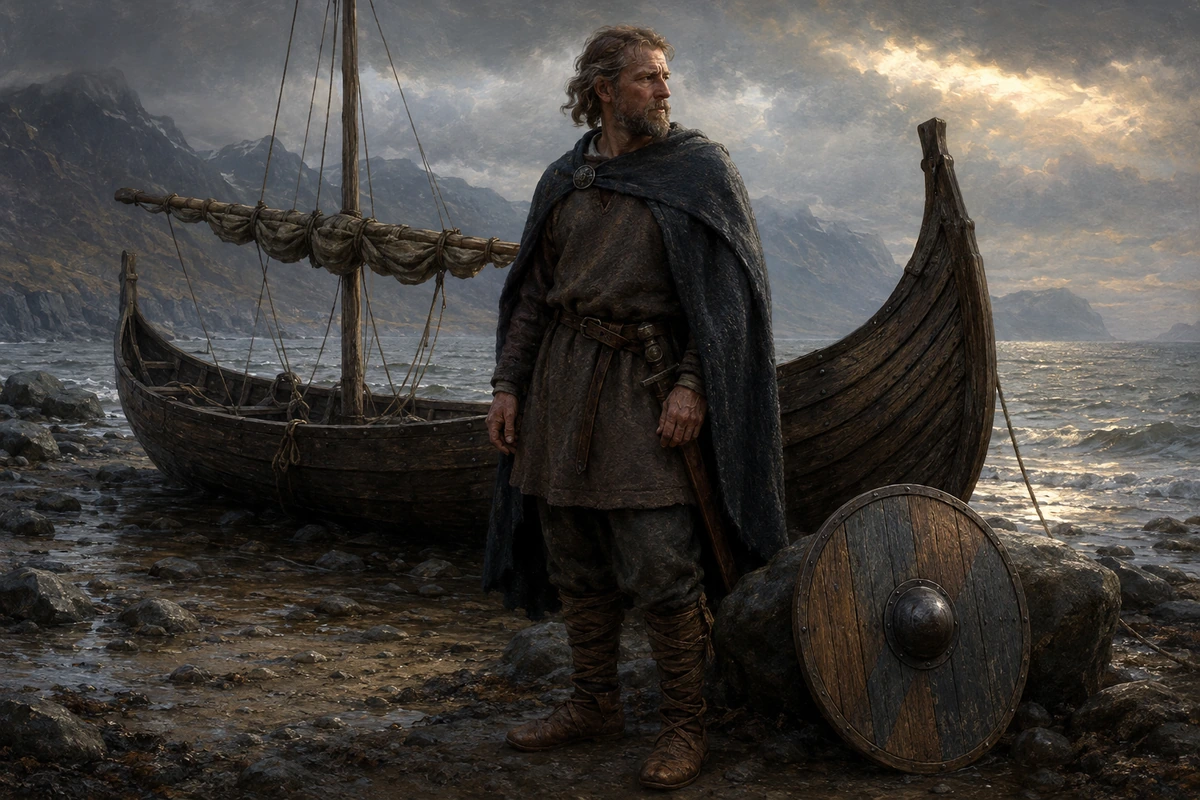
In Ragnar’s saga, a serpent threatens the home of Thora, daughter of Earl Herruð. Ragnar prepares protective shaggy clothing treated with pitch and attacks with a spear. The clothing shields him from the creature’s blood. He wins Thora’s hand, and the episode explains his epithet Loðbrók, commonly rendered “shaggy-breeches.” This is the saga’s explanation of a memorable name, not evidence that the monster fight occurred.
After Thora’s death, Ragnar encounters the woman known as Kráka. She is Aslaug, daughter of Sigurd and Brynhild, whose ancestry has been concealed. Her connection to that earlier heroic family links Ragnar’s adventures to the Völsung tradition. These episodes can be read in the saga’s Old Norse text and Chris Van Dyke’s translation.
Aslaug’s intelligence matters
Ragnar tests Kráka by requiring her to arrive neither dressed nor naked, neither fed nor fasting, and neither alone nor accompanied by another person. She answers through a fishing net and her hair, a taste of onion, and a dog as companion. The scene turns a seemingly impossible command into a demonstration of judgment.
Aslaug is therefore more than a name in Ragnar’s family tree. Her concealed identity and cleverness make the marriage a story about recognition. The hero who can defeat a monster still needs to learn who another person is. Modern retellings that focus entirely on raids lose this important part of the narrative.
The expedition to England and the snake pit
In the saga, Ragnar plans to conquer England with two large vessels. Aslaug warns that more, smaller ships would be wiser. He persists, seeking an exceptional achievement, and the expedition ends in defeat. King Ælla has him thrown among snakes; the resulting death leads into the sons’ revenge.
As a reading of the story, the contrast is sharp: protective preparation saves Ragnar in the first serpent episode, while his final expedition proceeds against good advice. This creates a literary pattern, not independent confirmation of the snake pit as a historical execution.
What is historical, and what remains uncertain?
The Viking attack on Paris in 845 and ninth-century campaigns in England belong to recorded history. Equating the Paris raider Reginherus with the complete saga figure is a separate, uncertain step. Historical evidence for a leader’s name or an attack cannot authenticate every marriage, speech, or death scene in a much later narrative. Likewise, historical connections proposed for Ragnar’s sons do not automatically prove the genealogy assigned to them. World History Encyclopedia’s survey explains the competing identifications and source problems.
| Evidence | What it can establish | What it cannot establish by itself |
|---|---|---|
| A contemporary record of a raid | An event within its own historical context | The saga hero’s complete biography |
| A medieval Ragnar narrative | How an author presents the hero and his family | That every narrated event happened |
| A modern television adaptation | A modern interpretation of the legend | Independent evidence about the Viking Age |
Why the sources should not be combined into one biography
Lagertha belongs to Saxo’s version; she is not simply a missing episode that must be inserted into every account of Ragnar. The television series Vikings further rearranges people and events. In particular, its presentation of Rollo as Ragnar’s brother is not supported by Ragnar’s saga. Copenhagen’s comparison of the series and its literary sources is useful here.
The uncertainty does not make Ragnar uninteresting. His stories show how later communities imagined an impressive ancestry, debated the relationship between courage and judgment, and turned defeat into a lasting reputation. He can be studied seriously as a literary hero without being presented as the securely documented subject of a modern biography.