
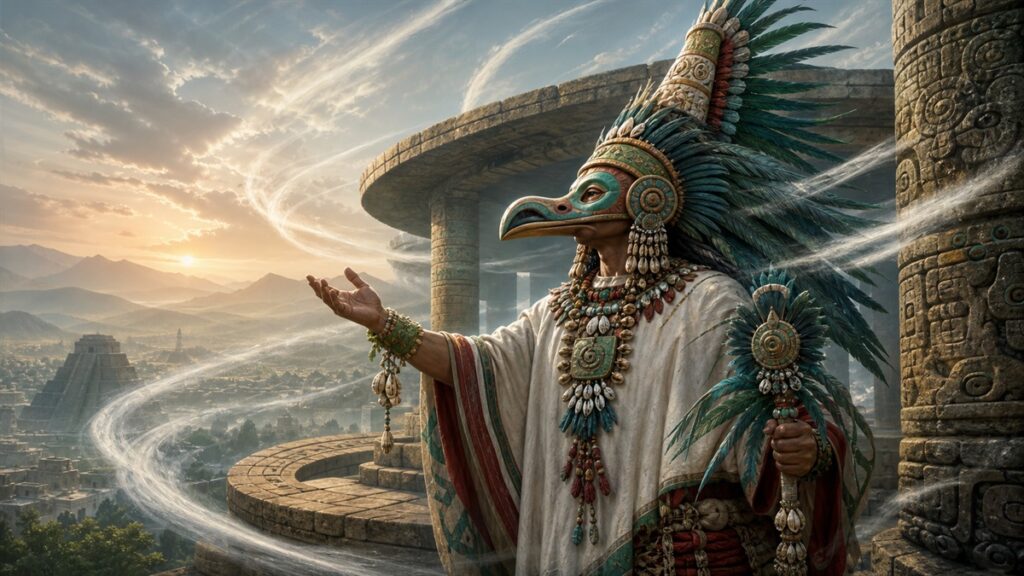
Ehecatl was the wind manifestation of Quetzalcoatl in central Mexican religion. Called Ehecatl-Quetzalcoatl in many sources and archaeological contexts, he moved the sun and moon, cleared the road for rain, and animated a cosmos that otherwise stood still. His projecting red wind mask and circular temples make him one of the most recognizable Nahua deities.
Ehecatl and Quetzalcoatl
Ehēcatl is the Nahuatl word for wind. In religious names it identifies the wind aspect or manifestation of Quetzalcoatl, the “Feathered Serpent.” The relationship is closer than two unrelated gods sharing a story: sculptures, temples, and colonial texts often use the combined name Ehecatl-Quetzalcoatl.
Quetzalcoatl could also appear in other forms and narratives, including priestly, creator, and Venus associations. Not every deed of Quetzalcoatl belongs specifically to Ehecatl, and not every Mesoamerican Feathered Serpent tradition should be collapsed into the late Mexica wind god.
The wind mask and shell ornaments
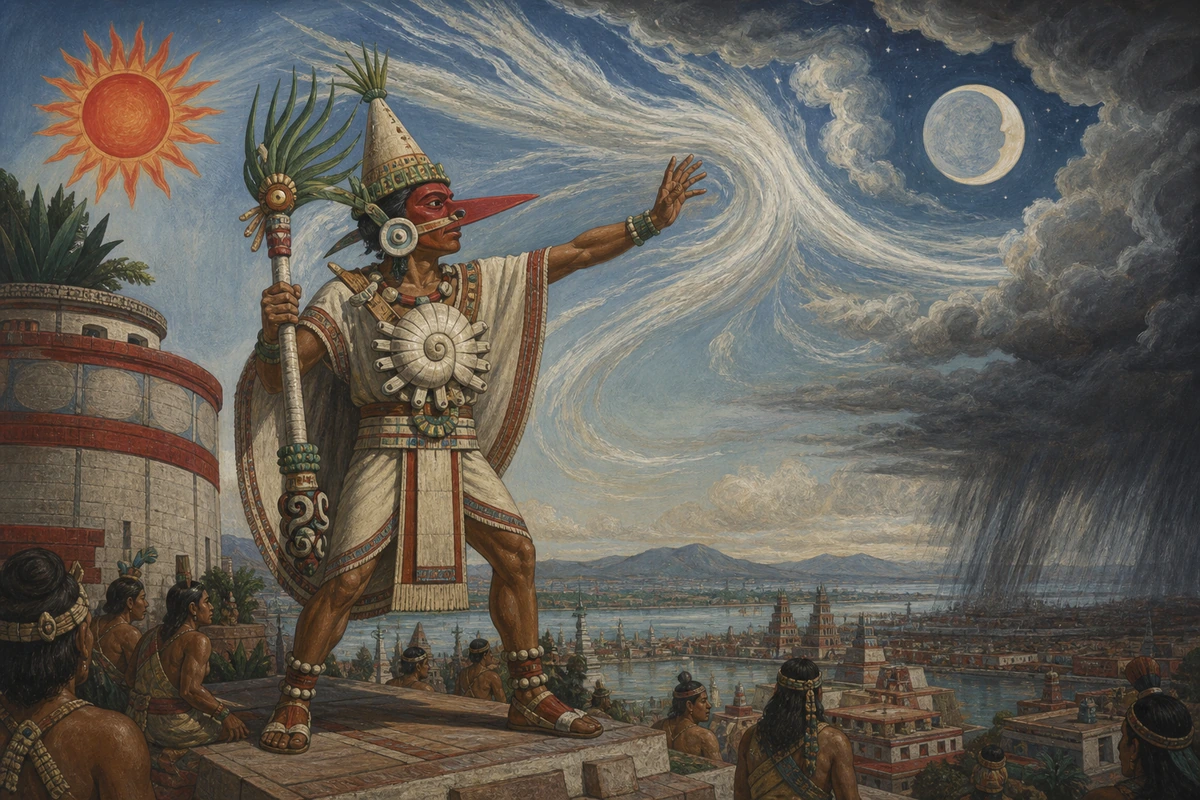
Ehecatl is commonly shown with a red, projecting mouth mask sometimes compared to a bird’s beak. The shape expresses the force of blown air rather than turning him into a bird god. A conical cap, curved shell ear ornaments called epcololli, and a cut conch-shell pectoral called the ehecacozcatl complete the recognizable ensemble.
The spiral section of the shell evokes the movement and sound of wind. These attributes are more reliable identifiers than generic feathers or a modern tornado.
Moving the Fifth Sun
In accounts of the creation of the present age, the gods sacrifice themselves at Teotihuacan so that a new sun and moon can rise. The lights appear but remain motionless. Ehecatl then blows with immense force and sets them on their courses, establishing day and night.
Versions differ over the order of sacrifice and the identities of the divine actors. The central role of the wind is stable: light alone is not enough; breath and motion make a functioning world.
Wind, rain, and agriculture
Ehecatl’s wind sweeps the road before Tlaloc and the rain-bearing powers. In the Valley of Mexico, changing winds announced seasonal weather and could bring both fertility and destructive storms. Farmers did not experience “air” as an abstract classical element; it was a force that carried clouds, cooled or damaged crops, and made breath possible.
Small wind beings called ehecameh could also be credited with gusts and illnesses. The category therefore extended beyond one benevolent god of breezes.
Why were his temples round?
Temples dedicated to Ehecatl often have a circular rear section attached to a rectangular platform and stair. Archaeologists have identified examples at Tenochtitlan, Tlatelolco, Calixtlahuaca, and sites well beyond the Mexica capital. Their rounded profile may have been understood as allowing the wind to flow around the structure without meeting a sharp corner.
At Tlatelolco, an Ehecatl-Quetzalcoatl temple was associated with offerings made during the devastating drought of 1454–1458. Such finds connect cosmological stories to practical appeals for weather and survival.
Love stories and later retellings
Some narratives connect Ehecatl with Mayahuel and the gift or discovery of maguey. Modern retellings often turn this into a single romantic myth in which wind teaches humanity to love. The sources vary, and the episode should be identified as one strand rather than the universal explanation of human affection.
Ehecatl’s strongest source-based profile remains the moving breath of Quetzalcoatl: visually distinct, architecturally honoured, and necessary to the cycles of sun, rain, and living bodies.