

The Gáe Bolg—also written gáe bulga, Gáe Bulg, or Gáe Bolga—is the extraordinary weapon associated with Cú Chulainn in medieval Irish heroic literature. Its most famous appearance comes during the hero’s tragic duel with Fer Diad in the Táin Bó Cúailnge. The text does not present it as an ordinary spear with a single, stable biography. It is a weapon, a specialized martial feat, and a narrative advantage that only Cú Chulainn possesses.
What does the name mean?
Gáe is the Old Irish word for a spear. The second element is less certain. Translations such as “belly spear,” “notched spear,” and “spear of mortal pain” reflect different attempts to explain bolg or bulga; none should be treated as an uncontested ancient definition. The variation in modern spelling also reflects the fact that the story survives in several manuscript recensions and later editions.
For that reason, the weapon is best identified by its role in the texts rather than by an overly confident English translation of its name.
The weapon and the feat
In the first recension of the Táin, Fer Diad and Cú Chulainn have learned the same arts of combat from the warrior-teacher Scáthach. One advantage remains exclusive to Cú Chulainn: the feat of the Gáe Bolg. The wording matters. The hero’s superiority lies not merely in owning a magical object but in knowing a technique that his foster-brother was not taught.
The weapon’s operation is deliberately uncanny. A passage describing its use says that it enters as one barb and then becomes twenty-four within the body. Other recensions describe its points filling the victim’s limbs or joints. These are variant literary descriptions, not a technical specification that can be reconstructed as an archaeological weapon.
The duel with Fer Diad
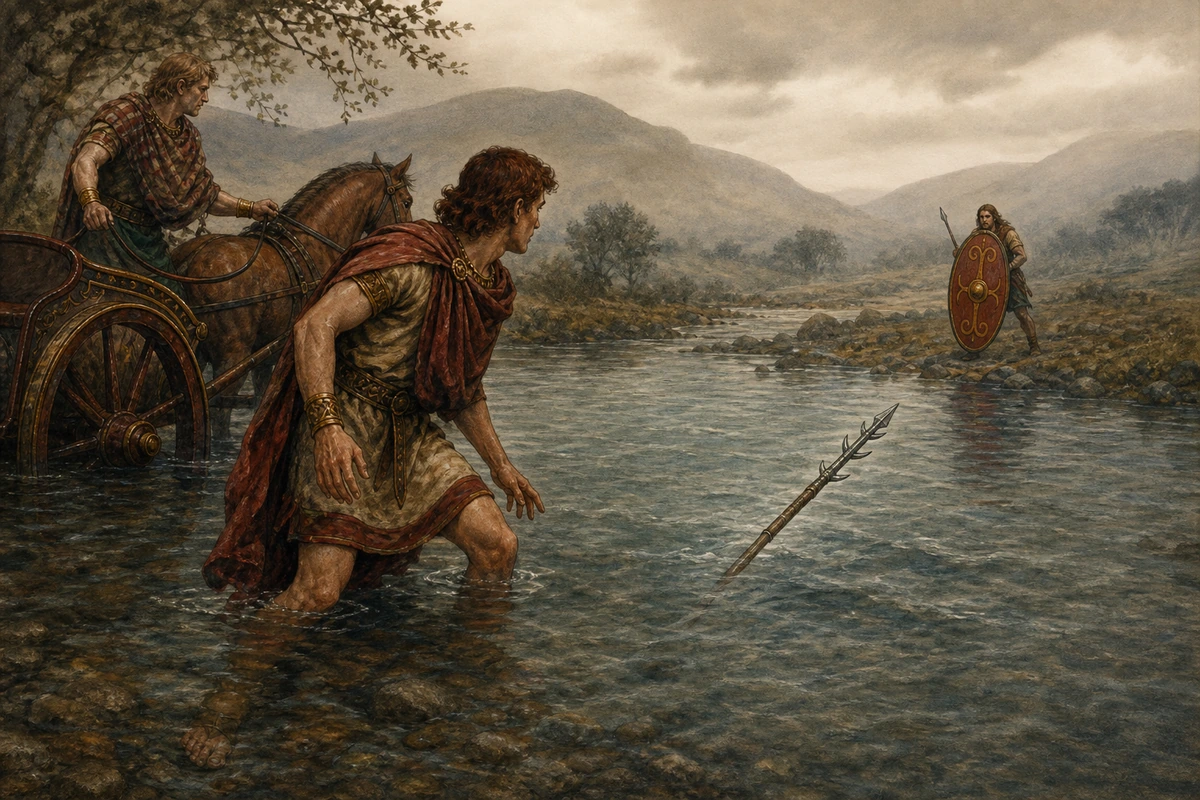
Fer Diad fights for Medb’s army while Cú Chulainn defends Ulster at a series of river crossings. Their single combat lasts for days and is painful precisely because the two men are former companions and near equals. When Cú Chulainn finally calls for the Gáe Bolg, Fer Diad hears the order and tries to protect the lower part of his body with his shield.
The charioteer Láeg sends the weapon along the current. Cú Chulainn catches it between his toes and launches it from the water. The older text gives the point of impact bluntly; modern summaries often soften the anatomy, but they should not replace the river, the foot-cast, or the expanding barbs with a conventional thrown spear. Fer Diad is fatally wounded, and Láeg must cut the weapon from the body afterward.
The episode is not a triumphant monster-slaying scene. Cú Chulainn mourns Fer Diad and recalls their shared training, meals, and friendship. The impossible weapon ends an impossible contest, but its victory is inseparable from grief.
Scáthach and the weapon’s origin
Accounts consistently connect Cú Chulainn’s advanced training with Scáthach in Alba. The Táin emphasizes that she taught him the Gáe Bolg feat while Fer Diad lacked it. Later summaries sometimes add a detailed origin in the bones of a sea creature and connect the weapon to Scáthach’s rival Aífe. Those details belong to particular recensions and later retellings; they should not be folded into every version as though Irish tradition preserved one fixed origin story.
Another fatal use: Connla
The Gáe Bolg also appears in Aided Óenfir Aífe, “The Death of Aífe’s Only Son.” Cú Chulainn unknowingly fights Connla, his son by Aífe, and uses the weapon when the young warrior refuses to identify himself and cannot otherwise be overcome. Only after the fatal blow does the recognition become complete.
That second use reinforces the weapon’s literary function. It guarantees victory against an opponent closely bound to Cú Chulainn, and it turns that victory into personal catastrophe. The Gáe Bolg is therefore less a symbol of uncomplicated power than a marker of the hero’s most devastating wins.
What the sources do—and do not—say
The medieval narratives support four central points: the weapon belongs to Cú Chulainn’s heroic repertoire; Scáthach teaches him its unique feat; it is deployed with the feet in the water during the Fer Diad combat; and its barbs make the wound impossible to treat normally. Claims about a single maker, exact material, universal number of points, or one authoritative English meaning for the name require more caution.
Modern fantasy often turns the Gáe Bolg into a generic enchanted lance. The Irish texts make it stranger and more specific: a learned technique used at close narrative quarters, where the defeated opponent is someone the hero loves.