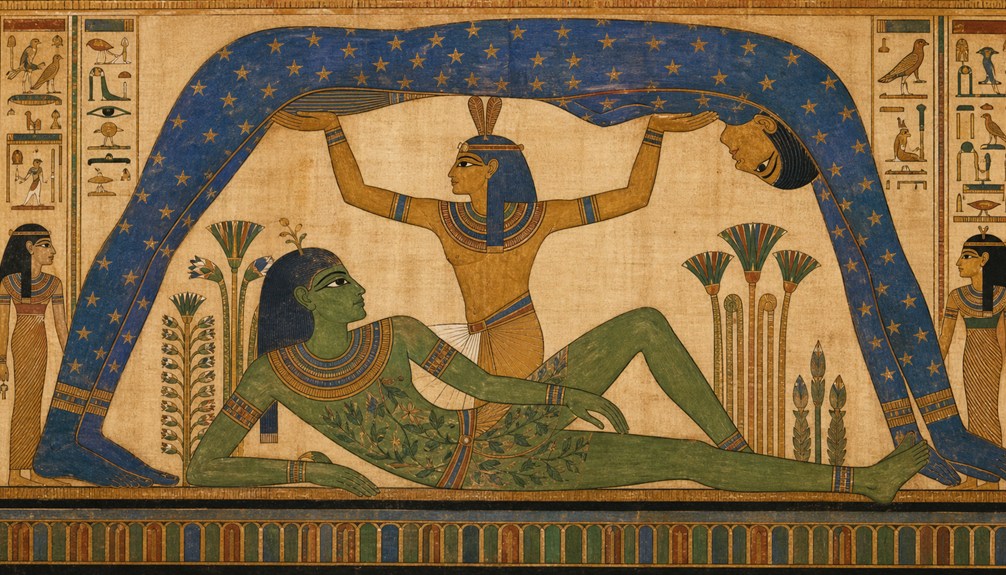
Geb is the ancient Egyptian earth god, commonly paired with the sky goddess Nut. Unlike many later European personifications, Egyptian art often presents earth as male and sky as female.
Geb in the surviving tradition
In the Heliopolitan Ennead, Geb and Nut are children of Shu and Tefnut. Shu separates the embracing pair and holds Nut above Geb. Their children include Osiris, Isis, Seth, and Nephthys. This genealogy links physical space with the divine family that governs kingship, death, and succession.
Texts, objects, and evidence
Geb can be shown reclining beneath Nut, with plants growing from his body or with green skin. His laughter is linked with earthquakes in later summaries, but the source and wording should be checked rather than repeated as a universal Egyptian doctrine. As earth, he is associated with fertility, burial, and the physical ground of rule.
Key points
- Kingship: The throne can be called the inheritance of Geb, and rulers receive authority through divine succession.
- Goose: A goose is linked with Geb in writing and iconography, though the old phrase great cackler also appears in creation contexts.
- Dead: Bodies return to the earth, giving Geb both nourishing and restraining aspects.
- Greek Kronos: Greek and Roman writers made comparisons among divine genealogies, but Geb is not simply the Egyptian name for Cronus.
How to read the material
The earth god belongs to Egyptian cosmology, cult, and royal language. Modern elemental rankings miss those relationships.