
Accuracy note: The Argonaut story survives in sources composed across many centuries. Pindar, Euripides, Apollonius of Rhodes, Diodorus, Apollodorus, and Roman poets do not give identical crew lists, routes, motives, or accounts of Medea and her brother.
Jason and the Argonauts undertake one of Greek mythology’s largest collective quests: a voyage from Iolcus to Colchis for the Golden Fleece. The expedition gathers heroes from many local traditions aboard the Argo, sends them through dangerous seas and foreign courts, and makes Jason’s claim to kingship depend on the intelligence and power of Medea.
The fullest surviving Greek epic about the voyage is the Argonautica of Apollonius of Rhodes, composed in the third century BCE. The myth is much older. Homer alludes to the famous Argo; Pindar narrates the quest in his fourth Pythian Ode; and Euripides assumes the audience already knows Jason and Medea when his tragedy Medea opens in Corinth. Reading those layers separately prevents a later detail from being mistaken for the only ancient version.
Why the Golden Fleece Was in Colchis
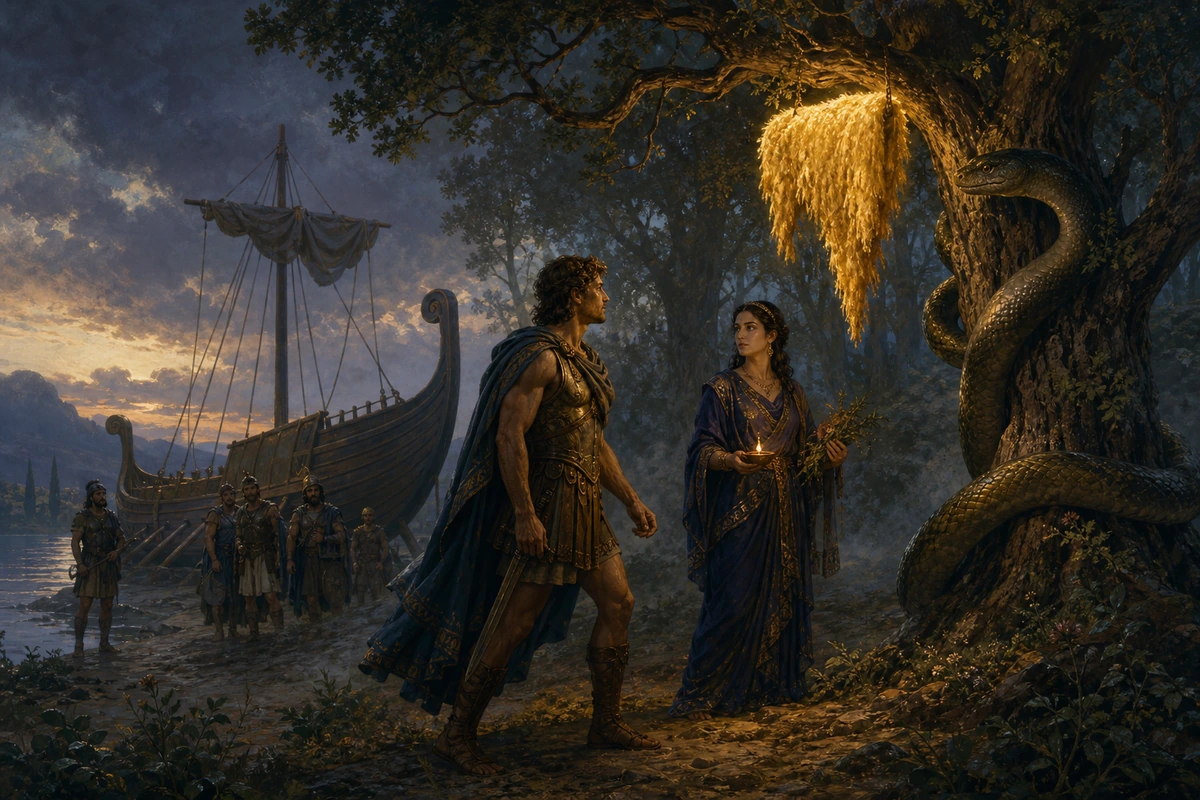
The fleece belongs to the earlier story of Phrixus and Helle. Threatened in Greece, the siblings escape on a miraculous golden ram. Helle falls into the strait later called the Hellespont, while Phrixus reaches Colchis at the eastern edge of the Black Sea. There he sacrifices the ram and gives its fleece to King Aeetes, who places it in a sacred grove under a sleepless serpent’s guard.
The object is therefore not random treasure. It marks a successful escape, a sacrifice, a relationship with Aeetes, and a displaced Greek lineage. Some ancient explanations connect the expedition with recovering Phrixus’s spirit or resolving a family obligation. Later interpreters have proposed trade, kingship, solar imagery, or the use of fleeces to collect gold from streams, but no single theory exhausts the myth.
Pelias and the Man with One Sandal
Jason belongs to the royal house of Iolcus. Pelias holds power in place of Jason’s father, whose identity and fate differ among sources. An oracle warns Pelias about a man wearing one sandal. Jason arrives having lost a sandal while crossing a river—often after carrying an old woman who is Hera in disguise—and the sign identifies him as the danger.
Pelias sends Jason for the Golden Fleece, expecting the impossible mission to remove his rival. In some tellings Jason himself answers a hypothetical question by proposing the very quest later imposed on him. Either way, the expedition begins as a struggle over legitimate rule disguised as a heroic assignment.
Building the Argo and Gathering the Crew
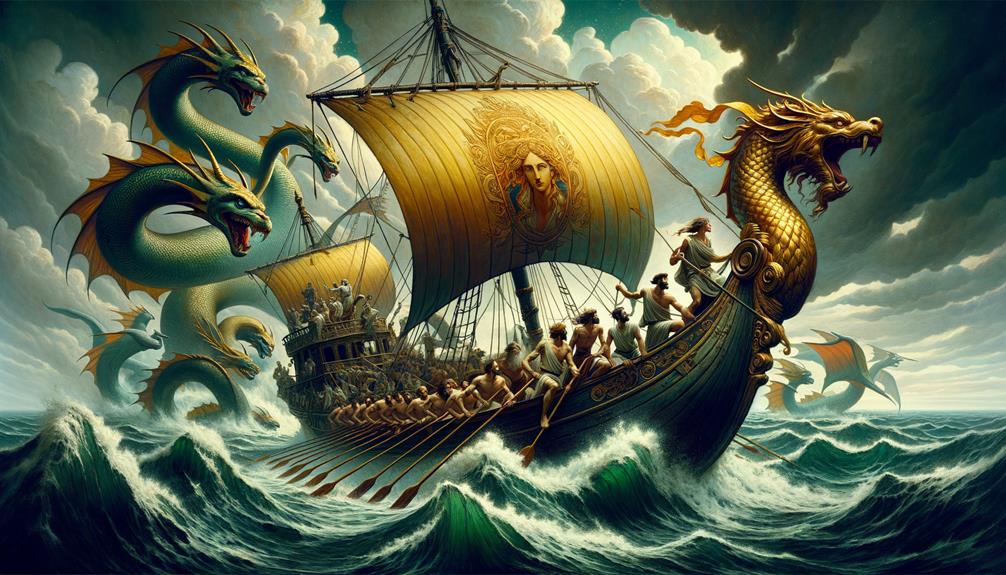
Argus builds the Argo with divine assistance, commonly from Athena. A piece of speaking oak from Dodona is fitted into the ship in influential versions, giving the vessel warning or counsel. The name “Argonaut” comes from the Argo, making the crew’s identity inseparable from the shared ship.
Crew lists vary dramatically because poets used the voyage to assemble heroes from across the Greek world. Orpheus, Castor and Polydeuces, Peleus, Telamon, Zetes and Calais, Meleager, Idas, Lynceus, and many others appear. Heracles joins in several accounts but leaves before Colchis in Apollonius. Atalanta is accepted in some lists and excluded in others. A definitive roster made from every source creates a crew no ancient poem actually contained.
| Source | Date and genre | Distinctive contribution |
|---|---|---|
| Homeric allusion | Archaic Greek epic | Assumes the Argo and its dangerous passage were already famous |
| Pindar, Pythian 4 | 462 BCE victory ode | Connects the quest with kingship, prophecy, and Jason’s charisma |
| Euripides, Medea | 431 BCE tragedy | Begins after the voyage and focuses on Jason’s betrayal in Corinth |
| Apollonius, Argonautica | Third century BCE Hellenistic epic | The fullest surviving continuous Greek account of voyage, Colchis, and return |
| Apollodorus, Library | Later mythographic handbook | Summarizes variants and episodes in a compact genealogy |
| Valerius Flaccus | First-century CE Latin epic | Roman reworking with different emphases and an unfinished ending |
The Outward Voyage
Apollonius turns the trip into a sequence of tests for a whole community. On Lemnos, the Argonauts encounter women who have killed the island’s men. At Cyzicus, a tragic nighttime misunderstanding makes the heroes kill a friendly king they had just met. Hylas disappears while fetching water, and Heracles is left behind during the search.
Polydeuces defeats the brutal boxer Amycus. The winged sons of Boreas drive the Harpies away from the seer Phineus, who then advises the crew about the Clashing Rocks. A dove is sent through first; the rowers follow at speed, and divine help carries the Argo past the Symplegades. Each episode contributes knowledge, loss, or obligation needed for the next stage.
Aeetes Sets the Impossible Tasks
At Colchis, King Aeetes refuses to surrender the fleece freely. He orders Jason to yoke fire-breathing, bronze-footed bulls, plow a field, and sow it with dragon’s teeth. From the earth rises a company of armed men. Jason must survive both the monstrous animals and the warriors before approaching the serpent that guards the prize.
These tasks resemble a test of heroic strength, but the poem makes clear that Jason cannot complete them alone. The gods draw Aeetes’s daughter Medea into the crisis. Her knowledge of ritual and drugs changes the outcome of the entire expedition.
Medea Is the Key to the Fleece
Medea is a princess of Colchis, a granddaughter of Helios, and a practitioner of powerful ritual knowledge. In Apollonius, divine intervention and an intense inner struggle lead her to help Jason. She gives him a protective ointment and instructions: withstand the bulls, sow the teeth, and throw a stone among the earthborn warriors so that they turn on one another.
When Aeetes still will not yield, Medea helps Jason approach the grove and overcome or lull the serpent. Jason takes the fleece, but calling the act his achievement alone erases the person who makes it possible. His heroism throughout the epic is collaborative, persuasive, and often dependent, a marked contrast with the self-sufficient strength associated with Heracles.
Escape and the Death of Medea’s Brother
The Argonauts flee Colchis under pursuit, and Medea’s brother dies during the escape. The details are among the myth’s most significant variations. In Apollonius, the adult Apsyrtus leads pursuers and is killed in an ambush arranged by Medea and Jason. Other accounts make him a younger child whom Medea kills and dismembers to delay Aeetes.
Combining these versions produces a false single scene. Both forms make the return morally costly, but they assign age, agency, location, and responsibility differently. Apollonius has Circe purify Jason and Medea after the killing, emphasizing that possession of the fleece does not erase blood guilt.
The Return Is Not a Straight Line
The geography of the return varies and often becomes deliberately marvelous. The Argo travels through remote rivers and seas, reaches Circe, passes the Sirens with Orpheus’s music as protection, and encounters Scylla, Charybdis, and the bronze guardian Talos in influential accounts. In Libya the crew carries the ship across land before finding a route home.
Such itineraries are not practical Bronze Age sailing directions. They turn the world’s edges into a mythic map and connect the Argonauts with places claimed by many communities.
Pelias, Corinth, and the Collapse of the Victory
Returning with the fleece does not give Jason an uncomplicated reign. Medea engineers Pelias’s death by persuading his daughters that they can rejuvenate their father through a ritual they do not understand. Jason and Medea are driven from Iolcus and eventually settle in Corinth.
Euripides begins after Jason abandons Medea to marry the Corinthian princess. The tragedy converts the celebrated expedition into a history of broken oaths, exile, and catastrophic revenge. Other ancient versions give Medea’s children different deaths, reminding readers again that Euripides’s enormously influential plot is not the only tradition.
What Kind of Hero Is Jason?
Jason can lead, negotiate, attract allies, and endure danger, but ancient authors also expose his limitations. He succeeds because Argus builds, Orpheus sings, the sons of Boreas fight, Hera and Athena assist, and Medea risks everything. The Argo is a collective vessel, and its hero is inseparable from the network that carries him.
That dependence is the story’s strength. The quest begins as a demand for proof of kingship and ends by questioning whether possession of a brilliant object can justify betrayal and violence. The Golden Fleece is won, but neither Jason’s household nor his political future becomes secure.