
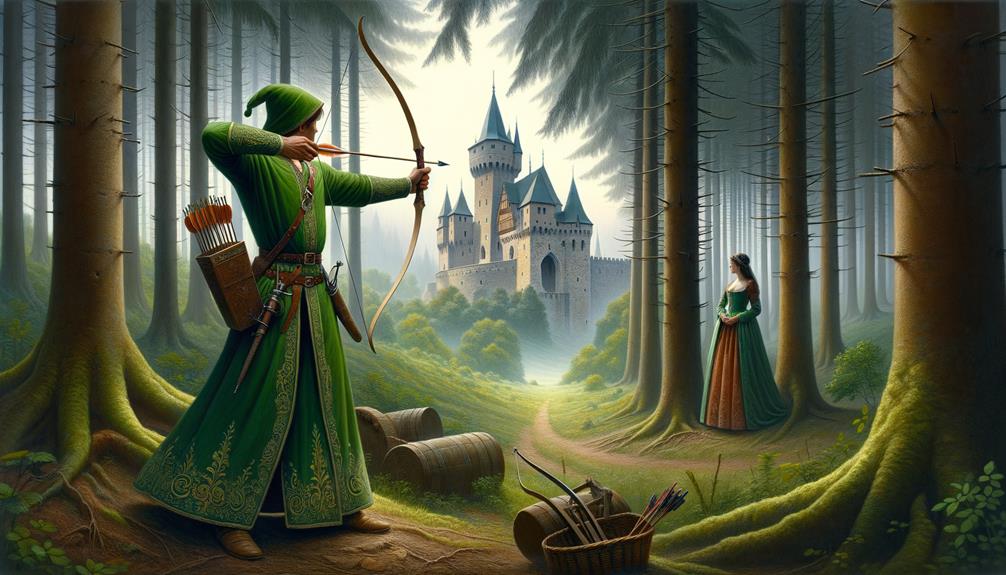
Accuracy note: Robin Hood is a tradition built by ballads, plays, chronicles, novels, film, and local memory. No surviving record proves that one historical outlaw was the original Robin, and many familiar features entered the story centuries after its earliest references.
Robin Hood is England’s most famous outlaw hero, but the character familiar from modern film is the result of continual reinvention. Late-medieval poems present a dangerous archer, loyal companion, devout admirer of the Virgin Mary, and enemy of sheriffs, churchmen, and other authorities. Later authors turn him into a dispossessed nobleman, place him in the reign of Richard I, add a romance with Maid Marian, and make redistribution to the poor his defining mission.
The legend therefore cannot be reconstructed like the biography of a missing medieval person. “Robin Hood” is a changing narrative identity. The best evidence comes from asking what each surviving text says, where it places the outlaw, and which later assumptions it does not yet contain.
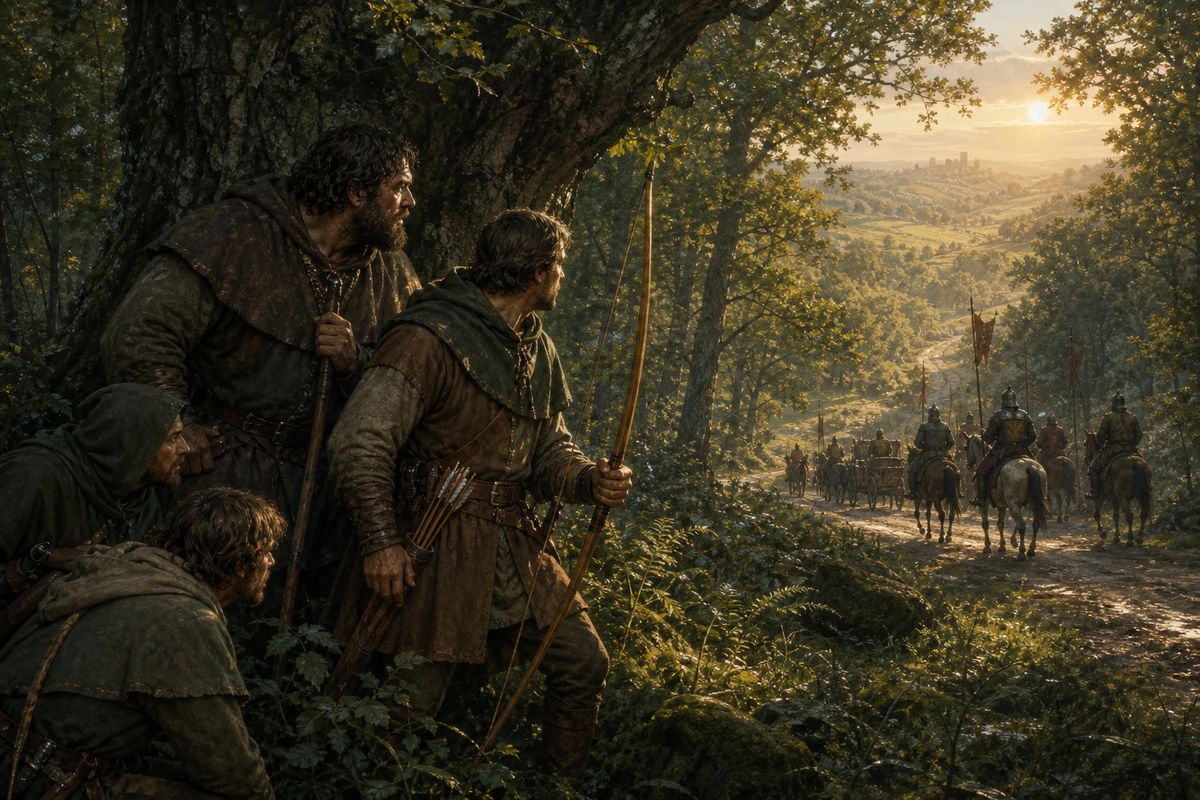
The Earliest References Are to Stories, Not a Proven Man
In the late fourteenth-century poem Piers Plowman, the character Sloth admits that he cannot perfectly recite the Lord’s Prayer but does know “rhymes of Robin Hood.” The remark is brief, but it shows that stories about Robin were already recognizable to an audience. It does not tell us where the hero came from or prove that a particular outlaw inspired him.
Legal and administrative records contain people named Robert Hood, Robin Hood, and similar forms. Some documents even use “Robinhood” as a nickname for criminals. The name’s spread may reflect the legend as much as its origin. With no record securely matching the stories’ companions, setting, and actions, attempts to identify a single “real Robin Hood” remain speculative.
Robin Hood and the Monk
One of the earliest surviving narrative ballads is Robin Hood and the Monk, preserved in Cambridge University Library MS Ff.5.48, a fifteenth-century manuscript. Robin travels to Nottingham to attend Mass at St Mary’s, is recognized, and is captured after a violent fight. Little John and Much organize his rescue through deception and force.
The poem already contains central features of the tradition: Nottingham, the sheriff, outlaw fellowship, devotion, disguise, sudden violence, and Little John’s resourcefulness. It does not read like a polite children’s tale. Robin can be impulsive, and the rescue depends as much on his companions as on his own skill.
A Gest of Robyn Hode
A Gest of Robyn Hode, surviving in early printed editions, gathers the tradition into a long sequence or “little geste.” Robin helps a knight burdened by debt, confronts wealthy churchmen, outwits the sheriff, demonstrates his authority within the greenwood, and eventually meets a king named Edward. The text calls Robin a yeoman, not the Earl of Huntingdon.
The distressed knight episode supports Robin’s reputation for generosity, but the modern slogan “rob from the rich and give to the poor” does not summarize the whole poem. Robin targets particular figures, protects his own honor and network, and operates through hospitality, gifts, threats, and repayment. The moral economy is personal and selective rather than a modern social program.
| Feature | Early tradition | Later development |
|---|---|---|
| Social rank | Robin is commonly a yeoman | Genealogies make him an earl or dispossessed noble |
| Royal setting | The Gest names a King Edward | Richard I and Prince John become dominant |
| Landscape | Barnsdale is prominent; Nottingham also matters | Sherwood becomes the universal popular home |
| Companions | Little John, Much, and Will Scarlet appear early | Maid Marian and a standardized “Merry Men” roster grow in importance |
| Purpose | Fellowship, honor, conflict with officials, selective generosity | A champion who consistently redistributes wealth to the poor |
| Costume | Not fixed by the ballads | Lincoln green and the pointed cap become visual shorthand |
Barnsdale, Sherwood, and Nottingham
The modern legend almost automatically places Robin in Sherwood Forest, but early ballads often send him through Barnsdale in Yorkshire. Nottingham and its sheriff are already important, so the geography was never a single neat map. Medieval forest was also a legal category: land governed by special rules protecting deer and habitat for royal hunting, not simply untouched woodland.
The University of Nottingham’s Manuscripts and Special Collections describes Robin Hood’s origins as owing more to folklore and literature than to historical record and notes that several northern forests claim him. Local attachment is part of the legend’s history. Place-names, caves, wells, trees, and graves labeled “Robin Hood’s” often tell us when communities adopted the hero, not where one historical outlaw lived.
Little John, Much, and the Power of Fellowship
Little John is not merely comic muscle. In Robin Hood and the Monk, he becomes the strategist who restores the captured hero. Much, the miller’s son, also appears in early material, and Will Scarlet or Scathlock belongs to the developing band. Their fellowship can involve argument, tests, loyalty, and mutual rescue.
The ballads repeatedly reverse authority. Sheriffs who command towns are vulnerable in the forest; officials are tricked by clothing and performance; the outlaw leader can enforce his own rules of hospitality. These reversals help explain why the stories remained adaptable in periods with very different politics.
Maid Marian, Friar Tuck, and the May Games
Maid Marian is not central to the earliest surviving outlaw ballads. She has roots in a separate European pastoral and festive tradition and becomes joined to Robin through late-medieval and early modern performance. Friar Tuck also grows in importance through plays and later ballads. A fifteenth-century dramatic fragment at Trinity College, Cambridge, demonstrates that Robin Hood material was already performed as well as recited.
May games changed the legend’s social atmosphere. Robin and Marian could preside over seasonal festivity, dance, disguise, and fundraising. The greenwood became a place not only of robbery and pursuit but also of temporary license and communal play.
Richard the Lionheart and the Noble Outlaw
Later chronicles and antiquarian genealogies move Robin into the late twelfth century and connect him with Richard I and John. The shift offered a grand national backdrop: a rightful king absent on crusade, an oppressive regime at home, and an outlaw whose loyalty is secretly legitimate. Walter Scott’s Ivanhoe and subsequent popular culture made this setting extraordinarily durable.
At the same time, Robin’s social status rose. A yeoman outlaw became Robert of Locksley or the Earl of Huntingdon, wrongfully dispossessed and destined for restoration. That story speaks to later tastes for hidden nobility; it is not evidence preserved in the earliest ballads.
How the “Give to the Poor” Ideal Developed
Early Robin can be generous, particularly to the knight in the Gest, and he attacks wealthy or abusive institutions. Yet he is not consistently shown collecting wealth for anonymous poor people. Tudor plays, broadside ballads, children’s books, political writers, and modern screen adaptations progressively sharpened the image of a social bandit.
This does not make the charitable Robin false. It makes him historical in another sense: each period used the outlaw to imagine fairness, legitimate resistance, or English identity. The medieval ballad hero and the modern redistributor are related, but they answer different questions.