
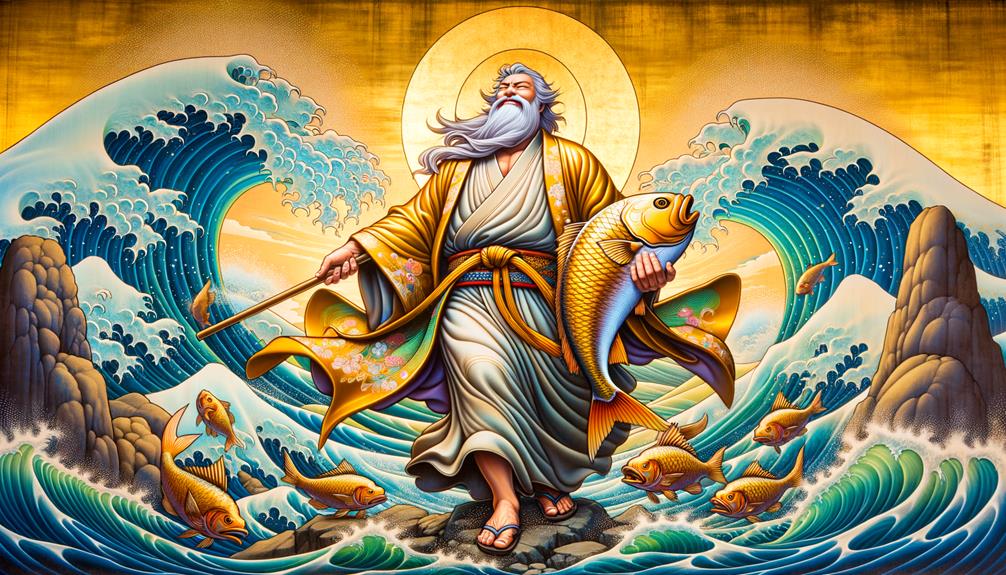
Accuracy note: Ebisu’s origins are not explained by one continuous biography. Coastal worship, the figures Hiruko and Kotoshironushi, marketplace cults, and the Seven Gods of Good Fortune contributed different layers to the kami known today.
Ebisu is one of Japan’s most familiar deities of good fortune. He is readily recognized by a fishing rod and a red sea bream, and he is worshiped as a protector of fishing, livelihoods, commerce, and—in some regions—agriculture. His broad popularity did not come from a single ancient story. The Ebisu known in modern shrines and popular art developed as local beliefs, classical mythology, medieval commerce, performance, and the cult of the Seven Gods of Good Fortune met over centuries.
That history matters because older summaries often tell a neat story in which the abandoned child Hiruko grows limbs, becomes Ebisu, and triumphs over disability. Some traditions do identify Ebisu with Hiruko, but others identify him with Kotoshironushi or treat him primarily as a deity arriving from beyond the sea. The “overcoming adversity” biography is therefore not a universal Japanese myth.
A Kami Whose Origins Remain Layered
Kokugakuin University’s Encyclopedia of Shinto stresses that the name and characteristics of Ebisu are not unambiguous. The name has been written with several combinations of characters, and proposed etymologies connect it with older words for outsiders or people at the edges of the Yamato world. This may help explain a recurring feature of the cult: Ebisu comes from elsewhere and carries blessings into the community.
In coastal villages, objects and beings arriving from the sea could be treated as manifestations or gifts of Ebisu. Stones brought up from the water were sometimes enshrined, and the cult could encompass unusual marine arrivals. The underlying pattern is not simply “a fisherman became a god.” Good fortune comes across a dangerous boundary from an unseen or distant realm.
Was Ebisu Originally Hiruko?
The Kojiki and Nihon shoki preserve versions of the story of Hiruko, a child born to Izanagi and Izanami and set adrift. The exact narrative differs between the chronicles, and neither presents the full later career popularly assigned to Ebisu. Centuries of interpretation connected Hiruko’s journey over the water with Ebisu’s arrival from the sea.
That identification is influential at Nishinomiya and in later religious culture, but it is not the only genealogy. Claims that Hiruko “grew legs at age three,” was rescued by a specific village, and then straightforwardly became Ebisu often combine localized or modern retellings without identifying their sources. It is safer to say that Hiruko became one important explanation for Ebisu’s identity.
Kotoshironushi and Another Ebisu Genealogy
Other traditions identify Ebisu with Kotoshironushi, a son of Ōkuninushi. In the land-transfer narratives, Kotoshironushi is consulted about yielding authority to the heavenly descendants. He agrees and withdraws behind an enclosure of green leaves in the sea. His connection with the sea, oracles, and important shrines made him another compelling identity for Ebisu.
The identification is especially visible in shrine traditions associated with Miho and in later accounts of the Seven Gods of Good Fortune. Hiruko and Kotoshironushi should not be forced into one original character. Their coexistence shows how cults can gather different stories and local histories around a shared divine name.
| Layer of the tradition | What it contributes | Caution |
|---|---|---|
| Coastal Ebisu worship | A blessing-bringer from beyond the sea and guardian of abundant catches | Practices differed among fishing communities |
| Hiruko identification | Links the abandoned child’s sea journey with a deity who arrives from afar | Not stated as a complete Ebisu biography in the earliest chronicles |
| Kotoshironushi identification | Connects Ebisu with Ōkuninushi’s son, the sea, and oracular authority | A distinct genealogy rather than proof that every tradition is identical |
| Medieval markets | Expands Ebisu from fishing livelihoods into commerce and urban prosperity | Developed historically rather than existing unchanged from creation time |
| Seven Gods of Good Fortune | Places Ebisu beside Daikoku, Benzaiten, Bishamonten, and other fortune deities | The group’s membership and iconography took shape over time |
Fishing Rod and Red Sea Bream
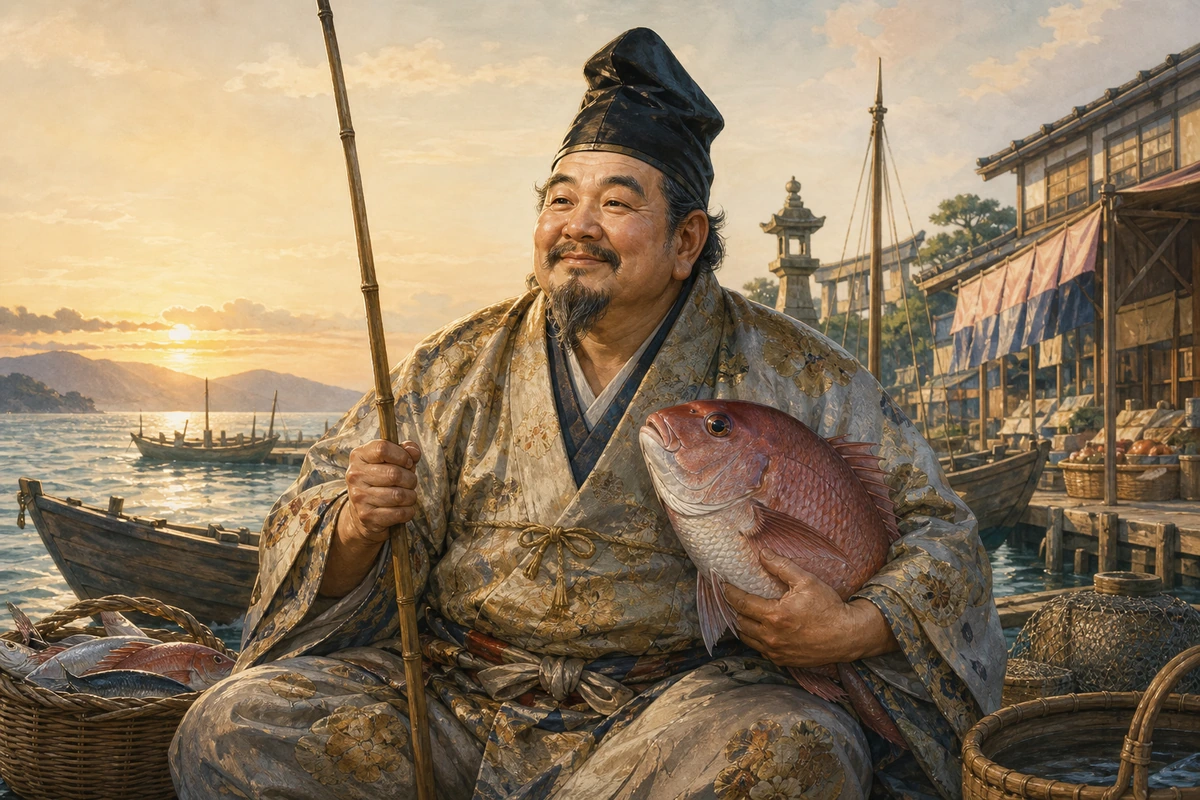
Ebisu’s most stable popular image shows a smiling, well-fed figure wearing courtly headgear, holding a fishing rod in his right hand, and carrying a large sea bream beneath his left arm. The equipment is humble compared with the weapons of a storm or warrior deity. It expresses livelihood: a successful catch, food for a household, goods for a market, and the uncertain fortune on which coastal communities depended.
The fish is usually tai, red sea bream, long associated with celebration and auspicious occasions in Japan. In Ebisu imagery it is not a universal fish symbol borrowed from every maritime culture. It belongs to a specifically Japanese visual vocabulary and to the god’s history as a source of bounty from the sea.
From Coastal Catch to Marketplace Prosperity
Ebisu’s commercial role is already documented in the medieval period. The Encyclopedia of Shinto notes that Ebisu was invoked as a guardian of markets at Tōdaiji in 1163 and at Tsurugaoka Hachimangū in 1253. As exchange networks grew, the deity of a good catch could also govern the successful circulation and sale of goods.
Wandering performers associated with Nishinomiya, known as ebisu-kaki or ebisu-mawashi, helped spread the cult. Through puppet performance and household visits, Ebisu’s blessings traveled beyond a single harbor. Shopkeepers and merchants came to display his image, often pairing him with Daikoku, another immensely popular deity of fortune.
Agriculture, Fields, and Mountains
Ebisu is not only a fishing and business god. In some farming communities he overlaps with the field kami who descends for the agricultural season and returns to the mountains afterward. He can receive offerings connected with rice planting and harvest. Other local traditions identify Ebisu with a mountain kami or link him with hearth deities.
These variations do not weaken the tradition. They show that “livelihood” takes different forms. The same name can protect boats in one place, markets in another, and fields in a third because worship develops through the needs and histories of communities.
Ebisu Among the Seven Gods of Good Fortune
The Shichifukujin, or Seven Gods of Good Fortune, became a popular grouping in the medieval and early modern periods. The usual company includes Ebisu, Daikoku, Bishamonten, Benzaiten, Fukurokuju, Jurōjin, and Hōtei. The group brings together deities with Japanese, Indian, Buddhist, and Chinese histories. Images of the seven riding a treasure ship became especially popular.
Ebisu’s inclusion strengthened his identity as a cheerful giver of worldly well-being. Yet the group should not be treated as a timeless pantheon with one fixed origin story. Membership varied, and each figure retained cults and meanings outside the seven-member ensemble.
Tōka Ebisu and Living Festival Practice
January festivals keep Ebisu’s commercial and communal roles visible. Tōka Ebisu is celebrated around the tenth day of the month at major shrines including Nishinomiya Jinja and Imamiya Ebisu Jinja. Worshipers seek good fortune for work and business, and decorated bamboo branches become prominent festival objects. Imamiya Ebisu lists its annual festival from January 9 through 11.
Modern advertising and shop displays continue to use Ebisu’s smile and fish, but this familiarity should not turn him into a mascot detached from worship. The same image can inhabit shrine ritual, household devotion, popular performance, commercial branding, and tourism in different ways.