
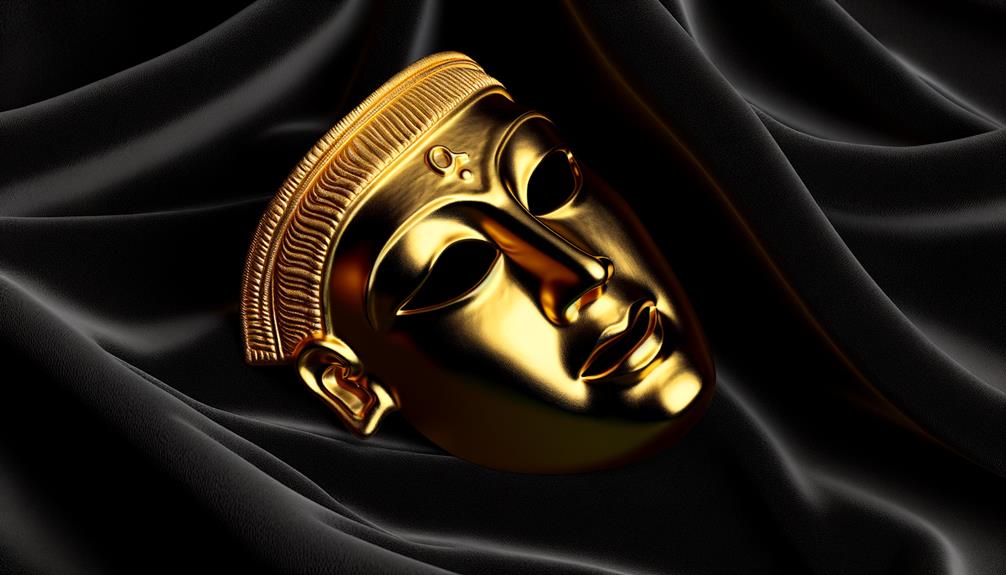
The gold face covering conventionally called the Mask of Agamemnon came from Shaft Grave V in Grave Circle A at Mycenae. Heinrich Schliemann’s excavations brought it to light in 1876, and his Homer-focused interpretation supplied the famous name. The name is memorable, but it is not an identification of the deceased.
Modern dating places the burials of Grave Circle A in the sixteenth century BCE, centuries before the period usually considered for a historical background to the Trojan War traditions. The mask belongs to the emergence of Mycenaean elite society, not to a verified king from Homeric poetry.

Grave Circle A
Grave Circle A contains six deep shaft graves used for multiple elite burials. The dead were accompanied by extraordinary displays of wealth: gold masks and breastplates, cups, jewelry, seals, weapons, and decorated objects made from imported materials. Later builders incorporated the burial circle into the fortified citadel and monumentalized it.
Several male burials received sheet-gold face coverings, so the famous mask was part of a wider funerary practice rather than a unique royal crown. Women and children also received rich offerings, allowing archaeologists to examine household, status, gender, and age without assuming that every valuable object belonged to a ruler named in legend.
| Evidence | What it supports | What it cannot establish |
|---|---|---|
| Find in Shaft Grave V | A sixteenth-century BCE elite funerary context | The deceased’s personal name |
| Multiple gold masks | A selective burial custom among high-status men | That the moustached mask was a king’s unique insignia |
| Modeled facial details | Deliberate visual differentiation | A modern portrait likeness made from life |
| Homeric label | Schliemann’s interpretive goal and the discovery’s modern reception | A link to the Agamemnon of the Iliad |
How the mask was made
The object was formed from a thin sheet of gold. Hammering from the reverse raised the main volumes, while work from the front sharpened brows, eyelids, nose, ears, moustache, and beard. Holes near the ears helped attach the covering. The technique transformed malleable metal into an idealized human face without requiring the thickness of a cast sculpture.
The face is distinctive, but “distinctive” does not automatically mean a literal portrait. Funerary images can combine individual traits, workshop conventions, age, rank, and an ideal appearance. Comparison with the other masks is therefore as important as staring at the famous one in isolation.
Schliemann and Stamatakis
Schliemann approached Mycenae through Homer and publicized discoveries in heroic language. His work was supervised by the Greek archaeologist Panagiotis Stamatakis, whose careful excavation diary documented the graves, human remains, and objects. The National Archaeological Museum emphasizes that Stamatakis’s records correct exaggerations and give the assemblage scientific coherence.
Claims that the mask was planted or altered have attracted occasional attention, partly because Schliemann’s conduct at Troy made skepticism understandable. They are not the mainstream archaeological conclusion. A responsible account should neither ignore questions about early excavation practice nor turn minority suspicion into a proven forgery. The documented Grave V context and the mask’s relationship to the assemblage remain central.
What the name gets wrong—and preserves
Agamemnon is a literary king whose story took shape through centuries of oral and written tradition. The Grave Circle A dead lived far earlier than the conventional destruction levels discussed in relation to the Trojan War. No inscription on the mask or in the grave names Agamemnon.
Yet the nickname preserves an important modern history: nineteenth-century archaeology was energized by efforts to connect epic, place, and artifact. The correction is not to discard the object’s popular name, but to explain why quotation marks and chronology matter.
Accuracy note
This article uses “Mask of Agamemnon” as a conventional museum name. It does not identify the deceased as a Homeric hero, claim the mask is a photograph-like portrait, or present forgery speculation as scholarly consensus.