
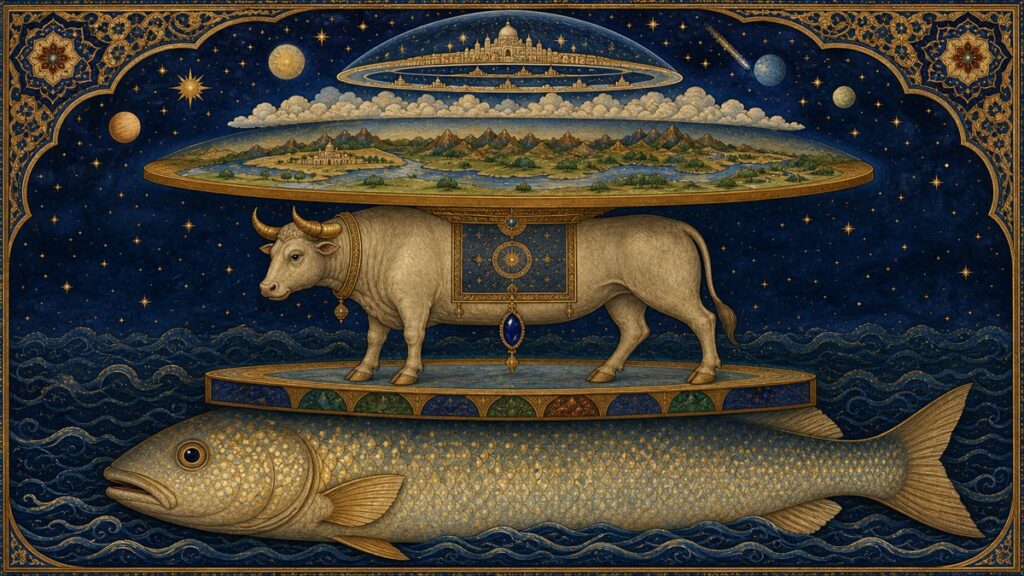
Accuracy note: Bahamut belongs to medieval Arabic and Islamic cosmographic literature, not Hindu mythology. In the historical accounts discussed here, Bahamut is a gigantic fish beneath the earth-supporting bull. The platinum dragon known from modern games is a later fictional reinvention.
Bahamut is best understood as part of the medieval literature of cosmography: writing that tried to describe the ordered universe, from the heavens and planets to the seas, animals, marvels, and unseen regions beneath the earth. These works combined inherited learning, observation, storytelling, and religious reflection. They are valuable evidence for the history of ideas, but they should not be treated as a single, uniform statement of Islamic doctrine or as a modern scientific account.
Where the Story Appears
One of the most influential works in this tradition is ʿAjāʾib al-makhlūqāt wa-gharāʾib al-mawjūdāt, usually translated as Wonders of Creation and the Oddities of Existence. It was compiled in the thirteenth century by Zakariyya al-Qazwini. The book surveys celestial and terrestrial creation, placing astronomy, geography, animals, extraordinary beings, and marvel tales within one encyclopedic framework.
Related accounts also circulated in works by authors such as Yaqut al-Hamawi, al-Thaʿlabi, al-Damiri, and Ibn al-Wardi. The manuscripts do not preserve one perfectly fixed version. Names, the order of the cosmic layers, and individual details can differ from text to text. A recent comparative study by Delio Vania Proverbio argues that the giant-fish and cosmic-ox traditions developed separately before being combined in the Islamic literary world; evidence of their synthesis appears by the tenth century.
The Fish Beneath the World
The version most familiar to English readers comes from Edward William Lane’s nineteenth-century compilation Arabian Society in the Middle Ages. Drawing on several medieval Arabic writers, Lane describes a layered support structure beneath the inhabited earth:
- An angel bears the earth.
- The angel stands on a great gemstone or rock.
- The rock rests on the back and horns of an enormous bull, whose name Lane writes as Kuyoota.
- The bull stands upon an immeasurably large fish called Bahamoot, now usually spelled Bahamut.
- Water and darkness lie beneath the fish, after which human knowledge ends.
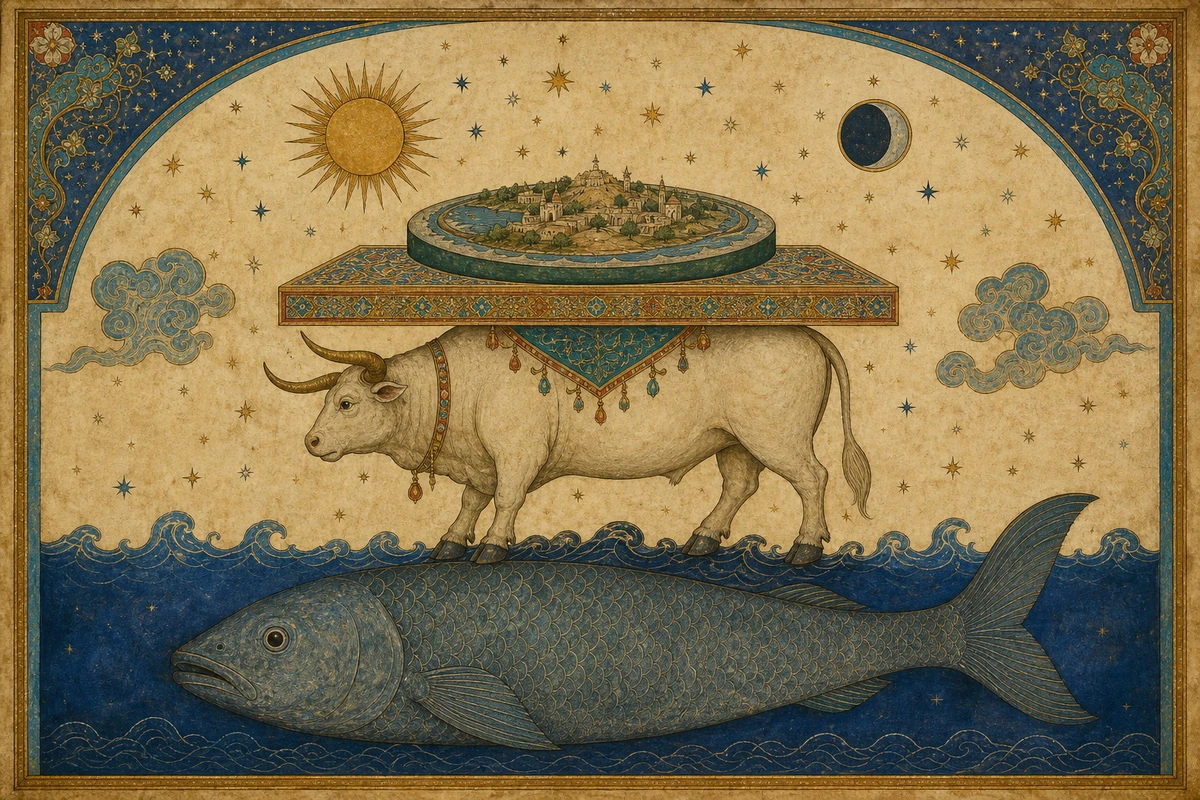
Lane emphasizes the fish’s scale with a deliberately impossible comparison: all the seas placed in one nostril would resemble a tiny seed in a desert. The point is not that Bahamut patrols the world, fights enemies, or guards a secret power. In this account, the fish is one element in a chain that expresses the immensity and hidden depth of creation.
Why the Details Vary
It is safer to speak of versions of the Bahamut tradition than of one definitive myth. Encyclopaedia Iranica notes that al-Qazwini’s cosmography survives in multiple recensions and that an early printed edition combined material in ways that do not reliably reproduce the author’s original text. The work was also translated and adapted in Persian and Turkish, sometimes freely. Spellings such as Bahamut, Bahamoot, and Balhut reflect different texts and transliteration systems, while the bull’s name also appears in several forms.
This variation matters. Claims that Bahamut is a serpent, a dragon, an eternal moral guardian, or a rival of the Mesopotamian figure Tiamat do not describe the medieval Arabic cosmic fish. Nor do the surviving accounts support invented episodes about sacrifice, battles, or a named angel called Kasyahuda. Those details should not be added simply to make the story resemble a modern fantasy biography.
Wonder, Order, and the Limits of Knowledge
Al-Qazwini’s work belongs to the ʿajaʾib, or “wonders,” tradition. Its subjects range from eclipses and climates to plants, animals, jinn, and remarkable creatures. Modern scholarship describes these books as encyclopedic surveys in which natural and supernatural phenomena could appear within the same created order. Their purpose included awakening wonder at the scale and variety of creation.
Bahamut’s position at the lowest imaginable level makes that purpose especially clear. Each support requires another support beneath it, until the account reaches darkness and admits that people do not know what comes next. Read historically, the scene is less a character adventure than a meditation on cosmic scale and the boundary of human understanding.
From Cosmic Fish to Platinum Dragon
Modern fantasy uses the same name for a very different being. Wizards of the Coast presents Bahamut in Dungeons & Dragons as the Platinum Dragon, patron of metallic dragons and an opponent of Tiamat. Square Enix likewise uses Bahamut as a ruler of dragonkind in Final Fantasy. These are legitimate fictional adaptations, but their dragon imagery, morality, battles, and relationship with Tiamat belong to modern game settings—not to the medieval cosmographic accounts.
Keeping the traditions separate makes both easier to appreciate. The medieval Bahamut is the incomprehensibly vast fish beneath the cosmic bull; the winged dragon is a later pop-culture character that borrowed the name and built new stories around it.
Sources and Further Reading
- Edward William Lane, Arabian Society in the Middle Ages, Chapter V: Cosmography
- Encyclopaedia Iranica, “ʿAjāʾeb al-Maḵlūqāt”
- British Library/Qatar Digital Library, manuscript of al-Qazwini’s Wonders of Creation
- Bilha Moor, Illustrated Ottoman Cosmographies, c. 1550–1700
- Delio Vania Proverbio, “At the Confluence of Eurasian Cosmological Mythologies”
- Wizards of the Coast, modern Dungeons & Dragons Bahamut
- Square Enix, modern Final Fantasy Bahamut