
Many mythologies describe beings that English translators call giants, but the shared label can be deceptive. Greek Gigantes, Old Norse jötnar, and the biblical Nephilim belong to different languages, narratives, and religious worlds. Some are physically enormous; others are “giants” because later translators needed a convenient word. Comparing them is useful only when their differences remain visible.
Accuracy note: This is a comparative article. It does not treat giants as one ancient species, and it does not equate Greek Gigantes, Norse jötnar, Hebrew Nephilim, or South Asian asuras, dānavas, and rākṣasas. Each term must be read in its own textual setting.
Why “giant” is a translation problem
In modern English, “giant” suggests unusual height. Ancient categories can also mark genealogy, place, hostility, age, or relationship to the gods. A being may be called a giant in translation even when a particular story says nothing about its measurements. Conversely, a very tall human warrior may not belong to a separate mythological race.
The safest method is to name the original category first, then ask what a specific source says. Do not begin with a universal definition and force every culture into it. Similar themes—earth, mountains, old powers, divine conflict—can emerge independently or through cultural contact without making the beings interchangeable.
The Greek Gigantes are not the Titans
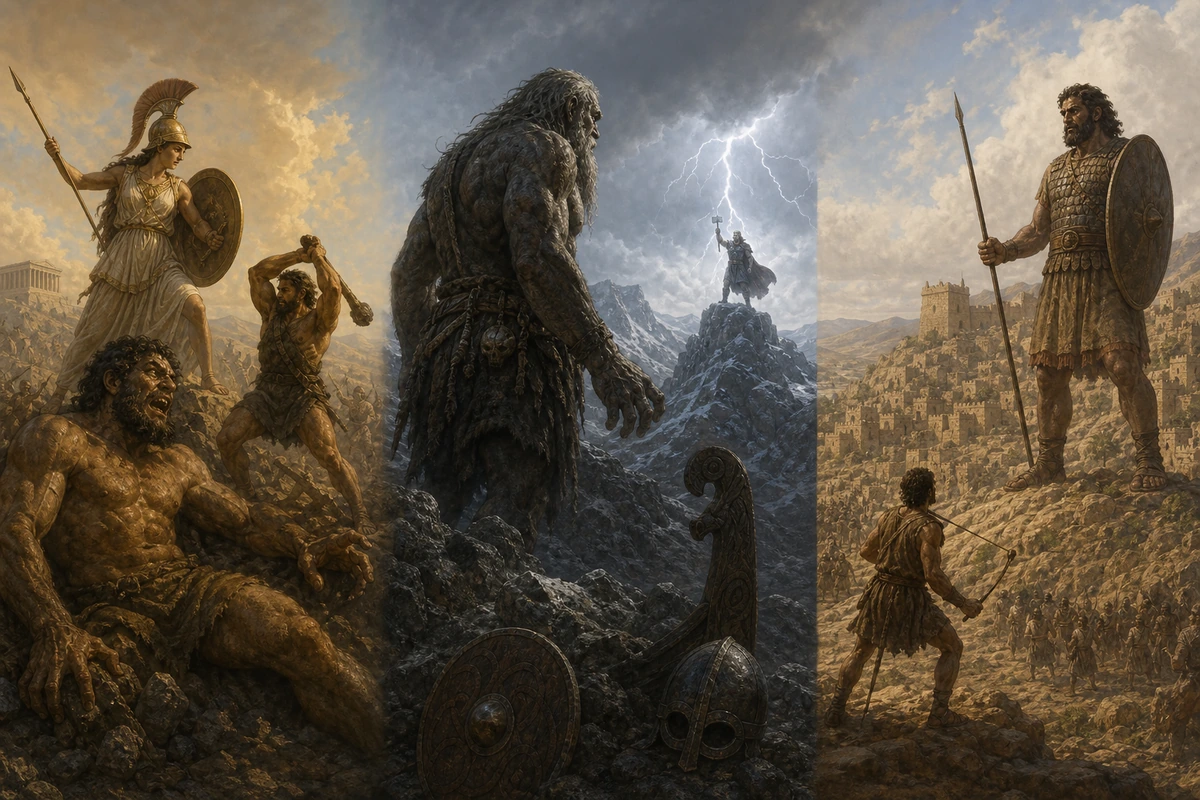
Greek myth gives the Gigantes a specific family and battle. In Hesiod’s Theogony, Gaia receives the blood that falls when Cronus mutilates Uranus and bears the Erinyes, the Melian nymphs, and the Giants. Later mythography describes the Giants attacking the Olympian order in the Gigantomachy.
Apollodorus says Gaia brought them forth and that the gods could defeat them only with help from a mortal. Heracles supplies that mortal aid. Alcyoneus revives while fighting in his native land, so Heracles drags him beyond it; other Giants fall to combinations of divine attacks and the hero’s arrows.
The Gigantes should not be merged with the Titans, the older divine generation overthrown by Zeus, or with the Cyclopes, who have their own genealogy and one-eyed form. The Titanomachy and Gigantomachy are separate conflicts, even though later art and summaries sometimes blur every enemy of Olympus into “giants.”
How Greek artists changed their appearance
Archaic Greek vase painters often represented Giants as armed warriors of broadly human form. Serpentine legs and increasingly monstrous features became prominent in later art, culminating in dramatic Hellenistic works such as the Great Altar of Pergamon. There was no single day when every artist switched from “normal warrior” to “snake-legged monster.”
The visual change served narrative and political needs. Human-shaped opponents make the battle resemble heroic warfare; hybrid bodies turn it into a cosmic collision between Olympian order and earthborn resistance. The Pergamon frieze layers bodies, animals, wings, and coils into a monumental vision of upheaval, with Athena subduing Alcyoneus as Gaia rises below.
Norse jötnar are more than oversized enemies
Old Norse jötunn is commonly translated “giant,” but size is not its only or defining feature. Jötnar include primeval beings, mountain and frost figures, wise opponents, dangerous hosts, builders, spouses, mothers, and ancestors of gods. The mythic worlds of gods and jötnar are opposed yet deeply related through marriage and descent.
In the Prose Edda, Ymir emerges in the creation story and becomes ancestor of the frost giants. Odin and his brothers kill him and form the world from his body. Elsewhere, Thor repeatedly fights jötnar, but other gods seek knowledge from them, enter their halls, or have jötunn parentage. Loki himself has jötunn ancestry and moves among the Æsir.
The wall-builder story illustrates the complexity. A mysterious craftsman offers to fortify the gods’ stronghold for an enormous price, works with the stallion Svaðilfari, and is revealed as a jötunn only when the bargain goes wrong. His building skill matters as much as physical menace. Calling every jötunn a stupid mountain-sized ogre erases that range.
Nephilim, Anakites, and the limits of a brief verse
Genesis 6:4 says the Nephilim were on earth “in those days, and also afterward,” in a difficult passage involving divine beings, human women, and heroes of old. The verse is terse, and translations differ. It does not provide a full biography, a precise height, or the elaborate fallen-angel narrative often repeated online.
In Numbers 13:33, frightened scouts report seeing Nephilim and say the Anakites come from them; the scouts felt like grasshoppers by comparison. The speech occurs within a report designed to terrify the Israelite community, so its rhetoric and narrative setting matter. Other biblical groups associated with exceptional stature—Anakites, Rephaim, and figures such as Og or Goliath—should not automatically be collapsed into one genealogy.
Later Jewish and Christian interpreters developed multiple explanations: ancient warriors, tyrants, offspring of heavenly beings, or fallen figures. Those traditions are historically important, but none should be projected backward as the only obvious meaning of Genesis’s few words.
| Tradition | Original category | Core evidence | Common mistake |
|---|---|---|---|
| Greek | Gigantes | Earthborn opponents in the Gigantomachy | Confusing them with Titans, Cyclopes, or every large monster |
| Old Norse | Jötnar | Primeval and relational beings in Eddic myth | Assuming all are huge, evil, or unrelated to the gods |
| Hebrew Bible | Nephilim; related but distinct names elsewhere | Brief passages in Genesis and Numbers | Presenting one later interpretation as the text’s complete biography |
| South Asian traditions | Asuras, dānavas, rākṣasas, and many specific beings | Different Vedic, epic, Purāṇic, Buddhist, and regional contexts | Translating every powerful antagonist as the same “giant race” |
Why South Asian categories need their own names
The page’s location within a Hindu-mythology section does not make the Greek, Norse, and biblical beings Hindu. South Asian literature contains many large or formidable figures, but asura, dānava, and rākṣasa are not synonyms for “giant.” Their meanings change across Vedic hymns, Sanskrit epics, Purāṇas, Buddhist texts, and regional storytelling.
Rāvaṇa, Kumbhakarṇa, Bali, Vṛtra, and other famous beings have specific parentage, moral characterization, and narrative roles. Physical scale may be part of a story, but translating the category only by body size removes its religious and literary history. A future article about one of these figures should start with the relevant Sanskrit or regional term, not borrow a European template.
Comparison without a universal giant myth
Comparative reading can reveal recurring concerns: old powers challenge new orders; landscapes become bodies; extraordinary size makes conflict visible; and heroic communities define themselves against daunting opponents. Yet no evidence requires a single prehistoric “giant religion” from which all these stories descend.
Nor should fossil discoveries be offered as the universal cause without evidence from a particular place and period. Ancient people did encounter large bones and dramatic geology, and some interpreted them through myth. That possibility is different from proving that fossils created every Gigante, jötunn, or Nephilim tradition.
What the stories do with scale
Scale is both physical and political. Greek art enlarges cosmic rebellion; Norse poetry places gods in a world built from Ymir and surrounded by jötunn powers; biblical scouts use overwhelming size to dramatize fear and doubt. “Giant” can therefore mark the point where an opponent, landscape, or past seems too great for ordinary human measure.
The strongest comparison preserves that function without flattening names. These traditions are not fragments of one lost encyclopedia entry. They are distinct ways of imagining ancestry, territory, danger, and the limits of established order.
Sources and further reading
- Apollodorus, Library 1.6.1, Perseus Digital Library
- The Met, Pergamon and the Hellenistic Kingdoms
- Prose Edda, Gylfaginning 1–10, Old Norse and English
- Genesis 6:4 and Numbers 13:33, Sefaria