
Accuracy note: Mwindo is the central hero of a Nyanga oral epic from the eastern Democratic Republic of the Congo, not Hindu mythology. This account follows the performance published by Daniel Biebuyck and Kahombo C. Mateene while recognizing that other Nyanga versions differ in some details.
Mwindo begins life as an unwanted son and ends as a ruler whose power has been tested on earth, beneath it, and in the sky. The epic celebrates extraordinary feats, but its hero does not mature simply by defeating enemies. He must confront the damage caused by vengeance, repair relationships, and learn that a chief’s authority is limited by obligations to other people and to the wider living world.
A Nyanga Epic Shaped in Performance
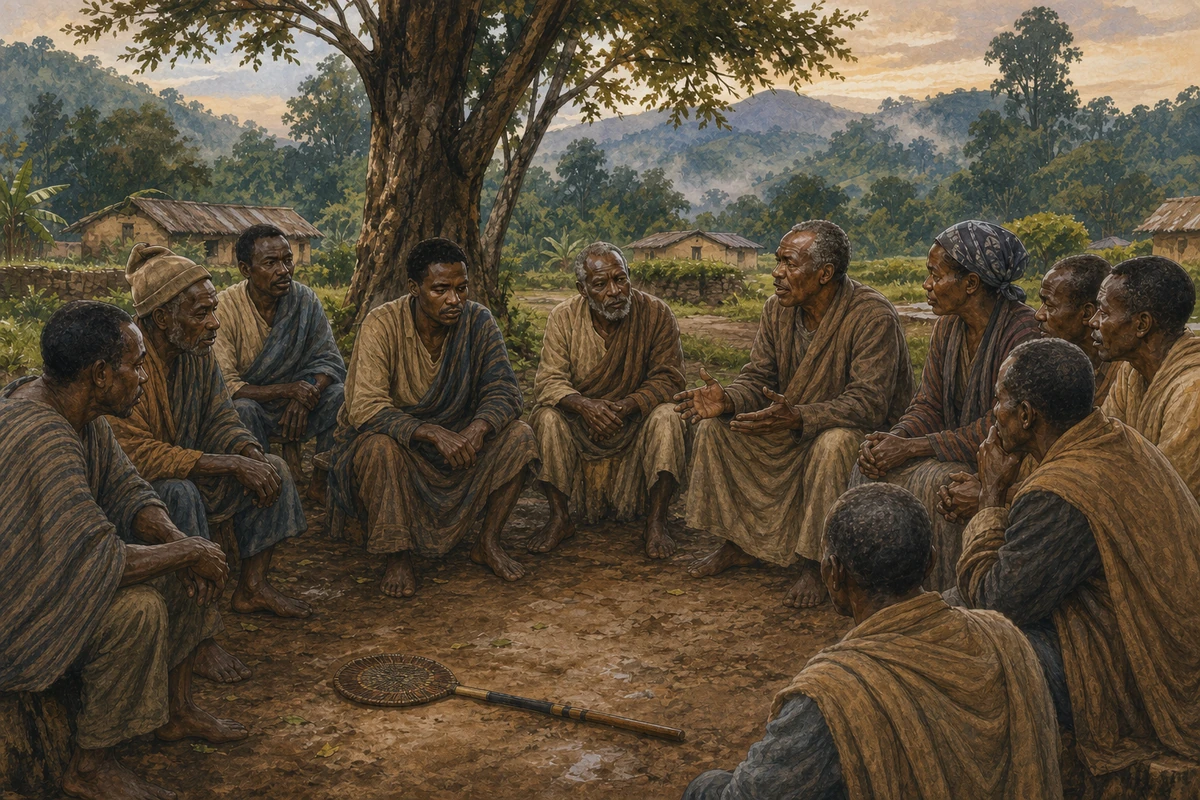
The principal published text used here is The Mwindo Epic from the Banyanga, edited and translated by anthropologist Daniel Biebuyck and Nyanga linguist Kahombo C. Mateene. It records a performance by the renowned narrator Shé-Kárįsį Candi Rureke and was first published in 1969. The University of California Press edition presents an art form that combines prose narration with songs, proverbs, gesture, and dramatic action.
This is important because the epic is not a single ancient manuscript with one permanent wording. Biebuyck and Mateene describe kárįsį, the Nyanga category of long narratives about Mwindo, as a specialized oral tradition known by a limited number of expert performers. Conception, birth, characters, and individual episodes can vary. A responsible summary therefore identifies the published performance it follows instead of combining every retelling as though all details belonged to one fixed canon.
The Son Shemwindo Tried to Prevent
The narrative opens at Tubondo, a village founded by the chief Shemwindo. He has seven wives and orders that none of them bear a son. Six give birth to daughters, but the seventh wife, Nyamwindo, bears Mwindo in a miraculous way. The editors note that versions differ about his conception and birth, yet they consistently present him as an exceptional child. One of his epithets means “the Little-one-just-born-he-walked.” He can speak and act immediately, and he possesses a powerful conga-scepter, a flyswatter-like object that becomes his chief magical instrument.
Shemwindo repeatedly tries to kill the child. In the published story, Mwindo survives attacks, burial, and confinement inside a drum thrown into the river. His survival is not explained by ordinary endurance: it depends on his inborn powers, his conga, and the aid of human and supernatural allies.
Exile, Iyangura, and the Return to Tubondo
The drum carries Mwindo away from Tubondo and toward his paternal aunt Iyangura. She receives and protects him, and his maternal uncles later strengthen him through an episode Biebuyck describes as “forging” the young hero. Mwindo then returns with allies to confront the father who rejected him.
That return is initially catastrophic. Nkuba, Lightning and one of Mwindo’s great supernatural allies, destroys Tubondo while Shemwindo escapes underground. The epic does not leave this destruction as a triumphant ending. Mwindo’s later actions include reviving people who were killed and repairing the damage he caused. His journey from retaliation to restoration is central to the story’s treatment of leadership.
Following Shemwindo Through the Underworld
Mwindo follows his father below the earth and moves through a sequence of supernatural domains. He encounters Kahindo, the daughter of Muisa, who gives him the knowledge needed to resist her father’s tricks. Among Muisa’s tests is the impossible demand that Mwindo create a banana grove and bring back ripe fruit in a single day. With the conga’s power, he completes the task.
The pursuit continues through the realms of Muisa, Ntumba, and Sheburungu. Biebuyck summarizes how Mwindo defeats Muisa in contests of power, calls on Nkuba to break through Ntumba’s obstructing cave, and finally beats Sheburungu at wikí, a wagering game played with seeds. These episodes combine physical action with verbal formulas, magical objects, negotiation, and cunning; Mwindo does not succeed through strength alone.
When Mwindo finally finds Shemwindo, he does not kill him. He leads his father back toward Tubondo, heals or restores beings harmed during the pursuit, and revives those he had killed. A formal council then divides the state between father and son, and Mwindo is enthroned. Reconciliation does not erase Shemwindo’s violence, but it prevents the feud from destroying their whole community.
Kirimu and Mwindo’s Final Lesson
Mwindo’s enthronement is not the end of his education. When Remba hunters attached to his chiefship are swallowed by Kirimu, a seven-headed forest dragon, Mwindo kills the monster and frees them. Yet Kirimu is also a friend of Nkuba. Mwindo has acted without understanding the bonds and obligations involved, and Lightning carries him into the celestial realm.
There Mwindo is deprived of his usual control and endures severe trials. Biebuyck interprets this sky journey as a rite of passage for a hero who has become a chief but is not yet a complete one. After these trials, Mwindo returns to Tubondo chastened. He establishes rules for communal conduct and rules in peace, no longer treating magical force as sufficient justification for every decision.
What the Epic Says About Power
Mwindo’s greatness lies in transformation rather than invincibility. He survives an abusive father, but his first answer is destructive. He conquers supernatural opponents, yet must repair the harm left behind. He rescues his people from Kirimu, but learns that even a successful act can violate relationships he failed to understand.
Read within its Nyanga setting, the epic joins entertainment, moral reflection, political thought, cosmology, song, and communal performance. It does not offer a simple slogan about mercy or personal resilience. It asks a harder question: how can exceptional power be converted into responsible rule?
Sources and Further Reading
- University of California Press: The Mwindo Epic from the Banyanga, edited and translated by Daniel Biebuyck and Kahombo C. Mateene
- JSTOR edition of The Mwindo Epic from the Banyanga
- Biebuyck and Mateene: introduction on the Nyanga, oral literature, and Mwindo variants
- Daniel Biebuyck, “Mwindo, a Nyanga Epic Hero, and Mubila, a Lega Epic Hero: A Comparison”
- Columbia University World Epics: Mwindo
- Royal Museum for Central Africa catalog record for the 1969/1971 bilingual edition