
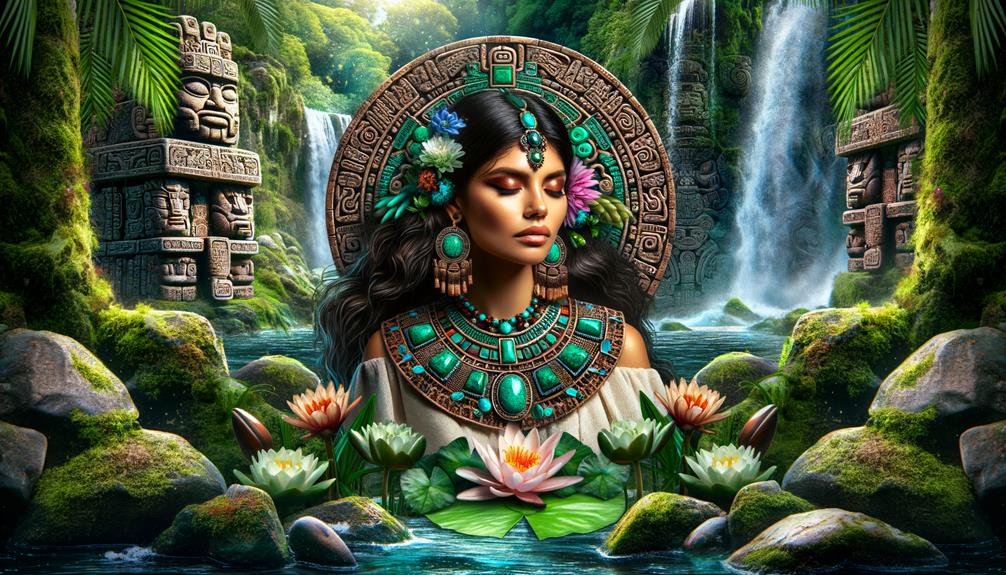
Chalchiuhtlicue—“She of the Jade Skirt”—was a central Mexican deity of terrestrial waters: rivers, lakes, springs, lagoons, and the water through which people and goods moved. She was closely linked with Tlaloc, but she was not simply a female version of him. Her own rituals connected water with birth, cleansing, travel, and the dangerous power of floods.
What her name means
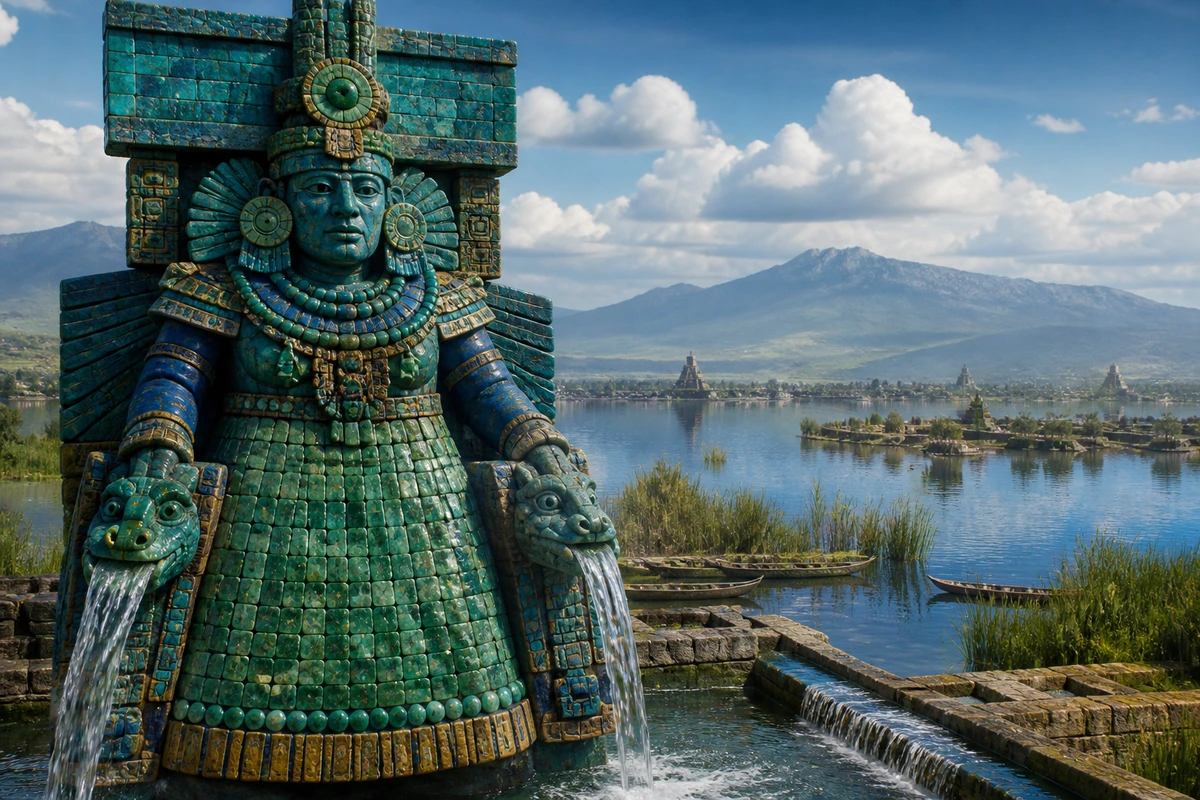
Chalchihuitl refers to precious greenstone, while cueitl means skirt. Jade and related greenstones carried associations of preciousness, fertility, and water. Mexica art made that connection visible through blue-green garments, beads, and streams that could flow from the deity’s skirt.
Sources variously call Chalchiuhtlicue Tlaloc’s companion, wife, or sister. These labels reflect the fluid relationships among central Mexican rain and water deities. The secure point is that their cults overlapped while their domains remained distinguishable: Tlaloc governed rain and storm from mountains and clouds; Chalchiuhtlicue presided especially over water already present and moving on earth.
Birth and cleansing
Sixteenth-century descriptions connect Chalchiuhtlicue with the ritual washing of newborn children. Water was addressed as a purifying and life-sustaining power, and the ceremony introduced the child into social and cosmic relationships. Calling this rite “Aztec baptism” imports a Christian category that can obscure its own Nahua meaning.
Her relationship with birth did not make Chalchiuhtlicue only a nurturing mother figure. Rivers and lakes could support communities, trade, and agriculture, but they could also drown, inundate, and destroy. Like Tlaloc, she joined sustenance and danger.
The Fourth Sun and the great flood
In the Historia de los Mexicanos por sus pinturas and related colonial accounts, Chalchiuhtlicue rules one of the previous cosmic eras, often called the Fourth Sun. That world ends in a catastrophic flood, and its inhabitants are transformed into fish. Versions differ in sequence and duration, so modern charts that present one perfectly fixed “Five Suns” chronology should be treated cautiously.
The flood places Chalchiuhtlicue within Mesoamerican ideas of repeated creation rather than a simple seasonal myth. Water sustains a world and can also close an age.
Images and archaeological caution
Mexica images identify Chalchiuhtlicue through garments and water imagery, including a distinctive headdress and jade ornaments. A famous 3.19-meter stone figure from Teotihuacan has long been called Chalchiuhtlicue and is displayed under that name at the National Museum of Anthropology. However, it was made centuries before the Mexica Empire. The familiar name is an interpretation, not proof that Teotihuacanos used the later Nahuatl identity in exactly the same way.
That distinction matters. Water deities have a deep Mesoamerican history, but similarities across centuries do not demonstrate an unchanged theology. Archaeology can show continuities in imagery and ritual attention to water while still leaving ancient names uncertain.
Water, movement, and community
Chalchiuhtlicue mattered to people whose work depended on lakes and canals as well as to households concerned with birth and health. Tenochtitlan itself stood in a lake environment joined by causeways, canals, chinampas, and aqueducts. Her terrestrial waters were therefore not an abstract element: they were the medium of daily urban life.