
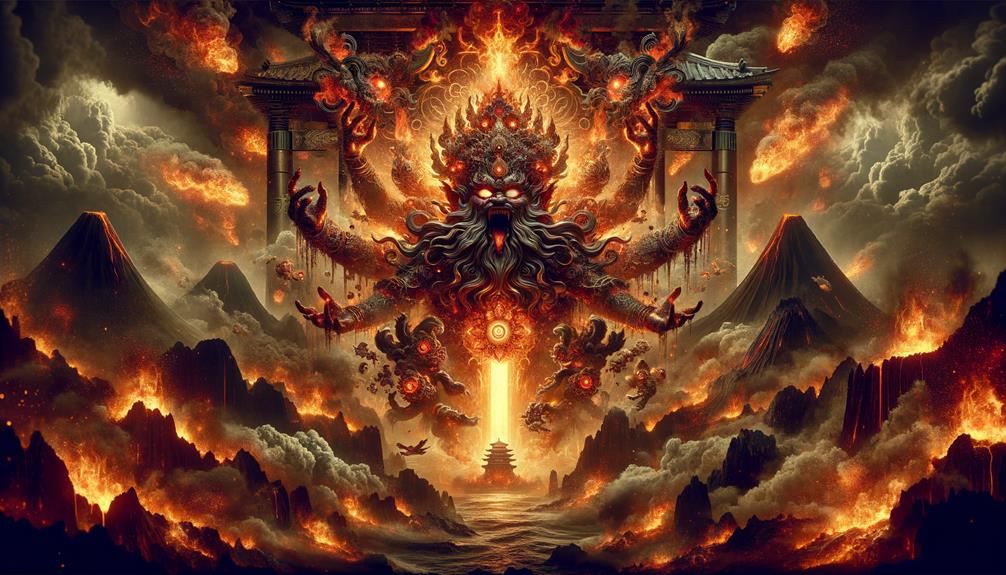
Accuracy note: In the best-known early accounts, Kagutsuchi's birth fatally burns Izanami and Izanagi kills the fire deity in grief. The deities generated from his blood and body differ between textual versions.
Kagutsuchi’s fiery arrival captivated Japan’s mythology, igniting volcanic eruptions and tragically claiming his mother Izanami’s life. Yet, from his remains emerged new deities – a important reminder of existence’s cyclical nature. This myth echoes familiar motifs: life, death, rebirth. Beneath its dramatic surface lie deeper truths about creation and destruction’s duality.
The narrative shows how one turbulent event sparked transformation in both celestial and earthly worlds. Kagutsuchi’s birth exemplifies the thin line separating beginnings from endings. His manifestation enabled new life forms while snuffing out another. This duality invites contemplation on the complex, often paradoxical forces shaping the world.
Contemporary thinkers may interpret Kagutsuchi’s story through diverse lenses – religious, philosophical, or scientific. Some might perceive it as an allegory for humanity’s capacity to create and destroy in equal measure. Others could view it as an ancient explanation for volcanic activity’s creative yet devastating impacts. Whichever perspective one adopts, this saga invites reflection on humanity’s role in nature’s perpetual cycle of renewal.
Mythological Origins

Kagutsuchi’s explosive arrival in Japanese mythology holds immense significance, born from Izanagi’s desperate attempt at purification. As the fire deity, Kagutsuchi’s birth wasn’t a simple event but a cataclysm reshaping the divine narrative. His emergence tragically led to his mother Izanami’s demise, unable to withstand the fiery intensity. This important loss paved Kagutsuchi’s destiny while highlighting fire’s potent and often destructive nature.
Izanami and Izanagi, primal deities, created Japan’s islands and countless kami. However, their son Kagutsuchi marked a pivotal turn. The fire god’s arrival encapsulates creation and destruction’s cycles, underscoring the eternal dance of opposing forces. His birth was both marvelous and cursed, catalyzing events forever altering the divine pantheon.
Exploring Kagutsuchi’s origins illuminates the important duality within Japanese mythology – life and death’s delicate balance, creation juxtaposed with destruction. His tale demonstrates the eternal interplay of opposing energies, shaping the world and its celestial inhabitants.
The Birth of Kagutsuchi
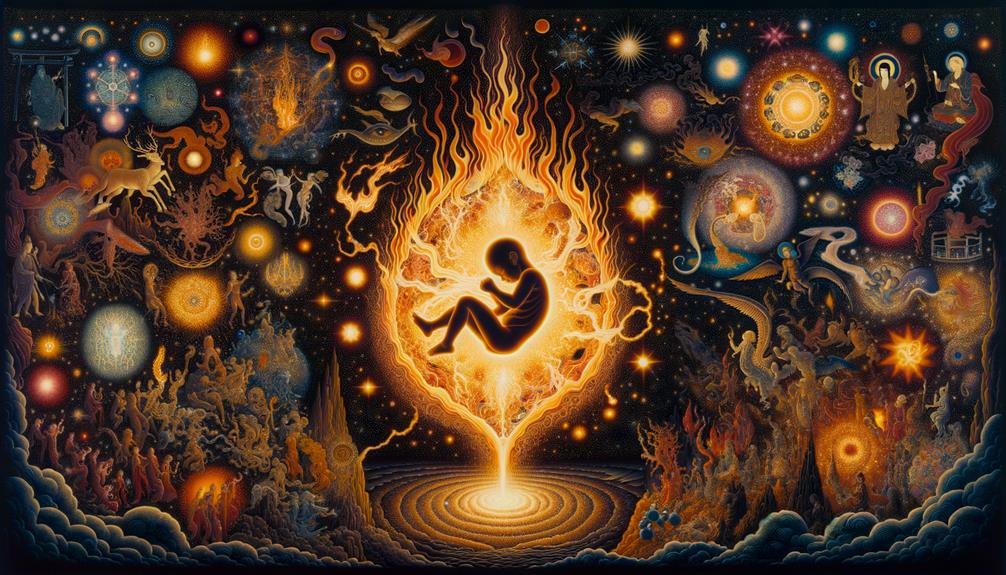
Kagutsuchi’s birth wasn’t just another incident; it marked a seismic shift in the celestial and mortal worlds. Emerging from Izanami, the Japanese goddess of creation, Kagutsuchi’s arrival triggered an intense surge of fire that tragically claimed his mother’s life, introducing death into Japanese mythology.
Overwhelmed with grief and anger, Izanagi, Kagutsuchi’s father, beheaded him, setting off a transformative chain of events:
- Volcanoes: mountain kami and related deities were born from Kagutsuchi’s severed body, embodying the earth’s fiery core.
- New Deities: Kagutsuchi’s blood and remains gave rise to new gods, like Watatsumi and Futsunushi, highlighting creation’s cyclical nature.
- Sacrifice: This myth shows sacrifice, as Kagutsuchi’s birth brought both creation and destruction.
- Fire’s Duality: Fire, represented by Kagutsuchi, symbolizes life-giving warmth and devastating power.
Kagutsuchi’s origin narrative powerfully illustrates the complex interplay between creation, death, and rebirth within Japanese mythology. His fiery essence reflects life’s dualistic nature.
Consequences of His Birth
From when Kagutsuchi’s flames engulfed his mother, the world transformed forever, sparking a saga of decimation and renewal. Grief-stricken and enraged, Izanagi severed Kagutsuchi’s head, unleashing even greater forces. Every fragment of the fire god’s body manifested as volcanic upheavals, crystallizing the cycle of creation and destruction central to Japanese mythology.
This earth-shattering event birthed deities Watatsumi and Takemikazuchi, representing life emerging from death’s duality. These two would later embody pivotal aspects of Japanese culture – fire fighting and balancing chaos with order.
| Event | Consequence |
|---|---|
| Kagutsuchi’s birth | Izanami’s demise |
| Izanagi’s wrath | Decapitating Kagutsuchi |
| Kagutsuchi’s fragmentation | Volcanic eruptions |
| Emergence of new gods | Watatsumi and Takemikazuchi born |
Ancient texts like the Engishiki describe rituals to pacify Kagutsuchi, underscoring the need to control his volatility. This narrative echoes universal themes of loss, transformation, and creation-destruction’s endless interplay. Through Japan’s cultural lens, Kagutsuchi’s birth and dismemberment reflect fire’s peril and promise – an eternal force demanding reverence.
Symbolism and Significance
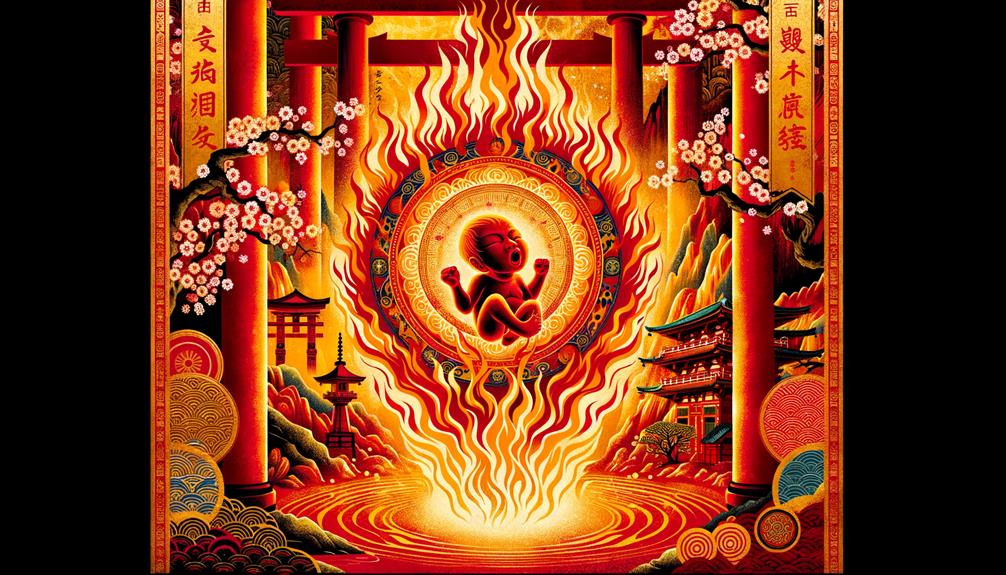
The fiery essence of Kagutsuchi, the Japanese god of fire, embodies both creation and destruction, igniting a story of rebirth woven into mythology. His birth and death at his father Izanagi’s hands highlight themes of tragedy and sacrifice, reinforcing how life and death intertwine.
Kagutsuchi’s influence extends beyond myth, permeating Japanese culture through volcanic eruptions and flames’ transformative power. Four key elements underscore his importance:
- Duality: Fire creates and destroys, a powerful reminder of its ability to forge new beginnings or bring devastating ends.
- Transformation: Flames purify and renew, reflecting Kagutsuchi’s role in life and death cycles.
- Artisan Respect: Craftspeople and weapon makers honor Kagutsuchi, acknowledging his influence on their creative processes.
- Regeneration: Depicted fiercely, Kagutsuchi embodies destruction leading to unending rebirth cycles.
Kagutsuchi’s legacy pays tribute to fire’s transformative power, forever shaping and reshaping the world left behind.
Depictions in Popular Culture
Legacy in Japanese Folklore
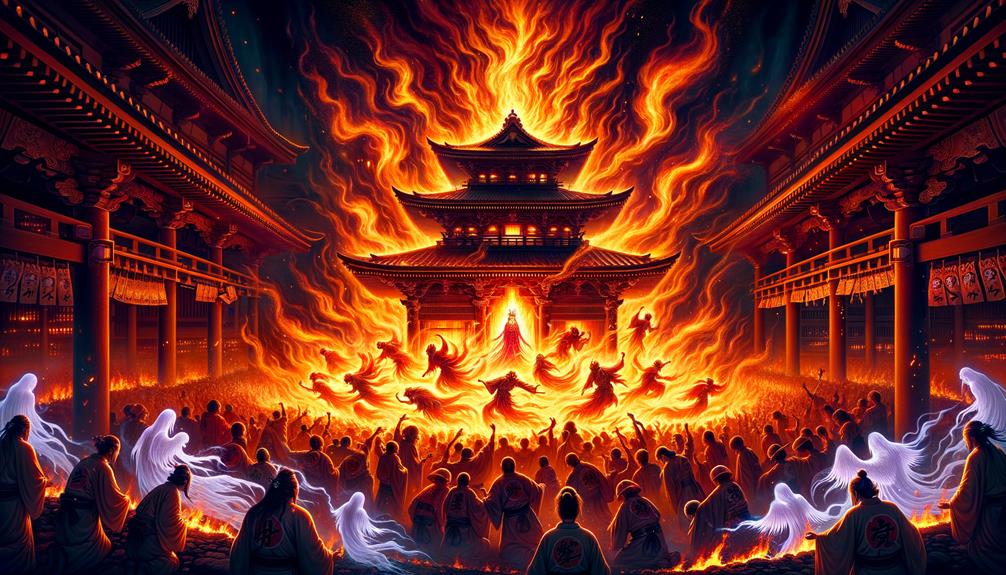
Kagutsuchi’s legacy in Japanese folklore captivates, his tale surpassing a tragic beginning and end to symbolize the perpetual interplay between creation and destruction. His mythological significance, evident in Japan’s volcanic formations, reflects nature’s enduring cycles. Over time, cultural depictions evolved, ensuring his fiery spirit endures through contemporary interpretations.
Mythological Significance Explained
The mythical birth of Kagutsuchi interweaves creation, destruction, and transformation into a memorable Japanese folktale. As the fire deity, Kagutsuchi’s arrival marked a pivotal moment. His emergence from Izanami’s passing symbolized life’s cyclical nature. When Izanagi slew Kagutsuchi in grief, the god’s fiery remains formed eight volcanoes, forever altering the natural landscape.
Kagutsuchi’s tale brims with archetypal mythological themes ingrained in Japanese culture:
- Duality: His fire brings life yet also heralds death, embodying creation and destruction’s dual nature.
- Natural Forces: Volcanoes stemming from his body highlight his integral role in the environment.
- Divine Interconnectedness: Deities like Watatsumi and Takemikazuchi arising from his remains showcase the mythos’ interlinked divine beings.
- Reverence and Rituals: The Engishiki’s measures to pacify Kagutsuchi underscore the respect and trepidation surrounding his volatile power.
Through these elements, Kagutsuchi’s enduring legacy as Japan’s fire and volcano god burns brilliantly within its cultural fabric.
Cultural Depictions Over Time
Across centuries, Kagutsuchi’s fiery tale burns bright through Japanese folklore, fusing creation with destruction in stories that mirror the hero’s path and archetypal myths. From his tempestuous birth to his pivotal role in Shinto beliefs, Kagutsuchi embodies duality – life and death, creation and chaos. Ancient texts like the Records of Ancient Matters immortalize his essence, portraying Kagutsuchi as an object of fear and reverence.
His influence extends beyond ancient scrolls, manifesting in various Japanese art forms and media. Artisans working with fire, such as blacksmiths and potters, call upon Kagutsuchi for protection and creative sparks, intertwining their craft with his mythic presence. His image adapts to modern video games too, retaining an uncertaintytic aura and commanding presence.
| Aspect | Description |
|---|---|
| Shinto Beliefs | Venerated as a fire deity, symbolizing creation and destruction |
| Ancient Texts | Documented in writings like Records of Ancient Matters, depicting life’s cycles |
| Japanese Artforms | Featured across art mediums, invoked by fire artisans |
| Video Games | Contemporary depictions keep his legend alive, inspiring audiences |
Kagutsuchi’s enduring legacy in folklore and modern reimaginings shows universal themes of transformation and balance, cementing him as a longstanding figure in Japanese mythology.
Modern Interpretations Influence
Kagutsuchi’s fiery essence ignites new worlds in countless modern stories, acting as a catalyst for creation and destruction. The Japanese remain captivated by his myth, weaving it into contemporary narratives in innovative ways.
Manga artists often depict Kagutsuchi as a fearsome dragon or powerful elemental being, embodying his fiery spirit. Video game characters inspired by him frequently possess fire-based powers, reflecting his destructive and creative capabilities. Anime storylines explore themes of balance between creation and destruction, drawing directly from his mythological roots. Modern authors integrate his legacy into their tales, using his archetype to examine into universal themes of rebirth and transformation.
These fresh interpretations shape how audiences connect with Kagutsuchi’s tale today. By reimagining his myth in new contexts, creators ensure his story burns brightly across generations.
Sources and related reading
- Ryujin Dragon Sea God on MythologyVault
- Hachiman War God Legends on MythologyVault
- Kokugakuin University: Encyclopedia of Shinto