Accuracy note: Sri Dalada Maligawa belongs to Sri Lankan Buddhist history and living religious practice, not Japanese mythology. This post currently sits in a Japanese Mythology URL path; its category should only be corrected when a tested redirect can preserve the existing address.
Sri Dalada Maligawa, commonly called the Temple of the Sacred Tooth Relic, stands within Kandy’s former royal palace complex in Sri Lanka. Devotees venerate a relic that the temple identifies as the Buddha’s left canine tooth. This is an active Buddhist place of worship and pilgrimage, not a ruined monument or a generic “mystical” attraction. A careful account distinguishes the temple’s religious tradition about the relic, the documented history of its royal and colonial custody, and the rites through which Buddhists honor it today.
What the Sacred Tooth Relic Represents
Bodily relics attributed to the Buddha have long been objects of Buddhist veneration. At Sri Dalada Maligawa, ritual treats the Tooth Relic as a living presence of the Buddha. That devotional understanding explains why offerings, music, and formal service surround the shrine; it should not be rewritten as a claim that the object opens a portal between Earth and heaven or automatically grants supernatural power.
The relic also acquired political meaning in Sri Lanka. The temple’s official history says that it became a symbol of kingship and was guarded beside the royal palace as capitals changed. UNESCO’s advisory evaluation similarly describes the relic as a palladium of the Sinhalese monarchy and notes the recurring placement of palace and relic shrine together. Custody therefore helped express legitimate rule. This historical relationship is more precise than saying that the tooth simply bestowed “divine authority” on any person who possessed it.
From Kalinga to Sri Lanka
According to the Sri Lankan Buddhist tradition presented by the temple, Princess Hemamala and Prince Dantha carried the relic from Kalinga in India to Sri Lanka during the reign of King Kithsirimevan, also rendered Sri Meghavanna, in the fourth century CE. UNESCO’s ICOMOS evaluation likewise places its arrival from Kalinga in that reign. This should be described as a received religious and chronicle tradition, not as an independently verified eyewitness report.
As political capitals shifted, the relic was associated with shrines at successive royal centers. It eventually came to Kandy under King Vimaladharmasuriya I. The city became the final seat of Sinhala royal power and remained independent until British forces entered in 1815. The relic’s journey is thus both a sacred narrative of protection and a record of the close relationship among Buddhist institutions, royal courts, and changing centers of government.
How the Kandy Temple Took Shape
The building visible today is the product of several periods, not one miraculous reconstruction. ICOMOS records a first Kandy temple built in 1603, destroyed in 1637, and rebuilt in 1697. The temple’s institutional history identifies the present two-storey shrine with King Sri Veera Parakrama Narendrasinghe, who ruled from 1707 to 1739, and credits later rulers with renovation and embellishment.
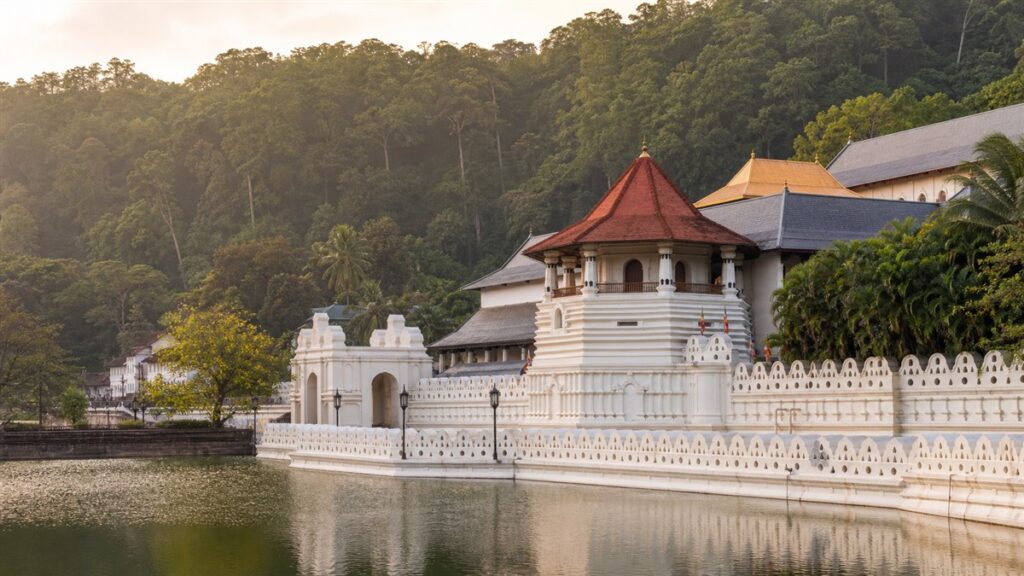
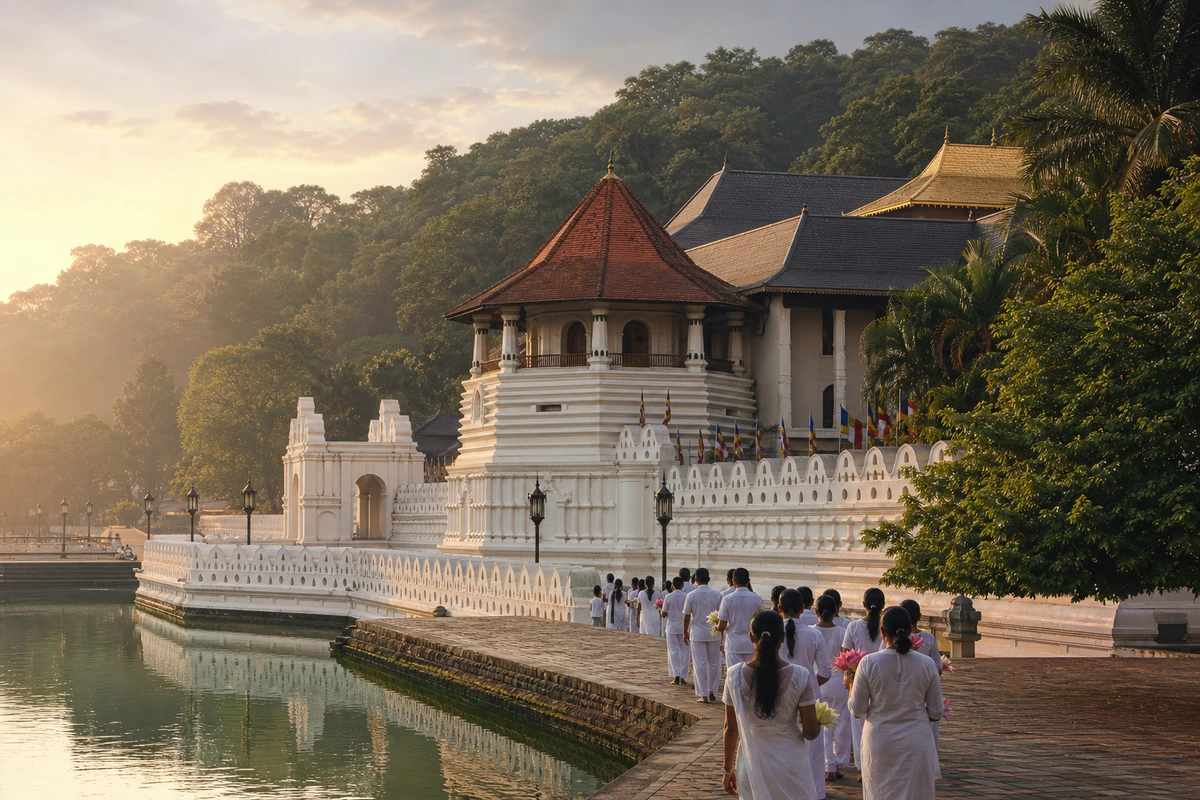
The Paththirippuwa, or Octagonal Pavilion, is a later addition from the reign of Sri Wickrama Rajasinha, the last Kandyan king. The temple attributes its design to the local architect Devendra Mulachari. Once separate from the main shrine, the pavilion was incorporated into the complex. Its roof, pillars, and surrounding wall express local architectural traditions rather than the invented pan-Asian fantasy architecture sometimes used in modern illustrations of the temple.
UNESCO inscribed the Sacred City of Kandy on the World Heritage List in 1988 under criteria (iv) and (vi). The listed property is the sacred city and monumental ensemble, not the temple as a standalone World Heritage property. The complex brings the Tooth Relic shrine together with the former royal palace and other religious buildings on the north side of Kandy Lake. Its carved wood, painted ceilings, stonework, metal, and other materials preserve the work of Kandyan artists and patrons.
Daily Theva and the Wednesday Nanumura Ceremony
The temple calls its daily services Theva or Thevava. Its published schedule has three service periods: early morning, mid-day, and evening. These include traditional sound offerings, the opening of shrine doors, flowers and lamps, food at mid-day, and liquid offerings in the evening. The responsibility for the services alternates annually between monks connected with the Malwatta and Asgiriya chapters under the oversight of their senior monastics and the temple’s lay chief custodian, the Diyawadana Nilame.
The weekly Nanumura Mangallaya takes place on Wednesday. The temple’s own description supplies an important detail often lost in summaries: attendants do not wash the Tooth Relic itself. A small silver casket symbolizes the relic casket, its shadow falls on a mirror, and the mirror is bathed with a fragrant herbal preparation while verses are recited. The preparation is then distributed to devotees, who attribute healing power to it. The temple suggests that this symbolic bathing custom may reflect South Indian influence. None of this supports importing unrelated Jagannath temple terms such as Dwaraphita, Abakasha, or Sakala Dhupa into an account of Kandy’s daily services.
The Esala Perahera and Other Annual Festivals
Sri Dalada Maligawa identifies four major annual observances: the New Harvest Festival in January, the New Year Festival in April, the Esala Perahera in July or August, and the Karthika Festival in November. These occur in addition to daily and weekly rites. Agricultural well-being, offerings, and older forms of royal patronage remain part of how the temple explains their significance.
The best known is the Kandy Esala Perahera, a sequence of night processions associated with homage to the Tooth Relic. The official account describes a Perahera casket carried through the streets amid drumming, dance, ceremonial offices, and processions connected with Kandy’s devalas. It is safer to call this the ceremonial Perahera casket than to claim that visitors see the Tooth Relic itself in the street. Annual dates change, so readers planning a visit should consult the temple’s current official schedule rather than rely on a permanent date copied into an article.
Colonial Rule, Custody, and Living Heritage
Kandy was the last capital of the Sinhala kings before British occupation in 1815. Historian of religions John S. Strong traces how British officials then dealt with the Kandy relic and how colonial interest in it exposed tensions between governmental power and religious authority. The episode is not merely a tale of destruction and rebirth: control of the relic remained politically consequential even after kingship ended.
Today, the temple names three principal custodial authorities: the senior monks of the Malwatta and Asgiriya chapters and the lay Diyawadana Nilame. Daily worship, annual processions, conservation, tourism, and UNESCO heritage status meet at the same site. Visitors should therefore approach Sri Dalada Maligawa as a living sacred institution. The temple asks visitors to remove footwear, dress respectfully, undergo entrance screening, and follow its current guidance.
The Temple of the Sacred Tooth Relic matters because tradition, political history, architecture, ritual, and modern heritage all remain present there. Its importance does not depend on invented prayers, vague promises of harmony, or fictional technology projects. It rests on a specific Sri Lankan Buddhist tradition sustained by communities and institutions over many centuries.
Sources and Further Reading
- UNESCO World Heritage Centre, “Sacred City of Kandy”
- ICOMOS, “Sacred City of Kandy” World Heritage evaluation (1988)
- Sri Dalada Maligawa, “History”
- Sri Dalada Maligawa, “Patthirippu (Octagon)”
- Sri Dalada Maligawa, “Daily Service”
- Sri Dalada Maligawa, “Weekly Service: The Nanumura Ceremony”
- Sri Dalada Maligawa, “Four Main Festivals”
- Sri Dalada Maligawa, “Kandy Esala Perahera”
- Sri Dalada Maligawa, “Frequently Asked Questions”
- John S. Strong, The Buddha’s Tooth: Western Tales of a Sri Lankan Relic (University of Chicago Press, 2021)
- Sarmistha Pasayat, “Dainandina Niti in Sri Jagannath Temple,” Orissa Review (Government of Odisha, 2006)