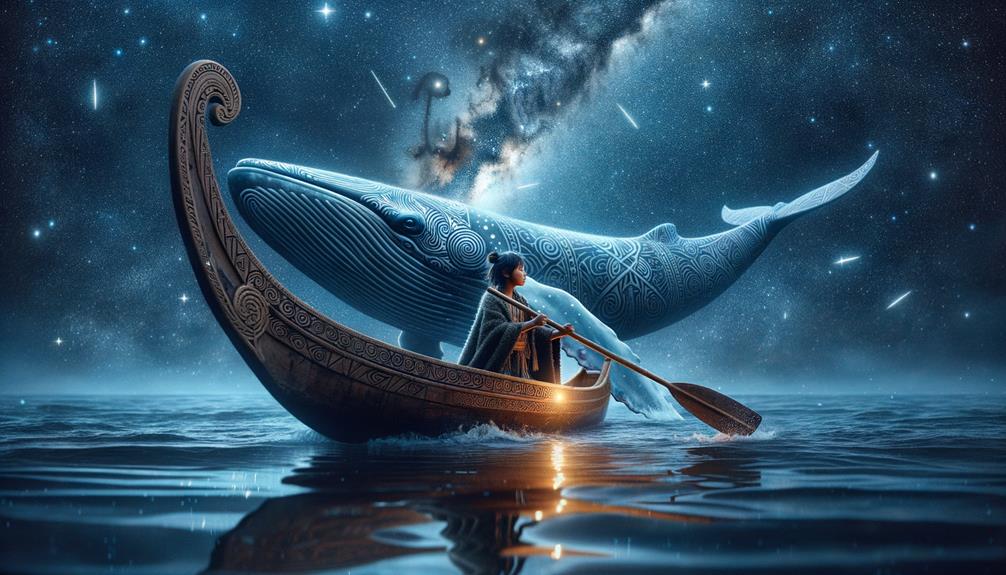
Paikea is remembered in several Māori traditions as a voyaging ancestor whose journey is inseparable from the sea and from whales. On the East Coast of Te Ika-a-Māui, especially at Whāngārā, that relationship is expressed through whakapapa, oral tradition, carving, place, and performance. It is more accurate to speak of Paikea traditions than to force every account into one fixed plot: communities preserve related narratives with their own genealogical and geographic emphases.
The popular phrase “whale rider” captures one memorable image, but it can also flatten the story. Paikea is not simply a fantasy hero who happens to use an animal as transport. The whale marks a relationship among ancestor, ocean, survival, and the people who locate themselves within his descent. That distinction matters when reading the tradition outside the communities that hold it.
Who is Paikea?
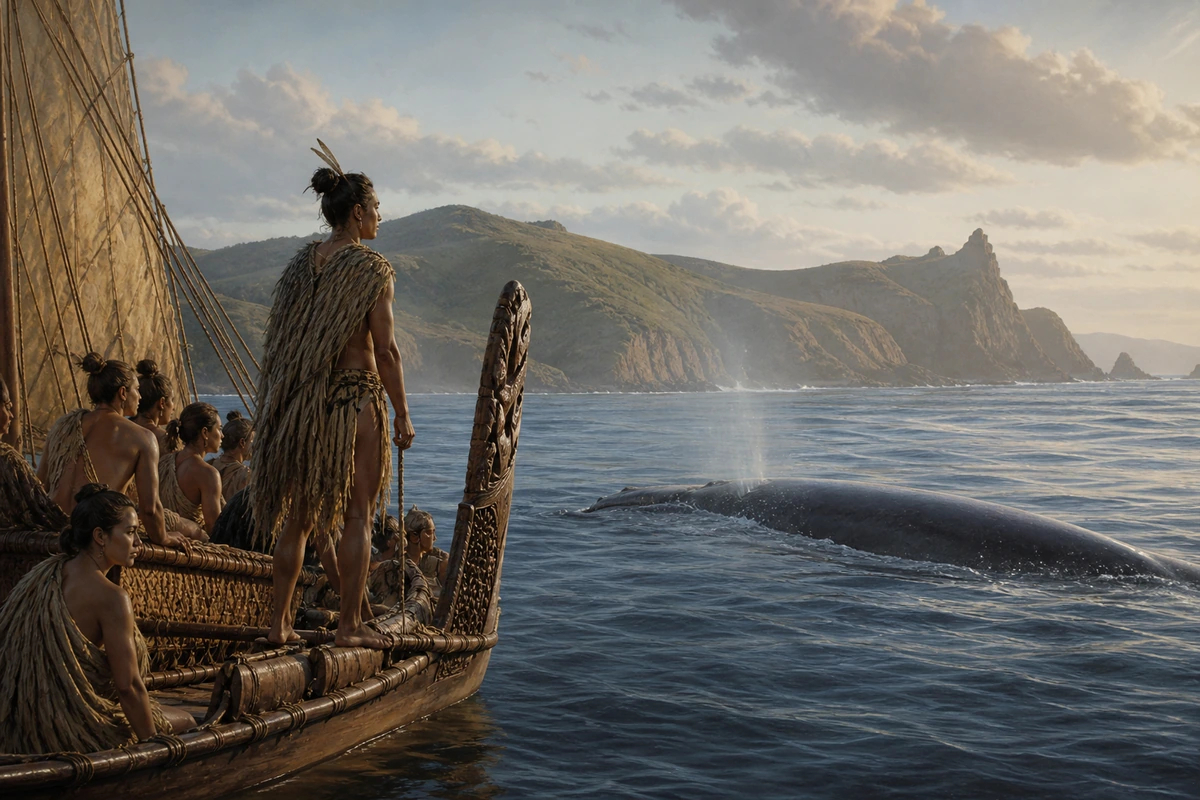
Paikea is an important ancestor for East Coast iwi and hapū, including Ngāti Porou and Ngāti Konohi. In widely shared accounts, he escapes danger in Hawaiki and reaches Aotearoa through the aid of a whale or in a form closely identified with a whale. The precise sequence, the names attached to episodes, and the genealogical lines emphasized can differ by narrator and community.
The name itself deepens the connection. Te Ara’s account of Māori whale traditions notes that paikea is also used as a whale name, often associated with a humpback or another grooved whale. The ancestor and the whale therefore should not always be imagined as two entirely separate figures in every telling. Some versions stress being carried; others stress transformation, identification, or divine assistance.
From Hawaiki to the East Coast
Hawaiki in Māori tradition is not merely a point that can be plotted on a modern map. It is an ancestral homeland and a place of origins, departure, and return. Paikea’s movement from Hawaiki to Aotearoa belongs to a wider body of Polynesian voyaging knowledge, but the story is not a substitute for a technical migration log. Its work is genealogical and cultural: it explains relationships among people, ancestors, named places, and the ocean route between them.
Whāngārā, north of present-day Gisborne, is the place most strongly associated with Paikea in public accounts. At Whitirēia marae, the ancestor is represented in the meeting-house tradition, and local narratives connect the community to his arrival. Te Ara identifies Paikea as an ancestor of Ngāti Konohi and describes whale symbolism as a recurring feature of East Coast carving and oral tradition.
What the whale means
Whales in Māori traditions can be ancestors, guides, guardians, signs, food sources, and powerful beings with their own kin relationships. Those meanings are not interchangeable, and no single story defines every iwi’s understanding. In Paikea narratives, the whale most consistently signals a safe passage made possible by a relationship larger than individual strength.
| Element | What it contributes | Reading caution |
|---|---|---|
| Hawaiki | Ancestral homeland and point of departure | Not reducible to one uncontested modern location |
| The whale | Kinship, aid, transformation, and ocean passage | Accounts do not all describe the relationship in exactly the same way |
| Whāngārā | A living East Coast place where Paikea traditions and descent are maintained | The story is not a placeless pan-Polynesian folktale |
| Whakapapa | Connects present communities with ancestor and land | Genealogy is more than a list of names; it carries obligations and identity |
Paikea in carving and community memory
The importance of Paikea is visible as well as spoken. A well-known carving created by Pine Taiapa in 1937 stands at the apex of the meeting house at Whitirēia marae in Whāngārā. Its location high on the building is not incidental decoration: the ancestor helps articulate the identity of the house and the people gathered beneath it.
Such works should not be treated as illustrations detached from their setting. A carving on a marae participates in a living cultural environment. Its meaning comes from whakapapa, local authority, ceremony, and the relationships of the people who care for it. Museum labels and online summaries can introduce that context, but they cannot replace it.
How The Whale Rider relates to the tradition
Witi Ihimaera’s 1987 novel The Whale Rider, followed by Niki Caro’s 2002 film, brought a contemporary story shaped by Paikea traditions to an international audience. The modern protagonist is a girl called Paikea, or Pai, whose struggle concerns leadership, inheritance, and the expectations placed on her within a present-day community.
The novel and film are adaptations, not transcripts of an ancient narrative. Their emotional power comes partly from placing ancestral relationships in conversation with contemporary questions. Viewers should therefore distinguish three things: the diverse Paikea traditions held by Māori communities, Ihimaera’s literary work, and the film’s own adaptation of that novel.
Why variation is not a flaw
Oral traditions are sometimes judged against the wrong standard, as though any difference must be an error. Variation can instead show where a story is being told, which relationships matter in that setting, and what a narrator is explaining. A national summary may emphasize the whale journey; a local account may give greater attention to descent, named descendants, or features of the coast.
Responsible reading starts with attribution. Rather than saying “the Māori believed” as if every group held one uniform account, identify the iwi, hapū, publication, or speaker when possible. Prefer sources produced by the communities concerned and recognize that some knowledge is not intended to be fully reproduced in a general-reference article.
Key takeaways
- Paikea is a voyaging ancestor of major importance in East Coast Māori traditions, especially those connected with Whāngārā.
- The whale relationship may be described as transport, aid, identification, or transformation depending on the account.
- Whakapapa and place are central; the narrative is not simply an adventure about surviving at sea.
- The Whale Rider is a modern literary and film adaptation, not the single authoritative version of Paikea’s story.