
Accuracy note: The Honjō Masamune is traditionally attributed to the swordsmith Masamune and was associated with the Tokugawa house. Its whereabouts have been unknown since the period following Japan's surrender in 1945, and sensational recovery claims should be treated cautiously.
The Honjo Masamune blade enthralls with its legend intertwined with heroism and fate. Master Masamune’s craftsmanship symbolizes purity and fortitude, accompanying heroes through battles and shoguns’ reigns. Yet its disappearance during World War II poses an notable mystery – did this fabled sword survive, awaiting a worthy owner?
Origins of the Honjo Masamune

In the fiery forge of the legendary swordsmith Masamune, a weapon rose to combat the Mongol invaders – the Honjo Masamune. This katana transcended mere swordcraft; it embodied divine artistry and resilience. Masamune, renowned across Japan, meticulously layered over repeated folding that creates thousands of layers of steel, birthing a blade of unmatched sharpness and strength.
Named after General Honjo Shigenaga in the 1500s, the Honjo Masamune’s prestige soared. From a war tool, it became a symbol of power coveted by samurai and shoguns. Eventually, this national treasure graced the Tokugawa shogunate‘s hands, solidifying its legendary status.
The katana’s journey didn’t end there. Displayed at the Kyoto National Museum, it stood as a example to its enduring legacy. However, during World War II‘s turmoil, this sword mysteriously vanished, enshrouding its storied past in uncertainty and leaving a void in Japan’s heritage.
The Craftsmanship of Masamune
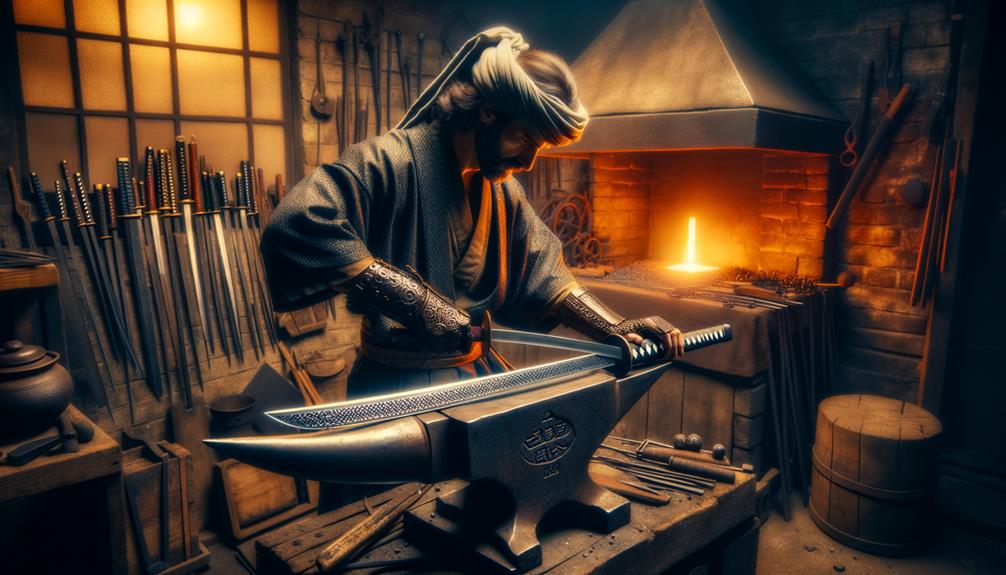
As Masamune’s reputation grew, the craftsmanship behind the Honjo sword revealed his extraordinary artistry. In ancient Japan, the legendary swordsmith Masamune hammered with divine precision. Each strike wasn’t just work but sacred art, forging swords beyond mere weaponry. He merged soft and hard steels in a fiery dance, creating blades of unmatched durability and flexibility.
The wavy pattern along Masamune’s swords, the hamon, optimized armor penetration and ensured a lightweight design – not just decoration. These blades, like the Honjo, symbolized power, revered by samurai and passed down generations.
The Honjo itself, named after a formidable general, stood as the pinnacle of Masamune’s craftsmanship. Declared an official Japanese treasure, it embodied the samurai spirit and Masamune’s enduring legacy. The Tokugawa Shogunate marveled at the Honjo’s legend, cementing its place in history as more than a sword – an archetype of divine craft, an embodiment of authority and honor.
Legends and Myths
The legend surrounding the Honjo Masamune sword spins an complex tale of masterful craftsmanship and unmatched quality. Years ago, swordsmith Masamune forged this revered blade, its name etching into Japanese lore as one of history’s finest swords.
This tale intertwines with the story of Honjo Shigenaga, a general whose swordsmanship was unparalleled. During a fierce battle, Shigenaga’s helmet was cleaved by a mysterious sword he soon realized was the Honjo Masamune itself. Masamune’s exceptional craftsmanship earned great respect, his creation becoming a symbol of supreme artistry.
Among Masamune’s many attributed swords, the Honjo Masamune stands apart. Its disappearance during World War II only deepens the uncertainty surrounding this blade that once embodied power and honor for the samurai warrior spirit.
Role in the Tokugawa Shogunate
Honjo Shigenaga’s legendary tale involving the Masamune blade paved its revered path within the Tokugawa Shogunate. This sword, crafted by the masterful Masamune, transcended its origins as a mere weapon, becoming a symbol of aristocratic power and prestige.
As the Tokugawa Shogunate rose to power, the Honjo Masamune was adopted as a ceremonial artifact, representing the divine right to rule. Passed through generations, it embodied continuity amidst Japan’s tumultuous history, more than just a blade but an esteemed possession.
Its 1939 designation as a Japanese national treasure cemented the sword’s legendary status. Within the Shogunate, the Honjo Masamune was wielded not in battle but in ceremonies underscoring its symbolic importance. Its presence commanded respect, signifying the unbroken lineage of authority.
Thus, Masamune’s sword became an emblem of the Tokugawa Shogunate’s enduring legacy, an honored heirloom representing the spirit of the era.
The Sword’s Mysterious Fate
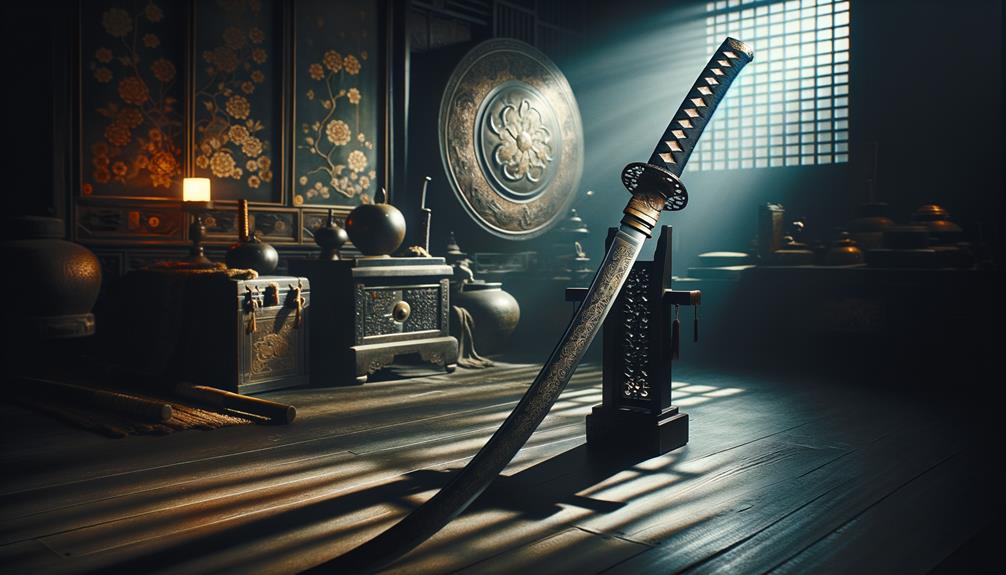
The legendary Honjo Masamune sword, a powerful emblem of the Tokugawa dynasty, mysteriously vanished after World War II’s chaotic conclusion. This prized weapon, forged in the 13th century, symbolized the Tokugawa family’s might until Japan’s surrender. As American troops collected enemy arms through the War Trophy System, the Honjo Masamune may have been seized and transported stateside, its current location unknown.
Despite extensive searches, the sword remains missing, fueling its mythical allure and memorable enthusiasts and historians. Its turbulent journey from imperial Japan to obscurity reads like an epic tale steeped in symbolism and historical intrigue. The Honjo Masamune’s unexplained disappearance adds mystique to an already illustrious legacy.
| Event | Year | Impact |
|---|---|---|
| Honjo Masamune’s Creation | 13th century | Birth of a fabled sword |
| Tokugawa Shogunate’s Rise | 1603 | Sword represents Tokugawa power |
| World War II Ends | 1945 | Upheaval and the sword goes missing |
| American War Trophy Program | Post-1945 | Potential removal to the United States |
The sword’s story captivates, from its forging to its perplexing loss. Its vanishing act remains an unsolved riddle notable sword enthusiasts worldwide. This legendary blade’s shrouded whereabouts only heighten its already considerable mystique.
Sources and related reading
- Kusanagi Sword Imperial Regalia on MythologyVault
- Cloak of Prophet Muhammad on MythologyVault
- Japanese sword collection research at the Tokyo National Museum