
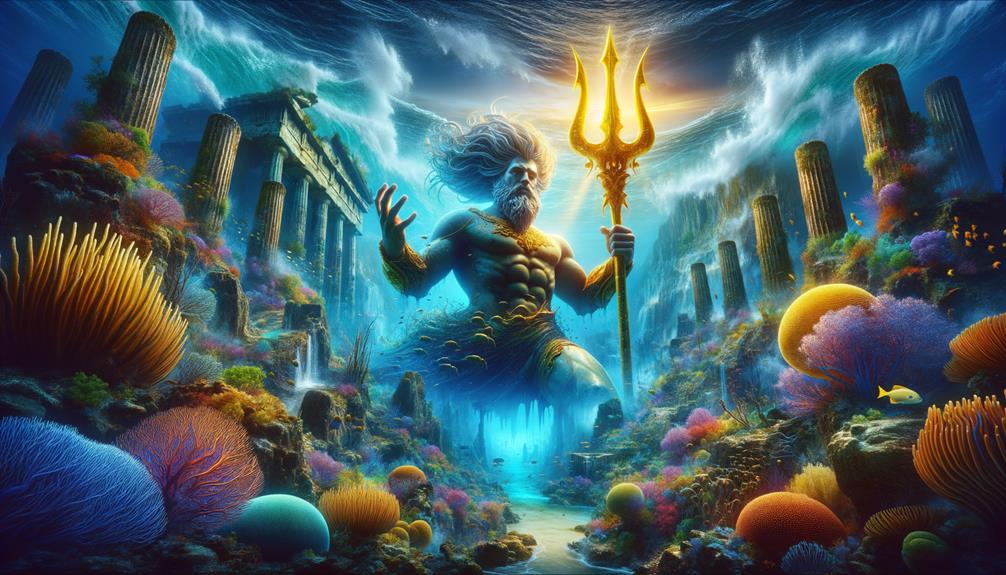
Poseidon’s trident is one of the clearest divine attributes in ancient Greek art and poetry. Homer uses it as the instrument with which the earth-shaker troubles the sea and smashes rock. A later mythographer, Pseudo-Apollodorus, explains its origin as a gift from the Cyclopes during the war against the Titans.
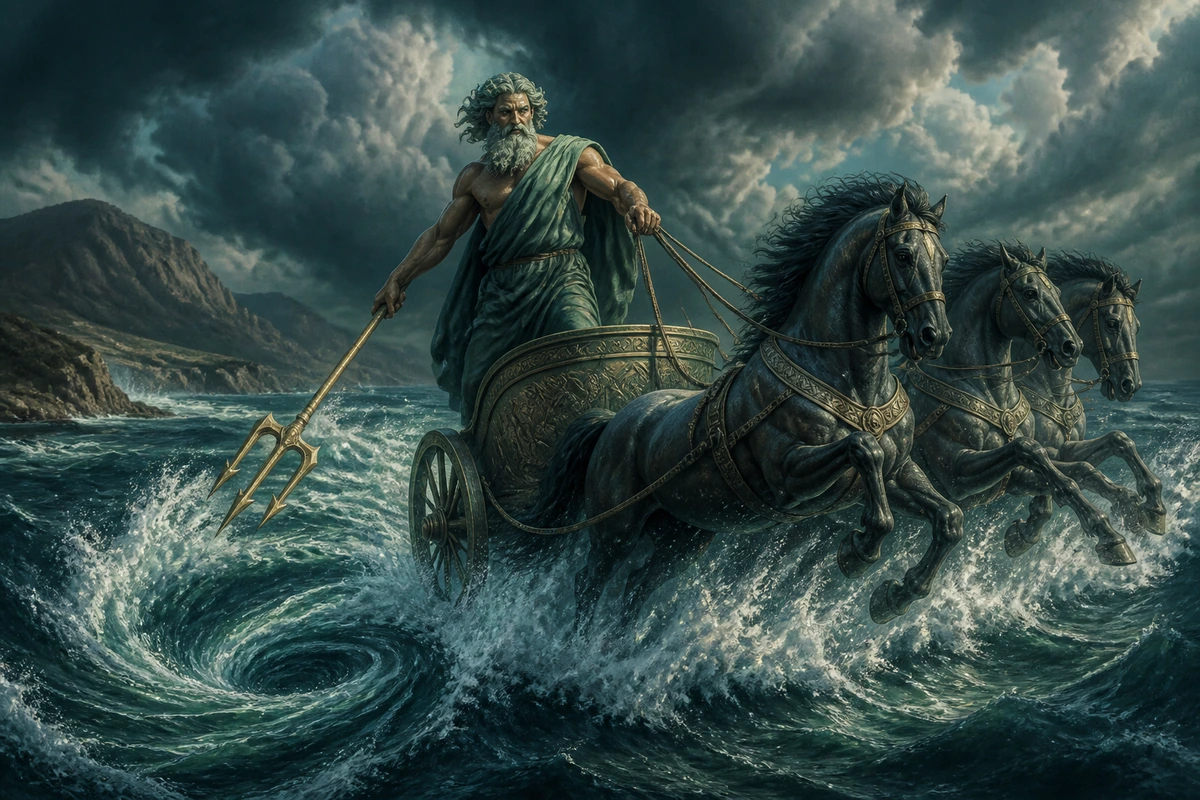
Who made Poseidon’s trident?
Pseudo-Apollodorus says that Zeus frees the Cyclopes before the Titanomachy. They arm the three divine brothers: Zeus receives thunder, lightning, and the thunderbolt; Hades receives a helmet; Poseidon receives a trident. The gods then defeat the Titans and divide the sky, sea, and underworld by lot.
Hesiod tells only part of that equipment story. His Cyclopes give Zeus thunder and the thunderbolt, but the Theogony does not say that they also forge Poseidon’s trident and Hades’s cap. Articles that cite “Hesiod” for all three gifts are silently importing Pseudo-Apollodorus.
The trident in Homer
The weapon is already a familiar attribute in the Homeric epics. In Odyssey 5, Poseidon seizes his trident, gathers clouds, troubles the sea, and rouses winds against Odysseus’s raft. The poem presents a sequence of divine action, weather, and wave—not a generalized list of magical powers.
In another episode, Poseidon strikes the rock of Gyrae with the trident and splits it, punishing the boastful Ajax. The object therefore expresses his force over both water and rock, fitting a god repeatedly called earth-shaker and earth-enfolder.
Springs, earthquakes, and contested land
Later local myths use the trident to mark places. In the contest for Athens, Poseidon strikes the Acropolis and produces a sign associated with sea water; ancient visitors were shown a trident mark and a salt-water well in the Erechtheion. Athena’s olive tree becomes the rival gift.
At Argos, traditions about Amymone connect Poseidon’s strike with the release of a spring. Such stories map divine presence onto rock, water, and civic territory. They vary by location and author, so they should not be compressed into one universal tale in which every spring comes from the trident.
Why three prongs?
Ancient texts use the three-pronged shape as a recognizable fact, not as a puzzle that receives one official symbolic solution. Modern writers have proposed sea, earthquake, and horse; past, present, and future; or creation, preservation, and destruction. Those triads are later interpretations, not meanings supplied by Homer.
The form may evoke practical fishing spears, but the divine trident is more than ordinary gear. In art it identifies Poseidon even when the scene is not maritime, just as Zeus’s thunderbolt and Athena’s aegis identify them.
Poseidon’s trident in Greek art
Black-figure and red-figure vase painters regularly show Poseidon holding the trident. A sixth-century BCE cup attributed to the Amasis Painter depicts him carrying it among Greek warriors, while the reverse imagines his underwater stables. The weapon lets a viewer recognize the god immediately.
Artists vary the shaft, prongs, and scale. There is no documented surviving “original trident” and no ancient evidence that a historical weapon owned by Poseidon was kept in a temple. Archaeological images are evidence for representation and worship, not proof of a physical divine relic.
Roman Neptune and later reception
Roman art transfers the trident to Neptune, and later European images make it a general sign of maritime rule. Modern logos, naval emblems, statues, and fantasy weapons inherit that visual shorthand.
These later uses show the attribute’s durability, but they should not be used to backfill Greek sources with modern claims about Atlantis, planetary energies, or a scientifically precise control of tsunamis.