
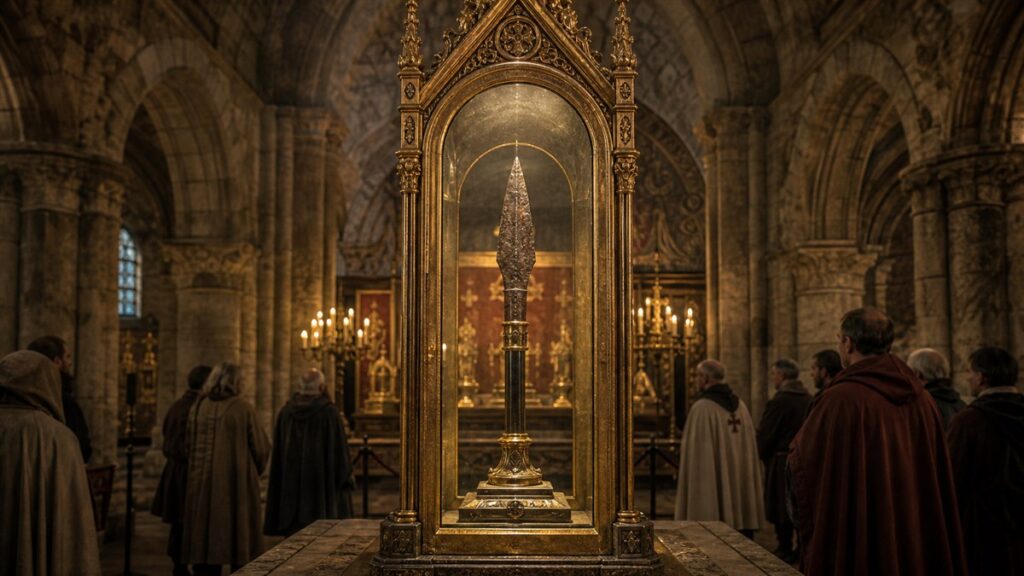
Accuracy note: The Holy Lance belongs to Christian scripture, relic tradition, and medieval history—not Greek mythology. The Gospel account, the later legend of Longinus, and the surviving objects claimed as the lance should be treated as separate layers of evidence.
The Holy Lance, also called the Lance of Longinus, is the spear associated with the piercing of Jesus’s side at the crucifixion. It is one of Christianity’s best-known Passion relic traditions, but no single object has an uncontested history back to the first century. The story developed through scripture, apocryphal literature, pilgrimage, art, politics, and competing relic claims.
What the Gospel of John Actually Says
The canonical starting point is John 19:33–37. The passage says that soldiers found Jesus already dead, did not break his legs, and that one soldier pierced his side with a lance. Blood and water flowed from the wound. John does not name the soldier, call him a centurion, describe his conversion, or identify what happened to the weapon afterward.
The Gospel establishes the religious narrative behind the lance, but it provides no chain of custody for a surviving artifact. Claims about the soldier’s identity and later life belong to later Christian tradition.
How the Soldier Became Longinus
The name Longinus appears in the apocryphal tradition of the Gospel of Nicodemus, also known as the Acts of Pilate. Scholar Boris Uspensky traces both eastern and western forms of the Longinus tradition to that text. In the Christian West, the soldier who used the lance became identified with Longinus and was eventually venerated as a saint. Stories about his conversion and impaired sight, also reflected in medieval art, are hagiographic traditions, not details documented by John.
The Earliest Record of a Venerated Lance
An early record comes from the anonymous Pilgrim of Piacenza, who visited the Holy Land around 570. Older scholarship often called this traveler “Antoninus of Piacenza,” but the account is anonymous. Its description of Jerusalem reports a lance “with which the Lord’s side was pierced” in the Basilica of Holy Zion.
This shows that a lance identified with the Passion was venerated in Jerusalem by the late sixth century. It does not prove that the object was the weapon described in John; a substantial documentary gap remains.
Why There Is More Than One Holy Lance

Relics could be moved, divided, reinterpreted, or copied. Separate objects in Rome, Vienna, and Armenia have therefore been associated with the Holy Lance. Their histories should not be combined into one seamless journey. Historian Luke Clossey documents that the lance sent to Pope Innocent VIII in 1492 was already treated with doubts because another famous claimant existed in Nuremberg.
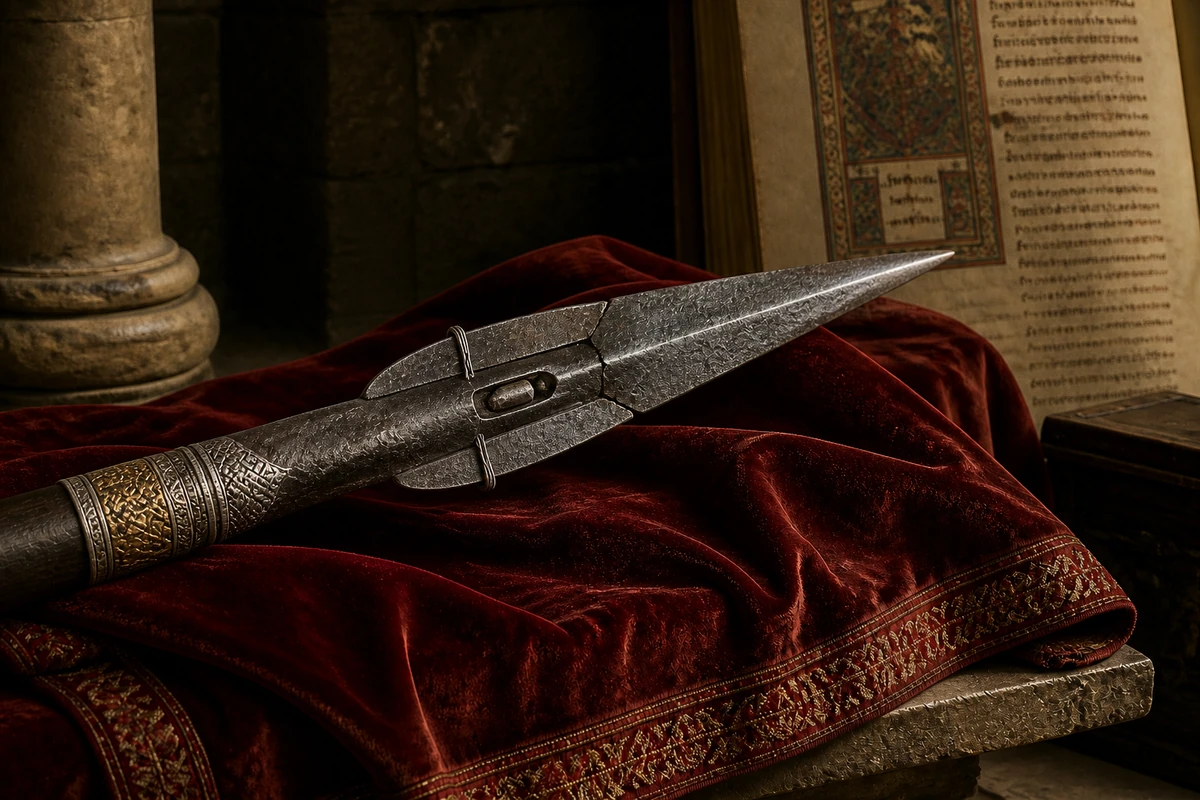
The lance in Vienna’s Imperial Treasury is especially instructive. The Kunsthistorisches Museum identifies it as an eighth-century Carolingian winged lance. It was interpreted at different times as the lance of Constantine, the spear of Saint Maurice, and, by the thirteenth century, the lance of Longinus. Its date rules it out as a first-century Roman weapon, while its history reveals its importance as an imperial symbol.
Armenia preserves another major tradition. According to UNESCO’s history of Geghard Monastery, a spear said to have wounded Christ was allegedly brought to Armenia by the apostle Thaddeus and kept there for centuries. The name Geghardavank means “Monastery of the Spear.” The attribution is sacred tradition, not an archaeologically demonstrated provenance.
The Holy Lance Found at Antioch
Another claimed lance emerged during the First Crusade. In June 1098, while crusaders were trapped at Antioch, Peter Bartholomew reported visions of Saint Andrew directing him to the relic beneath the Church of Saint Peter. Raymond of Aguilers, a crusade chronicler and supporter of the claim, described the excavation and the joy that followed the discovery.
The find affected morale, but saying that it single-handedly caused victory goes beyond the evidence. Historian Thomas Asbridge shows that contemporary accounts differ and later writers simplified a complicated sequence. The episode demonstrates the power relics held in medieval religious and military culture, not that Peter’s object was the biblical lance.
What Can Be Said About Authenticity?
No surviving claimant has an uncontested chain of custody to the crucifixion. Scientific examination can date materials or reveal construction, but it cannot turn a medieval object into a documented first-century artifact. The Vienna lance remains meaningful as Carolingian and imperial history even though it cannot be the weapon described in John.
The Holy Lance remains significant because it shows how a brief Gospel passage generated centuries of devotion, visual art, pilgrimage, and political symbolism. A careful history can respect those traditions while distinguishing faith claims from what texts, artifacts, and modern scholarship can establish.
Sources and Further Reading
- The Holy See: John 19, New American Bible
- Boris Uspensky, “The Gospel of Nicodemus and the Cult of St Longinus”
- The Metropolitan Museum of Art: Longinus in the Belles Heures
- The Piacenza Pilgrim, translated by Andrew S. Jacobs
- Luke Clossey, “Jesus Objects,” in Jesus and the Making of the Modern Mind, 1380–1520
- Kunsthistorisches Museum: The Holy Lance
- UNESCO: Monastery of Geghard and the Upper Azat Valley
- Fordham Medieval Sourcebook: Raymond of Aguilers on the Holy Lance at Antioch
- Thomas Asbridge, “The Holy Lance of Antioch”