Accuracy note: Poseidon's trident is an identifying divine attribute in Greek art and literature. It belongs to mythic representation, not to a documented surviving weapon.
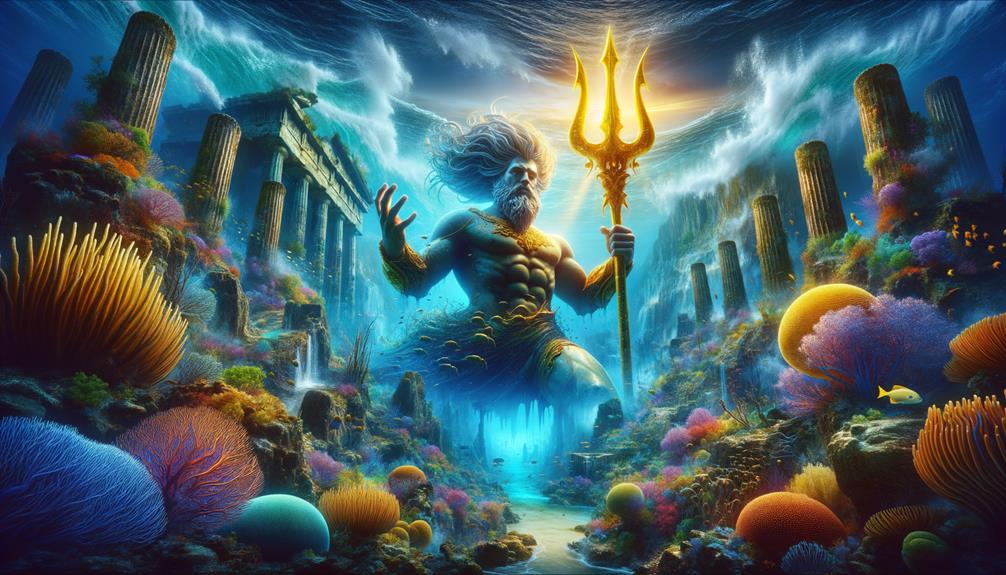
Poseidon’s Trident evokes ancient mythological power, a three-pronged symbol of the sea god’s authority over vast oceans. Crafted by the Elder Cyclopes, this iconic weapon represents creation and destruction, mirroring its wielder’s tempestuous nature. Studying its depictions in Greek art reveals how this emblem of maritime dominance extends beyond myth, inspiring modern military insignia and corporate logos. However, the Trident’s enduring allure lies in…
Origins and Mythology

When gods and titans battled, Poseidon’s Trident emerged, symbolizing divine oceanic authority. Forged by Elder Cyclopes with magic, this wasn’t just a tool but an extension of the sea god himself, ruler of vast, turbulent waters. One of three mighty weapons alongside Zeus’s thunderbolt and Hades’ Helm of Darkness.
In the standard Titanomachy sequence, the Elder Cyclopes and Hekatonkheires were first freed from Tartarus, after which the Cyclopes forged the divine weapons : the trident for Poseidon, the thunderbolt for Zeus, and the helm of darkness for Hades. Their crafting displayed immense power. Covered in moss and algae, its ancient mystical nature showed Poseidon’s connection to the sea. With it, he commanded water, summoned storms, and asserted dominion over aquatic worlds.
Some stories credit ancient blacksmiths, the Telekhines closely tied to Poseidon, for its creation. Regardless of origins, the Trident played a pivotal role in mythology.
Symbolism and Meaning
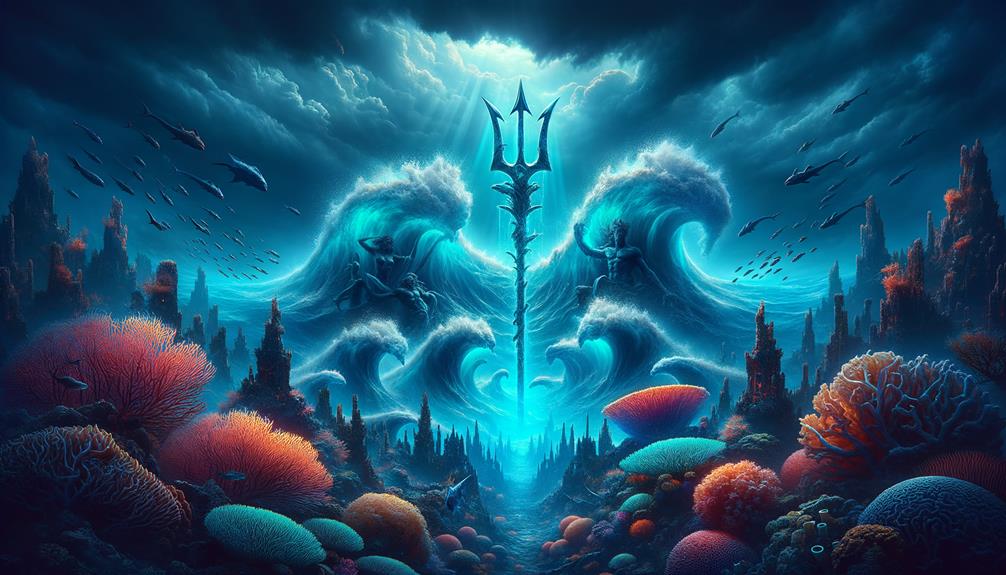
Poseidon’s trident, a three-pronged spear, symbolized his control over the ocean’s depths in Greek mythology. More than just a weapon, its prongs embodied water’s fluidity, fertility, and life-sustaining qualities, highlighting the sea god’s vast dominion.
The trident represented Poseidon’s naval supremacy, protecting sailors while reminding all to respect the ocean’s might. Each prong encapsulated a vital aspect of water: liquidity enabling life, fecundity fueling growth, and drinkability for survival.
Centuries later, the trident endures as an iconic representation of maritime power and Greek mythology’s lasting impact.
| Aspect | Symbolism | Significance |
|---|---|---|
| Liquidity | Water’s fluid state | Necessary for life |
| Fecundity | Fertility and abundance | Enables growth |
| Drinkability | Potability | Sustains humans |
The trident wasn’t merely symbolic; it exemplified Poseidon’s authority over creation and destruction in the watery worlds he governed. Its legacy extends beyond ancient tales into contemporary associations with naval dominance.
The Trident in Art
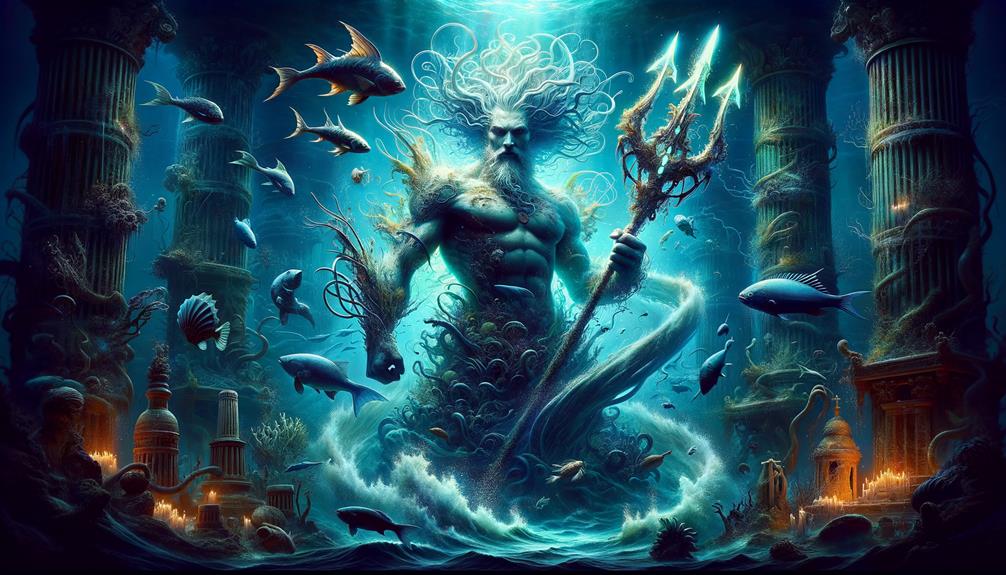
Glimpsing ancient Greek artworks, Poseidon’s Trident instantly catches the eye – a potent symbol of his unwavering mastery over the oceans. Exploring these longstanding pieces reveals the trident, a three-pronged spear, extends beyond being just a weapon; it embodies Poseidon’s immense power and control over the aquatic world.
Greek artists frequently depicted Poseidon wielding his trident authoritatively, surrounded by sea creatures reinforcing his dominion. These depictions narrate mythological tales, illustrating the might of Poseidon’s reign.
The Roman equivalent Neptune’s trident similarly signified maritime power in Greco-Roman art and literature. This iconography endures, representing sailors’ protector and the sea god’s vast influence.
Appreciate the trident in art through:
- Sovereignty Symbolism: It represents Poseidon’s command over the seas.
- Artistic Portrayals: Ancient Greek art often shows Poseidon holding his trident.
- Mythological Narratives: The trident features centrally in stories involving deities and marine creatures.
- Cultural Continuity: Modern interpretations evoke the trident’s protective, powerful essence.
With every brushstroke and chisel, ancient artists immortalized Poseidon’s trident, echoing the sea god’s enduring dominance.
Comparative Mythology
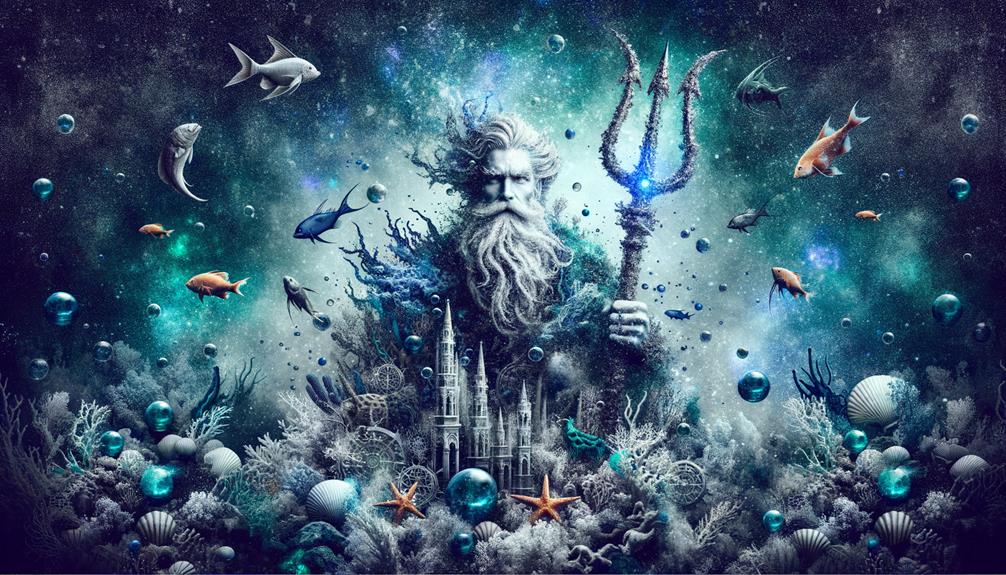
Comparing the divine symbols of Poseidon’s Trident and Shiva’s Trishula unveils notable connections across mythologies. While each weapon carries distinct representations, they share an embodiment of mastery over elemental forces.
Poseidon wielded the Trident as a symbol of maritime dominion. Its three prongs reflected his command over oceans and storms. In contrast, Shiva’s Trishula, with its three blades, symbolized the cycle of creation, sustenance, and dissolution in Hindu beliefs. This contrast highlights differing interpretations of divine intervention.
Despite these differences, both weapons serve as archetypal symbols across cultures. The uncertainty surrounding which deity ancient tridents represent hints at possible shared origins. These parallels provide insights into mythology’s universal themes of heroic journeys and restoring balance between chaos and order.
Modern Cultural Impact
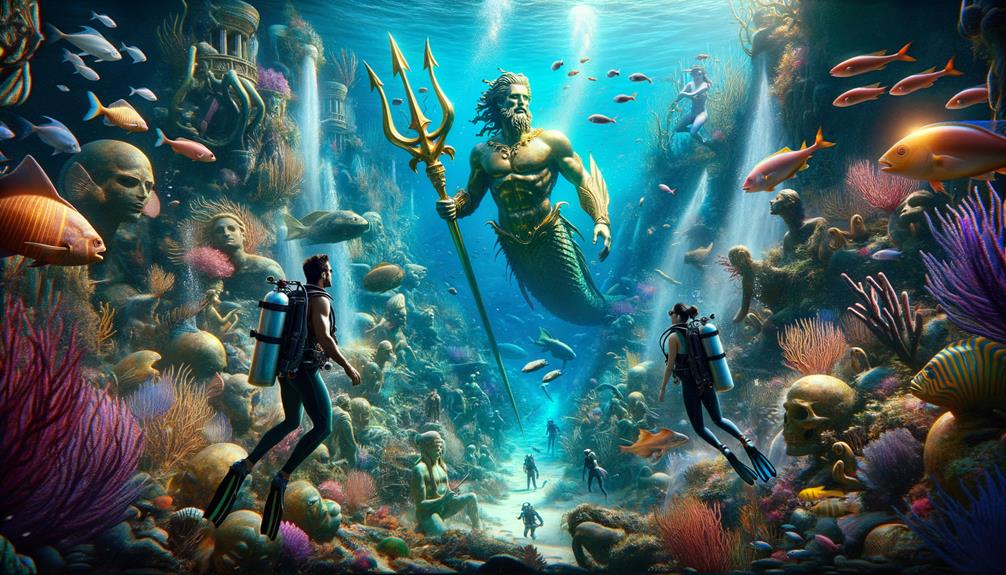
Poseidon’s trident, an iconic maritime symbol, remains deeply woven into contemporary culture. Rick Riordan’s ‘Percy Jackson‘ book series brings the trident to life, with the demigod protagonist wielding this ancient weapon.
But the trident’s influence extends further. Maserati adopted it as their logo, representing speed and power. Even civic heraldry like Liverpool’s coat of arms bears the trident, nodding to the city’s maritime heritage.
Echoing across ‘Percy Jackson’, naval forces, and luxury brands, the trident remains an enduring cultural touchstone, embodying humanity’s historic bond with the oceans.
Sources and related reading
- Fragarach Sword Irish Lore on MythologyVault
- Argo Ships Epic Voyage on MythologyVault
- The Metropolitan Museum of Art: medieval art resource