
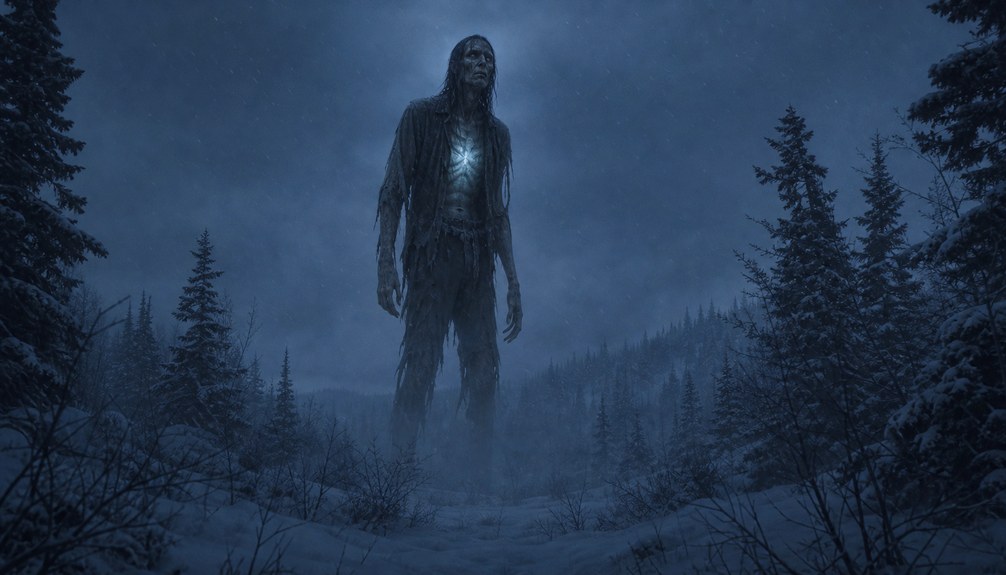
Windigo, also written Wendigo, Weendigo, Wiindigoo, and in other forms, names a cannibal being or condition in traditions of several Algonquian-speaking peoples. Ojibwe, Cree, Saulteaux, Naskapi, and Innu accounts are related but not identical. “Algonquian” describes a large language family, not one tribe with one set of beliefs.
Hunger that can never be satisfied
Many Windigo narratives center on winter, famine, cannibalism, and an appetite that grows as it is fed. In some accounts the Windigo is a giant. In others a human becomes Windigo through cannibalism, possession, or extreme selfishness. The figure can therefore be both an external danger and a warning about what a person may become.
Ojibwe writer and language teacher Basil Johnston described the Windigo as an image of self-interest that expands until principles and values are destroyed. Other Indigenous writers have used Windigo language to discuss greed, extraction, colonial violence, and consumption without limit. These uses grow from living intellectual traditions, not from a generic horror monster.
Winter, community, and restraint
In northern environments, survival depended on food sharing, restraint, and responsibility to the group. A figure defined by solitary appetite and cannibalism reverses those duties. The Windigo is terrifying because it consumes relatives and neighbors and still remains empty.
It is too simple to say that the story was invented only to stop people from eating one another during famine. Narratives also concern moral law, spiritual danger, social relations, and the destructive growth of greed. Meanings differ among communities and storytellers.
The antlered image is modern
Traditional Algonquian descriptions do not establish the now common deer skull and antlers. Scholarship on modern representation traces the antlered form through non-Indigenous fiction, film, television, and online art. The design is visually memorable, but it has displaced Indigenous accounts of a gaunt or gigantic human-like cannibal being.
The distinction matters. Treating the antlered animal monster as ancient fact replaces specific traditions with a recent horror convention. Art based on Windigo narratives should not add faux Indigenous symbols or present unrelated ceremonial objects as decoration.
“Windigo psychosis” and historical records
Older psychiatric and anthropological writing used the label “Windigo psychosis” for reported fears of becoming a cannibal or for cases interpreted through Windigo belief. The category has been heavily debated. Colonial observers sometimes misunderstood events, relied on secondhand reports, or forced different cases into one diagnosis.
The term should not be used casually for modern mental illness. Historical cases belong to particular communities and colonial conditions, and current symptoms require qualified medical assessment.
Literary appropriation and Indigenous writing
Algernon Blackwood’s 1910 story “The Wendigo” helped move the name into English-language horror. Later novels, comics, games, and screen works changed the creature further. Many of these adaptations detach it from community obligations and make it a wilderness predator.
Contemporary Indigenous writers use Windigo in more grounded ways, including as a figure for greed and systems that consume people and land. Reading those writers helps correct the notion that the tradition ended in the past or belongs to anyone who wants a monster design.
How to discuss the Windigo accurately
Use the spelling preferred by the relevant source, identify the specific people or author, and distinguish a traditional account from a modern adaptation. Avoid antlers unless the subject is explicitly the recent pop-culture design. The Windigo is not a cryptid awaiting zoological proof. It is a culturally specific being and moral concept within living Indigenous traditions.
Sources
- Dillon, Windigo Violence and Resistance
- University of Toronto, Basil Johnston’s The Manitous
- McMaster University Libraries, Basil H. Johnston fonds
- University of British Columbia, Dictionary of Canadianisms entry