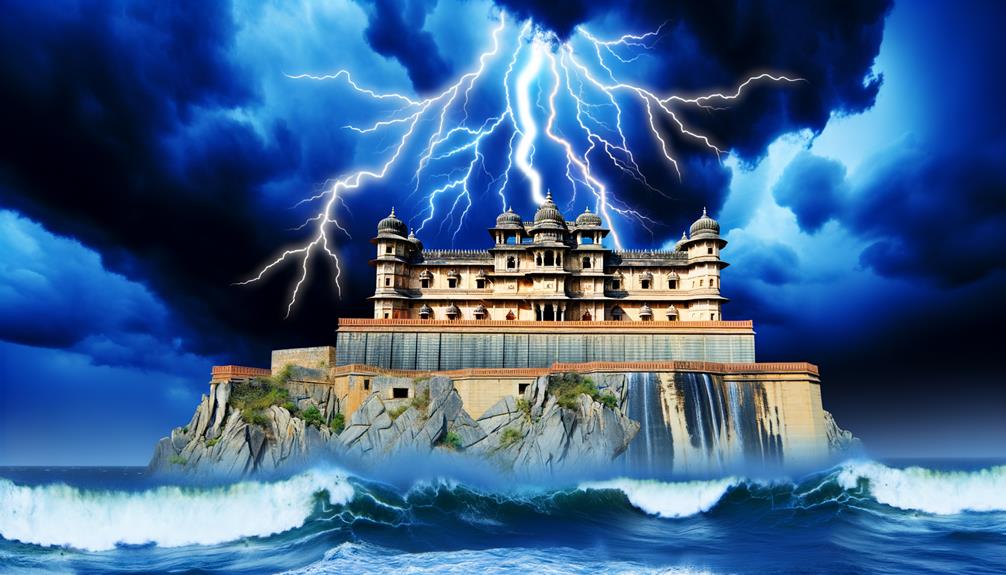
Indra is the most prominent warrior deity in the Rigveda, praised for breaking obstacles, defeating Vṛtra, releasing the waters, winning cattle, and sustaining worshippers through victory and generosity. Calling him only a “storm god” captures part of the imagery but misses the social and ritual world of the hymns. His character also changes greatly across Vedic, epic, Purāṇic, Buddhist, and Jain traditions.
Indra in the Rigveda
A large group of Rigvedic hymns addresses Indra directly, and many more mention him. The singers praise a deity who drinks soma, wields the vajra, rides with tawny or bay horses, rewards patrons, and destroys hostile enclosures. These are not separate “powers” arranged like a modern character profile. They are overlapping poetic ways of describing effective divine force.
Indra’s importance is inseparable from Vedic ritual. Hymns invite him to drink pressed soma and respond with protection, cattle, horses, rain, wealth, and victory. Praise is reciprocal: the poet magnifies Indra’s famous deeds while asking him to make that power present for a new community and occasion.
Vṛtra and the release of the waters
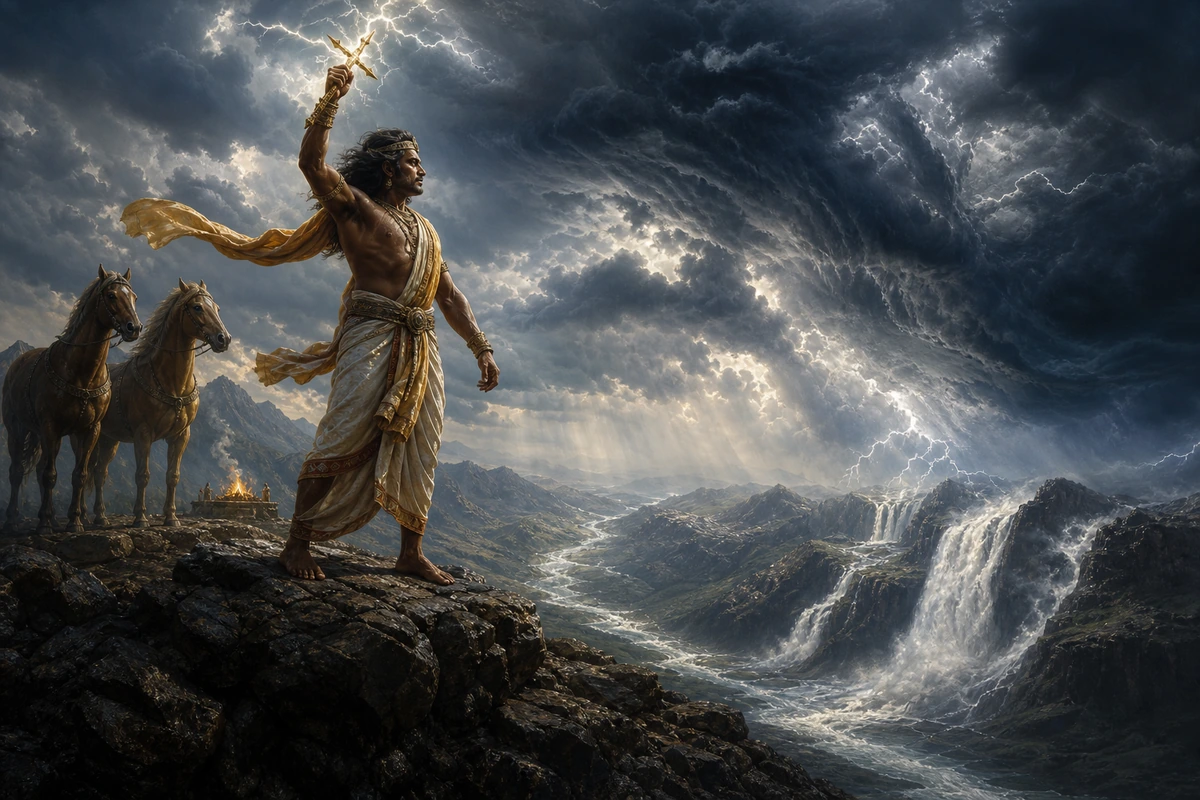
Indra’s defining opponent is Vṛtra, whose name is connected with obstruction or enclosure. Vṛtra holds back the waters, and Indra strikes with the vajra. Rivers then rush outward, often compared to cows released from confinement or mothers running toward their calves. The victory can involve mountain, serpent, cloud, fort, darkness, cattle, and hidden light imagery.
It is tempting to turn the episode into one literal weather report: a thunder god kills a drought serpent and rain falls. The monsoon reading is useful, but the hymns operate on several levels at once. The released waters are atmospheric and terrestrial, yet also cosmic and life-giving. The breaking of enclosure mirrors victory over enemies, the recovery of cattle, the opening of space, and the success of ritual speech.
The weapon’s origin also varies by telling. Later summaries often state that the divine craftsman Tvaṣṭṛ made the vajra, sometimes from the bones of the sage Dadhīci. The bone-sacrifice narrative is important in later literature, but it should not be inserted unmarked into every Rigvedic version.
Soma, speech, and heroic power
Indra drinks soma before great deeds, and Vedic poets repeatedly link the drink with exhilaration, expansion, courage, and strength. This is ritual language, not evidence that a human warrior simply became intoxicated and fought a monster. Soma is a consecrated offering and a deity in its own right; its preparation and consumption connect the sacrifice with Indra’s paradigmatic victories.
His epithets include “Vṛtra-slayer,” “wielder of the vajra,” “fort-destroyer,” and “lord of might.” Some terms resist a single English equivalent. “Fort” may render pur, for example, but the poetic enclosures are not always archaeological masonry cities. Translation should preserve uncertainty where the Sanskrit image is broader than a familiar English label.
Indra and the Maruts
The Maruts are a troop of brilliant, noisy storm deities associated with wind, rain, flashing weapons, and youthful energy. They often accompany Indra, but the relationship is not uniformly harmonious. Some hymns stage questions about who deserves credit for victory or depict Indra asserting his independence. That tension is part of the poetry, not a continuity error.
Agni, Soma, Viṣṇu, and other deities also join Indra in particular hymns. Vedic gods do not always occupy exclusive departments. A hymn can magnify the deity currently praised and connect that figure with powers emphasized elsewhere under another name.
From Vedic champion to king of heaven
In the Sanskrit epics and Purāṇas, Indra is widely portrayed as ruler of Svarga, husband of Śacī or Indrāṇī, and lord of a celestial court. Airāvata, the white elephant, becomes his best-known mount, and the vajra remains his emblem. He can still defeat demons and bring rain, but stories also expose his jealousy, fear of ascetics, pride, and dependence on higher divine powers.
The Govardhan episode is a famous example. When Kṛṣṇa persuades a pastoral community to honor the mountain and their own livelihood rather than make the expected offering to Indra, Indra sends destructive rain. Kṛṣṇa lifts Mount Govardhan to shelter the people, and Indra eventually recognizes his error. The story advances Kṛṣṇa-centered theology while retaining Indra as a meaningful cosmic ruler.
Descriptions of Indra’s “decline” therefore need care. His relative theological centrality changes, but he does not vanish. He remains active in narrative, ritual memory, temple imagery, kingship language, and the wider religious vocabulary of South and Southeast Asia.
Śacī, Ahalyā, and ethically difficult stories
Śacī, also called Indrāṇī, is not merely an accessory to Indra. She receives praise in Vedic material and becomes queen of the gods in later literature. Her portrayal varies from an independently voiced deity to a royal spouse defending her position.
The story of Indra and Ahalyā likewise varies significantly. In some tellings Indra approaches her in the form of her husband Gautama; texts and later retellings differ over recognition, consent, blame, punishment, and restoration. A short label such as “affair” can erase deception in one version, while a single deception narrative can wrongly overwrite other textual forms. Any responsible retelling must identify the source it follows.
Indra beyond Brahmanical Hindu literature
In Buddhist traditions, Śakra—often called Śakra Devānām Indra or Sakka—is ruler of the Heaven of the Thirty-Three. He supports the Buddha and appears in many narratives, but he is not an eternal creator or ultimate refuge. “Indra” also functions as a title in Jain cosmology, where multiple heavenly kings serve the Jinas. These figures inherit names and royal imagery from the broader Indic tradition while operating within distinct cosmologies.
That shared vocabulary is evidence of centuries of cultural exchange, not proof that every Indra figure has an identical biography or theology.
Indra’s attributes by period
| Context | Prominent roles and images | Reading caution |
|---|---|---|
| Rigveda | Vṛtra-slayer, water releaser, soma drinker, warrior, generous ally | The hymns use layered poetry, not a single systematic biography |
| Later Vedic literature | Royal power, ritual narratives, contests, theological interpretation | Later explanations should not automatically be read back into the earliest hymns |
| Epics and Purāṇas | King of Svarga, wielder of the vajra, rider of Airāvata | His flaws often serve the theology and ethics of a particular story |
| Buddhist traditions | Śakra/Sakka, protector and ruler of the Thirty-Three | He is a long-lived deva, not an omnipotent creator |
| Jain traditions | A title for heavenly kings who honor the Jinas | There are multiple Indras within a different cosmological system |
Comparison with other thunder gods
Indra is often compared with Zeus, Thor, Perun, and other Indo-European storm or thunder figures. Shared motifs—thunder weapons, serpent combat, rain, kingship—can help scholars reconstruct inherited patterns. Comparison does not make the deities interchangeable. Each belongs to a particular language, ritual system, landscape, and literary history.
Even the label “storm god” can mislead if it causes readers to overlook Indra’s links with cattle wealth, patronage, poetic praise, military success, and cosmic space. The Vedic Indra is best encountered through the hymns’ combinations rather than a narrow modern category.
Frequently asked questions
Is Indra the supreme Hindu god?
In many Rigvedic hymns he is the central deity being praised. Later Hindu traditions more often place Viṣṇu, Śiva, Devī, or an ultimate reality above him. There is no single answer that fits every period and school.
What is Indra’s weapon?
The vajra, a term associated with hardness, thunder, and the thunderbolt. Its form and origin develop across texts and art.
Who is Vṛtra?
Vṛtra is the great obstructor whom Indra defeats, releasing confined waters. “Serpent” or “dragon” conveys part of the imagery, but the hymns also imagine enclosure, mountain, darkness, and drought.
Is Indra still worshipped?
His prominence is smaller than in Vedic sacrificial religion, but he remains present in Hindu observance, Buddhist and Jain traditions, regional festivals, art, and Southeast Asian religious cultures.