
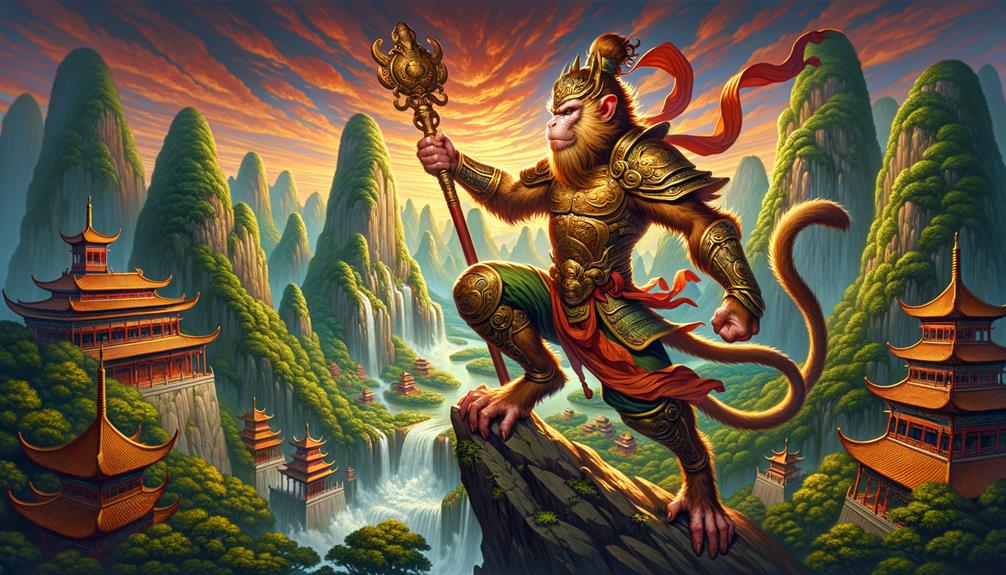
Sun Wukong, the Monkey King, is the most explosive personality in the Chinese novel Journey to the West. He is a stone-born animal, an immortal trickster, a master fighter, a rebel against Heaven, and finally a protector on a Buddhist pilgrimage. Reducing him to either a superhero or a symbol of enlightenment misses the tension that makes him memorable: extraordinary ability must be transformed into disciplined service.
The novel reached its canonical hundred-chapter form in the late sixteenth century. It is traditionally associated with Wu Cheng’en, although the surviving early editions were anonymous and the attribution remains debated. Its story draws on older pilgrimage legends, performance, religious traditions, and the historical monk Xuanzang’s seventh-century journey to India.
Birth from the stone
At the opening of the novel, a stone on the Mountain of Flowers and Fruit absorbs the vital energies of Heaven and Earth. It produces a stone egg that becomes a monkey. When he courageously passes through a waterfall and discovers a cave behind it, the other monkeys make him their king.
Comfort does not satisfy him because he realizes that every living creature is subject to death. He leaves his kingdom to seek a teacher and eventually studies with the patriarch Subhuti. The master gives him the religious name Sun Wukong, which can be read as “Monkey Awakened to Emptiness,” teaches him methods of longevity, the cloud-somersault, and the transformations conventionally numbered as seventy-two.
The number does not mean that he owns a fixed list of only seventy-two disguises. It identifies a category of transformation arts. Throughout the novel he changes size and shape, makes copies of himself from hairs, and uses deception as readily as direct force.
The staff from the Dragon Palace
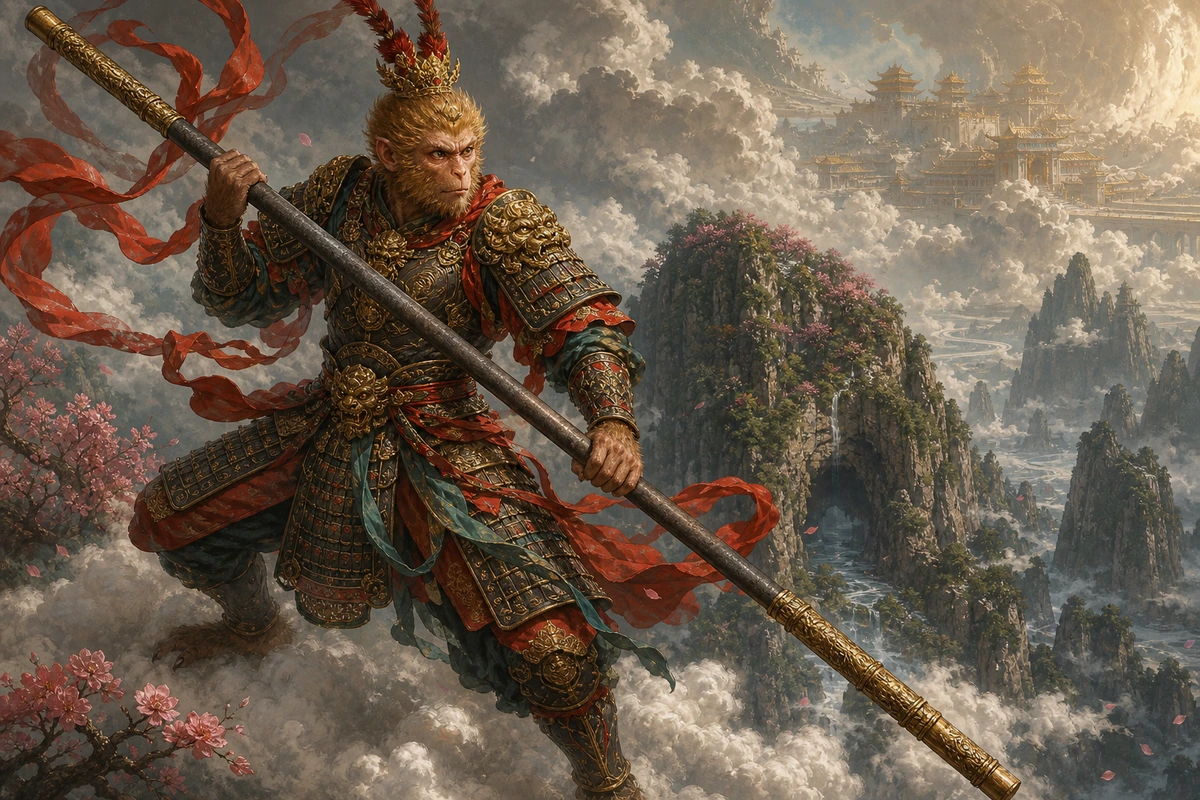
Sun Wukong acquires his signature weapon in the underwater palace of the Dragon King of the Eastern Sea. Ordinary weapons are too light for him. He chooses the iron pillar used to measure or steady the waters: the Ruyi Jingu Bang, the “As-You-Will Gold-Banded Cudgel.”
The staff can shrink to the size of a needle, grow to enormous dimensions, and change according to its owner’s will. Wukong commonly stores it behind his ear. Its immense weight and flexibility match the character who wields it—cosmic in power, impossible to fit within ordinary categories, and always ready to turn a practical object into a weapon.
How many times does Sun Wukong become immortal?
The comic escalation of the early chapters gives him several overlapping protections from death. He learns longevity techniques, erases monkey names from the registers of the underworld, eats the Queen Mother’s peaches of immortality, drinks celestial wine, and consumes Laozi’s alchemical elixir pills.
These episodes should not be forced into one tidy biological system. The repetition is part of the satire: each heavenly institution has its own controlled route to immortality, and the monkey invades all of them. Bureaucratic attempts to contain him repeatedly increase the problem.
Great Sage Equal to Heaven
After Wukong defies the underworld and the Dragon Kings, Heaven tries to manage him with an appointment. He is made keeper of the celestial stables but rebels when he discovers the low status of the job. Back on his mountain he adopts the audacious title Qitian Dasheng, “Great Sage Equal to Heaven.”
The celestial court eventually recognizes the title while giving him little real authority. When he is excluded from the Queen Mother’s peach banquet, he consumes the feast and elixirs, returns to open rebellion, and survives armies, magical weapons, and execution methods.
Laozi’s furnace fails to burn him away. Instead the smoke harms his eyes while leaving him with a fiery, golden gaze capable of detecting many disguises. The power is not perfect: Wukong can still misread situations, and his suspicious certainty regularly creates conflict during the later pilgrimage.
Why does the Buddha imprison him?
Wukong boasts that his cloud-somersault can carry him beyond the Buddha’s reach. The Buddha challenges him to escape the palm of one hand. Wukong travels to what he assumes is the edge of the universe, marks five pillars, and returns—only to learn that the pillars were the Buddha’s fingers.
The Buddha traps him beneath the Five Phases Mountain. Strength and speed cannot defeat a cosmos that Wukong has failed to understand. He remains confined until the pilgrimage gives his abilities a direction beyond self-display.
The pilgrimage with Tang Sanzang
Guanyin recruits protectors for the monk Tang Sanzang, the novel’s fictionalized version of Xuanzang. Wukong is released on the condition that he guard the monk on the westward journey for Buddhist scriptures. Zhu Bajie, Sha Wujing, and the transformed white dragon horse later join them.
Tang Sanzang can tighten a band around Wukong’s head by reciting a spell. The device is painful and coercive, but it also externalizes the discipline Wukong lacks. The two repeatedly clash because the monk values compassion while Wukong sees through monsters’ disguises and wants to strike first.
| Phase | Sun Wukong’s role | Central tension |
|---|---|---|
| Mountain of Flowers and Fruit | Stone-born monkey king seeking freedom from death | Courage becomes fear of mortality |
| Rebellion in Heaven | Great Sage who defeats efforts to classify and control him | Power without restraint becomes disorder |
| Five Phases Mountain | Prisoner defeated by the Buddha’s superior perspective | Speed and cleverness cannot escape ignorance |
| Westward pilgrimage | Protector, disciple, and detector of transformations | Violent effectiveness must coexist with compassion and obedience |
Daoist, Buddhist, and popular elements
Journey to the West freely combines Buddhist pilgrimage, Daoist alchemy, celestial bureaucracy, local cults, poetry, jokes, monsters, and moral argument. It is not a scripture of one institution. Daoist immortals may help or obstruct the travelers; Buddhist figures may be compassionate, terrifying, or administratively remote.
Sun Wukong embodies that mixture. His early training and immortality thefts use Daoist language and alchemical imagery, while his pilgrimage is directed toward Buddhist scriptures. His monkey appetite, theatrical boasting, and practical loyalty also belong to comic and popular storytelling rather than abstract doctrine.
Sun Wukong and the historical Xuanzang
Xuanzang was a real Buddhist monk who traveled from Tang China through Central Asia to India and returned with scriptures. His pilgrimage produced historical records and transformed Chinese Buddhist scholarship. Sun Wukong was not his documented companion.
Centuries of legend turned a demanding religious journey into a cosmic adventure. Tang Sanzang retains the pilgrim’s purpose but becomes a vulnerable master whose safety depends on supernatural disciples. Keeping history and fiction distinct allows both achievements—the real journey and the novel’s imaginative architecture—to remain visible.
Does Sun Wukong become enlightened?
At the journey’s completion, Wukong receives the title “Buddha Victorious in Strife.” The ending confirms a religious transformation, but it does not erase his personality. He succeeds because his disruptive intelligence has been redirected, not because he has become passive.
That arc helps explain his immense afterlife in opera, comics, film, animation, television, and games across Asia and beyond. Adaptations can emphasize rebellion, martial spectacle, comedy, spiritual growth, or resistance to bureaucracy because all of those possibilities already coexist in the novel.
Key takeaways
- Sun Wukong is a literary character in the sixteenth-century form of Journey to the West, not a companion recorded in Xuanzang’s historical travels.
- His powers accumulate through training, theft, magical objects, and repeated encounters with heavenly institutions.
- The Ruyi Jingu Bang changes size and serves as both tool and weapon.
- The Buddha defeats him by revealing the limits of his perspective rather than overpowering him in an ordinary fight.
- The pilgrimage turns rebellious ability toward protection, discipline, and eventual religious attainment.