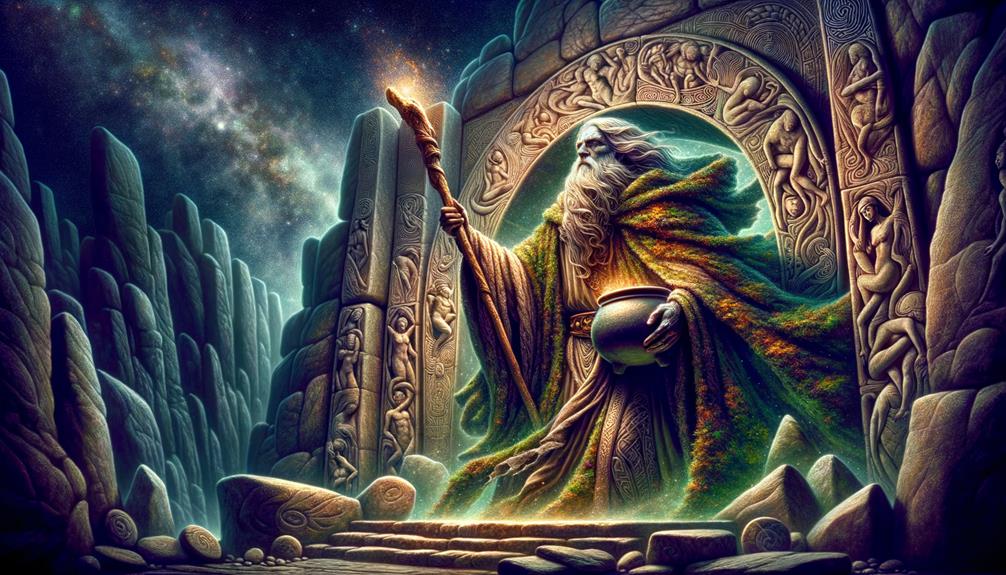
The Dagda is one of the leading figures among the Túatha Dé Danann in medieval Irish literature. He is a ruler, warrior, magician, negotiator, provider, and master of an extraordinary harp. Calling him a “Celtic father god” captures only part of that range and can make him sound like an Irish copy of Zeus. The texts instead present a distinctive figure whose immense authority coexists with hunger, sexuality, physical comedy, and rough appearance.
Most of the evidence comes from manuscripts written by Christian scholars centuries after Ireland’s conversion. These works preserve pre-Christian divine names and inherited narrative, but they are literary compositions rather than direct transcripts of an ancient creed. Details change across sources, so the Dagda has no single standardized family tree or inventory of magical objects.
What does “Dagda” mean?
The name in Dagdae is commonly translated “the good god.” Here “good” means capable or excellent at his arts, not simply morally kind. In Cath Maige Tuired, when Lug asks what skill he will contribute against the Fomoire, the Dagda claims the combined abilities that the other specialists have named. The title expresses mastery.
Other names and epithets include Eochaid Ollathair, often translated “great father,” and Ruad Rofhessa, “lord of great knowledge” or a similar sense. “Great father” supports paternal associations, but it does not establish that he created all gods or ruled an Irish version of a universal pantheon.
The Dagda and the Túatha Dé Danann
The Túatha Dé Danann are the supernatural people who contest Ireland with earlier inhabitants and with the Fomoire. The Dagda is frequently central to their leadership, kinship, and survival. Depending on the text, figures such as Brigid, Óengus, Bodb Derg, Cermait, and Midir are connected with him.
Medieval genealogies do not always agree. It is better to name the relationship in a particular story than to force every character into one modern diagram. The Dagda’s importance lies as much in his functions—abundance, knowledge, time, music, and sovereignty—as in biological descent.
Cauldron, club, and harp
Three objects dominate modern descriptions of the Dagda, although they do not always travel together in the same passage. A cauldron brought from Murias is named among the treasures of the Túatha Dé Danann in Cath Maige Tuired; no company leaves it unsatisfied. It makes abundance and hospitality visible.
His enormous club or staff can require several men to move and leaves a track like a boundary ditch. Later summaries often say one end kills and the other restores life. That life-and-death formula belongs to the wider literary tradition but should not be treated as the only meaning of the object. Its scale alone establishes the Dagda’s excessive, landscape-shaping power.
The harp is named Úaithne and also bears the names Daur Dá Bláo and Cóir Cetharchair in the battle text. Its music remains bound until the Dagda calls it. It orders season and emotion, turning music into a force that regulates both the natural and human worlds.
The Second Battle of Mag Tuired
Cath Maige Tuired tells how the Túatha Dé Danann prepare to overthrow Fomorian domination. Lug questions each specialist about a useful craft. The Dagda promises to perform everything the others have offered, reinforcing his name as the god good at many arts.
Before battle he meets the Morrígan beside a river around Samhain. Their encounter links alliance, sexuality, prophecy, landscape, and warfare. She tells him where the Fomorians will land and promises action against them. Neither figure fits a narrow modern job description.
The Fomoire also attempt to neutralize the Dagda by demanding that he eat a gigantic porridge of milk, meal, fat, goats, sheep, and pigs poured into a pit. He consumes it and scrapes the hollow clean, but his swollen belly and awkward movement make him an object of ridicule. The episode is comic without canceling his power. Medieval Irish narrative can make a god grotesque, hungry, and magnificent at once.
Recovering the magical harp
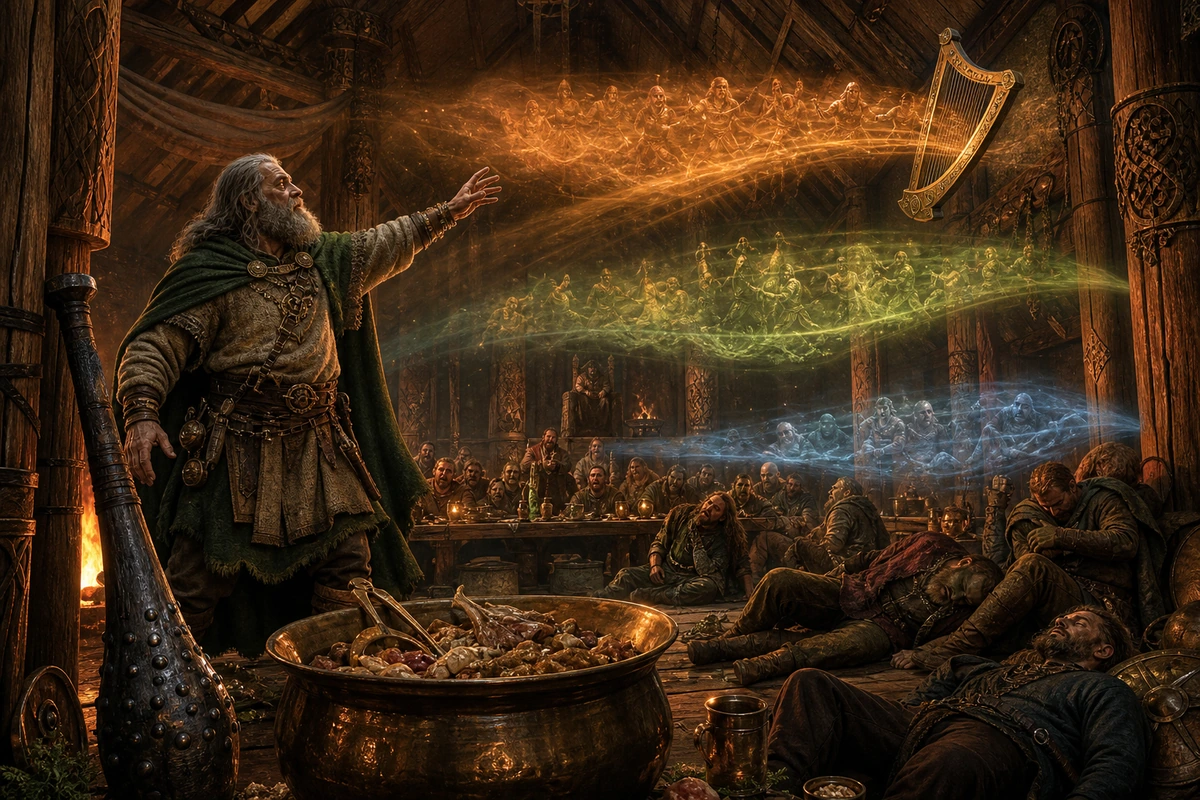
After the battle, the Fomoire carry away the Dagda’s harp. Lug, Ogma, and the Dagda enter the enemy feasting hall to retrieve it. The Dagda summons the instrument from the wall, and it flies to him, killing several men in its path.
He then plays the three strains or modes of music. The sorrow strain makes the listeners weep; the joy strain makes them laugh; and the sleep strain sends them into sleep. The companions escape while the enemy is incapacitated. The scene presents kingship and magical knowledge as the ability to restore proper order, not merely to win by brute force.
| Object or episode | Textual function | Common oversimplification |
|---|---|---|
| Cauldron from Murias | No company leaves it unsatisfied | A single universal “cauldron of plenty” appears identically in every tale |
| Great club or staff | Displays immense physical and landscape-shaping force | It is only a weapon matching another culture’s thunder god |
| Harp Úaithne | Returns when summoned and produces sorrow, joy, and sleep | It is a decorative bardic emblem without narrative agency |
| Porridge ordeal | Combines humiliation, appetite, endurance, and comedy | A powerful god must always appear dignified |
The Dagda, Boann, and Óengus
In the prose tale often called The Wooing of Étaín, the Dagda desires Boann, wife of Elcmar. He sends Elcmar away and manipulates the sun so that the period of his absence seems like a single day. Boann bears Óengus, whose name is explained through the idea that he was conceived and born within one day.
Óengus later gains Brú na Bóinne, the great prehistoric monument now called Newgrange, through clever wording about holding it for “a day and a night.” The narratives connect the Dagda’s family with time, legal speech, land, and the monumental Boyne landscape. They should not be treated as archaeological proof that a specific medieval story was known by Newgrange’s builders thousands of years earlier.
Is the Dagda an all-father?
The epithet Ollathair encouraged comparisons with universal father gods. The Dagda is indeed an important progenitor, and later classifications often make him head of a divine family. But the Irish sources do not consistently position him as sole creator, absolute king, or father of every deity.
Comparison can illuminate broad themes, yet equations such as “the Dagda is the Irish Odin” or “the Celtic Zeus” erase the narrative system around him. His cauldron, harp, appetite, boundary-making club, comic body, and relationships with the Morrígan and Boann belong to Irish texts with their own structures.
Abundance and ordered time
The Dagda’s powers repeatedly turn excess into continuity. The cauldron feeds a company, the harp regulates emotion and seasons, and his knowledge helps the Túatha Dé survive a political crisis. Even his appetite dramatizes the question of whether abundance can be exhausted.
This is why “god of agriculture” is also too narrow. Food, weather, season, kingship, hospitality, and social order overlap in the world of the tales. The Dagda does not preside over a modern department; he embodies the capacity required to sustain a people.
Key takeaways
- “The good god” means a god excellent in many skills, not merely a benevolent deity.
- The Dagda is prominent among the Túatha Dé Danann but is not a simple Irish equivalent of Zeus or Odin.
- His cauldron, club, and harp express abundance, force, knowledge, emotion, and ordered time.
- Cath Maige Tuired deliberately combines divine authority with bodily comedy.
- Medieval texts preserve variable traditions; one fixed family tree or object list cannot cover every account.