Accuracy note: Māori creation traditions are held and told through iwi and hapū, and their genealogies and narrative details are not identical. This article uses well-attested shared themes while preserving that variation.
Papatūānuku is the earth parent in Māori traditions: the generative ground from which forests, birds, waters, foods, people, and other forms of life are related through whakapapa. English summaries often call her an “earth goddess,” but that label is too narrow. Papatūānuku is at once an atua, an ancestor, the living land, and the source of relationships that join human communities to the rest of the world.
Her best-known narrative places her with Ranginui, the sky parent, in the darkness of Te Pō. Their children grow between them until separation opens Te Ao Mārama, the world of light. Yet the story is not simply about nature being divided into earth and sky. It explains why the world is alive with kinship, why rain and mist can express continuing grief, and why land carries obligations rather than functioning only as property.
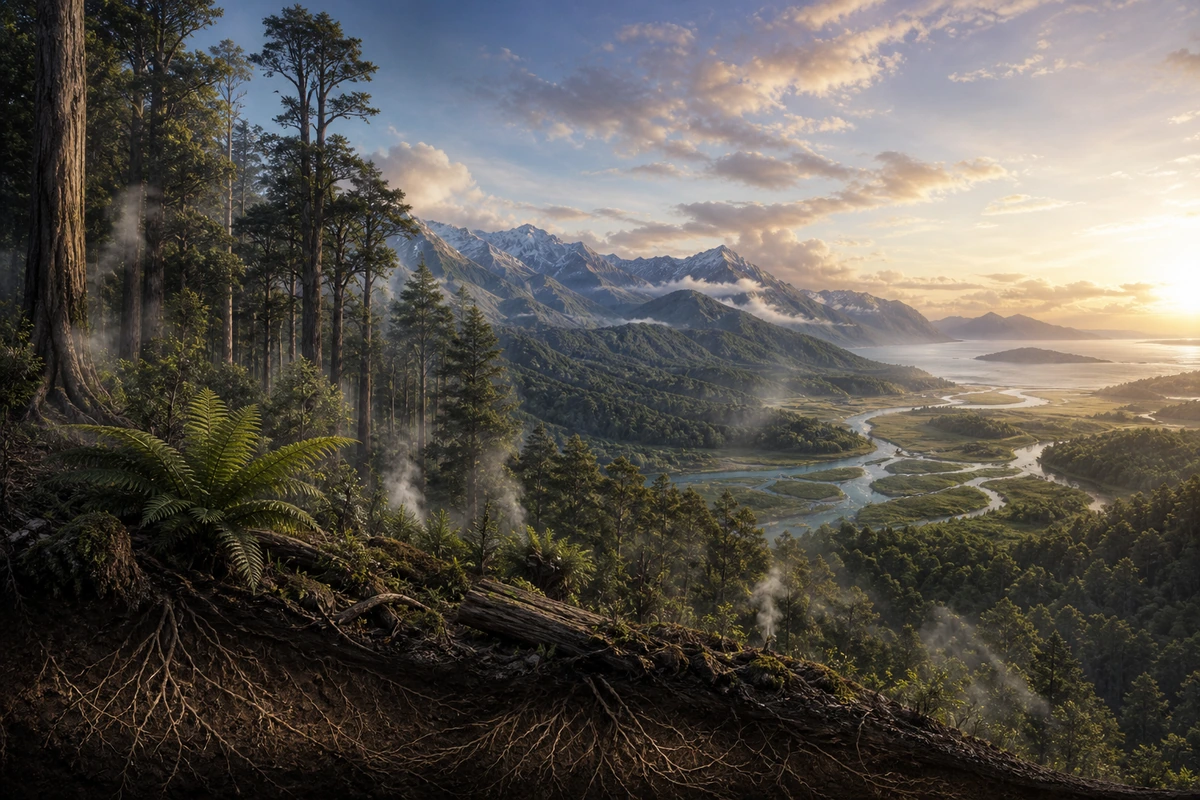
Ranginui, Papatūānuku, and Te Ao Mārama
Many creation accounts move through Te Kore, a realm of potential or absence, and Te Pō, the long night, before reaching Te Ao Mārama. The sequences and names vary, which is why no single chart should be treated as the universal Māori account. In widely known versions, Ranginui and Papatūānuku lie in a close embrace while their children remain confined in darkness.
The children debate what to do. Some propose killing their parents; others favor separation. One after another attempts to force them apart. Tāne finally succeeds by bracing himself against Papatūānuku and pushing Ranginui upward, allowing light and space to enter. Tāwhirimātea, who opposes the separation, follows Ranginui and later attacks his siblings with winds and storms.
Descriptions of rain as Ranginui’s tears and of mist as Papatūānuku’s sighs or breath preserve the parents’ continuing relationship. The separation produces a habitable world, but it also carries sorrow. Creation is therefore not a clean victory of order over chaos. It establishes a world in which growth, conflict, love, and loss remain bound together.
Whakapapa Makes the Natural World Kin
The children and descendants of Rangi and Papa are associated with domains such as forests, winds, seas, cultivated foods, and uncultivated foods. English sometimes calls them “departmental gods,” but the phrase can make them sound like officials in separate offices. Whakapapa expresses something more relational: birds, trees, fish, weather, crops, and people belong within an extended field of descent.
Te Ara’s account of Papatūānuku emphasizes that all life descends through this family and is therefore interconnected. Tāne’s shaping of Hineahuone from earth at Kurawaka deepens the connection between human life and the land. Hineahuone—whose name is commonly explained as “earth-formed woman”—is not merely made from neutral material. Her earth is part of an ancestral and sacred genealogy.
| Māori term or figure | Role in the tradition | Important caution |
|---|---|---|
| Papatūānuku | Earth parent, living land, and generative ancestor | More than a decorative equivalent of “Mother Nature” |
| Ranginui | Sky parent whose separation from Papa opens the world of light | Genealogies and details vary among iwi |
| Te Pō | Night or darkness within creation sequences | Not adequately reduced to Christian-style nothingness |
| Te Ao Mārama | The world of light and understanding | Creation remains an ongoing pattern, not only a past event |
| Whakapapa | Genealogical ordering of relationships among beings | Connects humans with the non-human world rather than isolating “nature” |
| Whenua | Land; also placenta | The double meaning carries lived and ceremonial significance |
Whenua: Land and Placenta
Whenua means land and also placenta. The shared word is often cited because it makes an intimate relationship visible: a person is nourished before birth through the whenua, and communities are nourished across generations by whenua. Practices of returning the placenta to the land can affirm connection to place, ancestry, and future descendants.
This linguistic relationship should not be flattened into a slogan. Land is connected with tūrangawaewae—a place where one has standing—and with histories of occupation, responsibility, loss, and endurance. Papatūānuku is consequently not an abstract planet seen from outside. She is encountered through particular places and genealogical relationships.
Children, Conflict, and the Living Earth
The separation of the parents is followed by conflict among their children. Tāwhirimātea attacks the domains of his siblings. Forests bend, seas rise, and cultivated and wild foods seek shelter. Tūmatauenga, associated with humankind, eventually turns the descendants of several brothers into food and materials. These episodes do not describe a static harmony in which nothing consumes anything else. They explain a living world of reciprocal dependence, danger, adaptation, and obligation.
Rūaumoko, associated with earthquakes and volcanic activity, is described in one tradition as remaining with Papatūānuku when she was turned away from Ranginui. His movements below the surface explain the shaking of the land. That account is one example of how geological, atmospheric, and biological phenomena can be situated within relationships among ancestors.
Papatūānuku in Contemporary Language
Papatūānuku is frequently invoked in environmental education and conservation. The connection is meaningful: traditions about whakapapa, mauri, reciprocity, and care can challenge a view of land as an inert commodity. But respectful use requires more than adding her name to a generic sustainability campaign. Māori concepts belong to living communities with authority over their own mātauranga and places.
It is also misleading to claim that every Māori person interprets Papatūānuku in exactly the same theological way. Contemporary understandings may be devotional, cultural, philosophical, political, educational, or several of these together. Iwi-specific kōrero remain essential, and public summaries should acknowledge the limits of what they can represent.
Why “Earth Goddess” Is Incomplete
“Earth goddess” gives an English-language reader a quick point of entry, but it can import a foreign pantheon model: one goddess assigned to soil, another god assigned to sky, and humans standing outside them. Papatūānuku’s importance lies instead in her position within whakapapa and in the way land, body, birth, ancestry, and responsibility meet through her.
A better short description is “earth parent and ancestral foundation of the living world.” Even that remains a translation. The fullest understanding comes from Māori language, iwi traditions, and the places in which those relationships are maintained.