
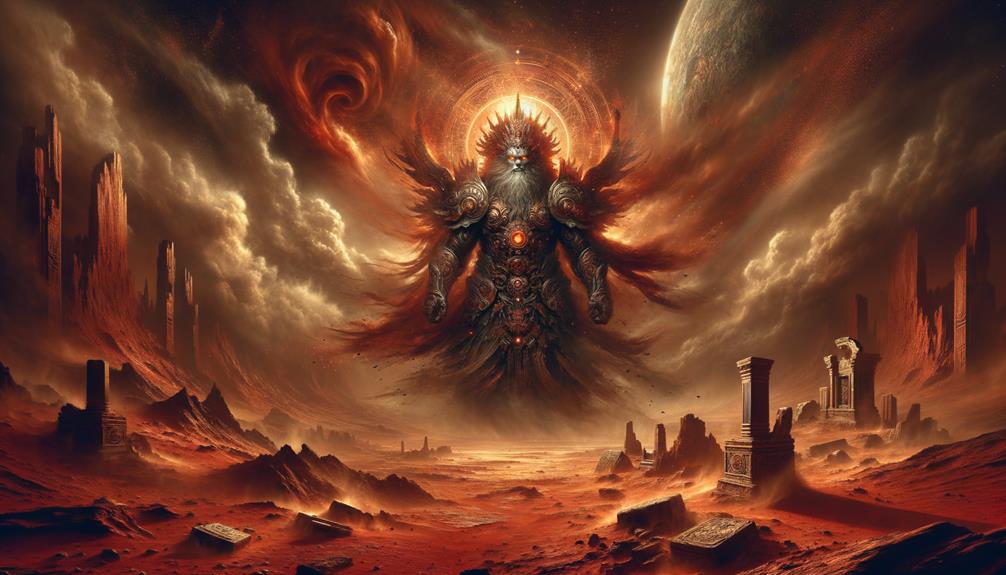
Mars was the Roman god of war, but “the Roman Ares” is not a complete description. He was the divine father of Romulus, a guardian invoked for fields and cattle, the recipient of public priesthoods and sacred weapons, and a focus of Roman claims about ancestry and military power. His cult changed with the Roman state, reaching a new political form when Augustus built the Temple of Mars Ultor—Mars the Avenger.
Who was Mars to the Romans?
Mars belonged to the highest level of Roman public religion. War was central to his identity, but Roman war was not imagined only as uncontrolled violence. It involved the protection of territory, the mustering and return of armies, the authority of commanders, vows, booty, and the safety of the community. Mars could therefore be invoked before a campaign, honored in victory, and approached in rites that purified land and people.
His name survives in March, Latin Martius. In an early Roman calendar, March stood at the beginning of the year, and its rites accompanied the renewal of military and agricultural activity after winter. October ceremonies marked the other end of the old campaigning season. The neat modern formula “spring meant farming and war” is useful only if it does not reduce a dense ritual calendar to an economic schedule.
Mars, Rhea Silvia, and the ancestry of Rome
In the foundation legend, Mars fathers the twins Romulus and Remus with the Vestal Rhea Silvia. The twins survive exposure, are suckled by a she-wolf, overthrow the usurper Amulius, and set out to found a city. Romulus kills Remus in the conflict surrounding Rome’s foundation and becomes its first king. By claiming Mars as the father of its founder, Rome places military power inside its family tree.
The wolf is connected most directly to the twins’ rescue and the city’s foundation story; it is not simply Mars’s pet in every source. The woodpecker also assists or feeds the infants in some Roman accounts and is elsewhere treated as sacred to Mars. These animals link wild landscape, survival, augury, and Roman origins without forming one uniform myth.
How was Mars born?
Genealogies commonly present Mars as the son of Jupiter and Juno, paralleling the Greek Ares as the child of Zeus and Hera. Ovid’s Fasti preserves a playful alternative in book 5. Juno, angered that Jupiter produced Minerva without a mother, seeks a way to conceive without him. Flora touches her with a miraculous flower, and Juno bears Mars.
This story should be identified as Ovid’s poetic version, not treated as the single ancient Roman creed. Ovid builds an elegant explanation connecting Flora, flowers, Juno, and Mars within a poem about the calendar. Readers can consult the episode in Ovid’s Fasti, book 5.
Mars and Ares: similar gods, different religious settings
| Aspect | Mars in Roman tradition | Ares in Greek tradition |
|---|---|---|
| Shared field | War, weapons, battle power | War, weapons, battle power |
| Place in civic identity | Father of Rome’s founder and major state god | An Olympian active in epic and cult, without one equivalent claim to father the Greek world |
| Ritual evidence | Salii, ancilia, sacred spears, seasonal festivals, military vows | Distinct local sanctuaries and cults across Greek communities |
| Literary character | Can embody Roman ancestry, vengeance, protection, and imperial authority | Often shown in epic as violent and vulnerable, though local worship was broader than literary caricature |
| Key caution | Not automatically “noble and strategic” in every context | Not merely a despised god of mindless bloodlust |
Romans identified Greek and Roman gods with one another, and Roman poets freely used Greek mythology. The comparison is therefore real, not an error. The error is turning it into a moral cartoon in which Romans admired organized war while Greeks disliked chaotic war. Ares had cult, cities, epithets, and protective roles; Mars could represent lethal conquest as well as defense. Their different prominence reflects different bodies of poetry, ritual, and civic history.
The Salii and the sacred shields
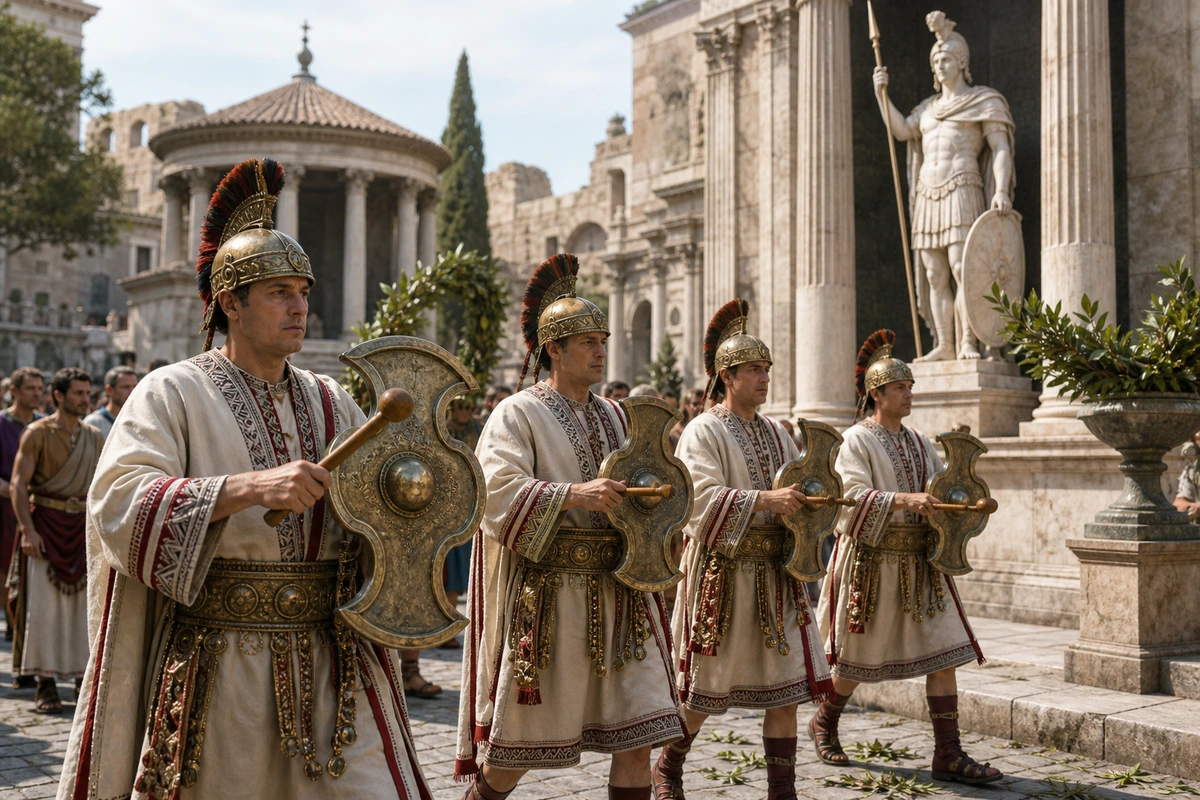
The Salii were a priestly college associated with Mars. Roman tradition credited King Numa with establishing them. In March they wore archaic military dress, carried the sacred shields called ancilia, moved through the city in a leaping dance, struck the shields, and sang an old hymn whose language later Romans found difficult.
One ancile was said to have fallen from heaven during a plague. Numa ordered eleven copies so that no thief could identify the divine original. Plutarch describes the story, the curved shape of the shields, and the priests’ movements in his Life of Numa, chapter 13. The story is legendary, but the Salii and their shields were real components of Roman public religion.
Mars also had sacred spears kept in the Regia, the old royal building in the Forum. Before military action, a commander was said to move them and call on Mars to awaken. Here the god’s presence was attached not only to a statue with a human body, but to weapons maintained in a charged ritual space.
Was Mars also an agricultural god?
Ancient evidence does connect Mars with rural protection. Cato’s On Agriculture includes an offering to “Mars Silvanus” for the health of cattle and a prayer to Mars during the purification of fields. The prayer asks him to keep disease, barrenness, and damage away and to allow crops, vines, herds, and people to flourish.
Scholars have disagreed about what this proves. It is too simple to declare that Mars was originally a peaceful vegetation god who only later became warlike. Protecting land, boundaries, herds, and the people able to defend them can belong to the same sphere in an early agrarian community. The sources support a rural protective function; they do not require one linear evolution from farming to war.
Major forms and epithets of Mars
- Mars Pater: “Father Mars,” a reverential address that emphasizes his ancestral and protective standing.
- Mars Gradivus: a major martial form, traditionally understood as Mars who strides or marches into battle.
- Mars Ultor: “Mars the Avenger,” promoted by Augustus in connection with vengeance for Julius Caesar and the recovery of captured Roman standards.
- Mars Silvanus: the combined address found in Cato’s rite for the health of cattle; its exact theological relationship remains debated.
Epithets identify a god in a particular function, place, or ritual relationship. They are not necessarily separate “versions” with fixed, game-like power sets. The same worshiper could encounter Mars through family ancestry, the civic calendar, a battlefield vow, or the protection of rural property.
Mars Ultor and the age of Augustus
Octavian vowed a temple to Mars Ultor before the Battle of Philippi, where he and Mark Antony fought the assassins of Julius Caesar. As Augustus, he eventually dedicated the monumental temple in his new forum in 2 BCE. Its meaning expanded beyond private vengeance. The sanctuary received recovered military standards, framed Roman commanders within a gallery of exemplary ancestors, and served state occasions connected with military authority.
Augustus himself records the project in the Res Gestae, stating that he built the temple and forum from war booty. The cult shows how an old god could be reorganized within a new political system. Mars the father of Romulus now also supported the self-presentation of Rome’s first emperor.
Symbols and images of Mars
Roman art commonly gives Mars a helmet, spear, shield, cuirass, and military cloak. He may appear youthful and nude or mature and heavily armored depending on date and purpose. The monumental type of Mars Ultor presents a disciplined, authoritative warrior suited to Augustan state ideology. A Metropolitan Museum of Art guide to Roman art discusses both the Mars Ultor sculptural type and the god’s sacred spears in the Regia.
Modern images often confuse the god with the red planet, use fantasy armor, or turn him into a generic legionary. Ancient viewers instead recognized combinations of attributes, inscriptions, setting, and context. A spear-bearing warrior beside Venus, Romulus, or an imperial monument communicated something different from an isolated fighter.
What Mars reveals about Roman religion
Mars demonstrates why Roman gods should not be reduced to one-sentence job descriptions. His meaning came from relationships: with Rhea Silvia and Romulus, Jupiter and Juno, the Salii and their ancilia, commanders and vows, farmers and purification, Augustus and recovered standards. Myth, ritual, art, and politics continually interpreted one another.
He was unquestionably a god of war. Yet Roman worship made war part of ancestry, seasonal order, territorial protection, and the power of the state. Understanding those connections explains both Mars’s exceptional rank at Rome and why a simple copy-and-paste comparison with Ares misses so much.