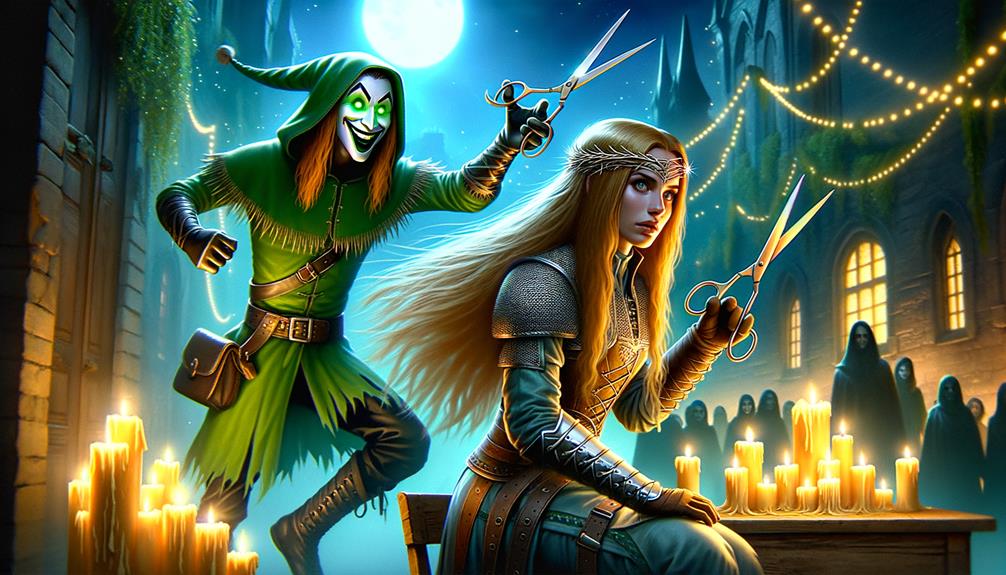
Accuracy note: Snorri’s Skáldskaparmál says that Loki cuts off all of Sif’s hair, but it gives no motive and does not narrate the act itself in detail. Popular explanations involving jealousy, romance, or a symbolic wheat harvest are later interpretations, not statements in the surviving episode.
Loki’s attack on Sif begins one of Norse mythology’s best-known craft stories. Thor forces him to seek a repair; the sons of Ívaldi forge living golden hair; and Loki’s subsequent wager brings five more treasures into the gods’ possession. Yet Sif is often reduced to a plot device in retellings. A close account should say what the text actually gives her—and what it leaves unsaid.
What happens in Skáldskaparmál?
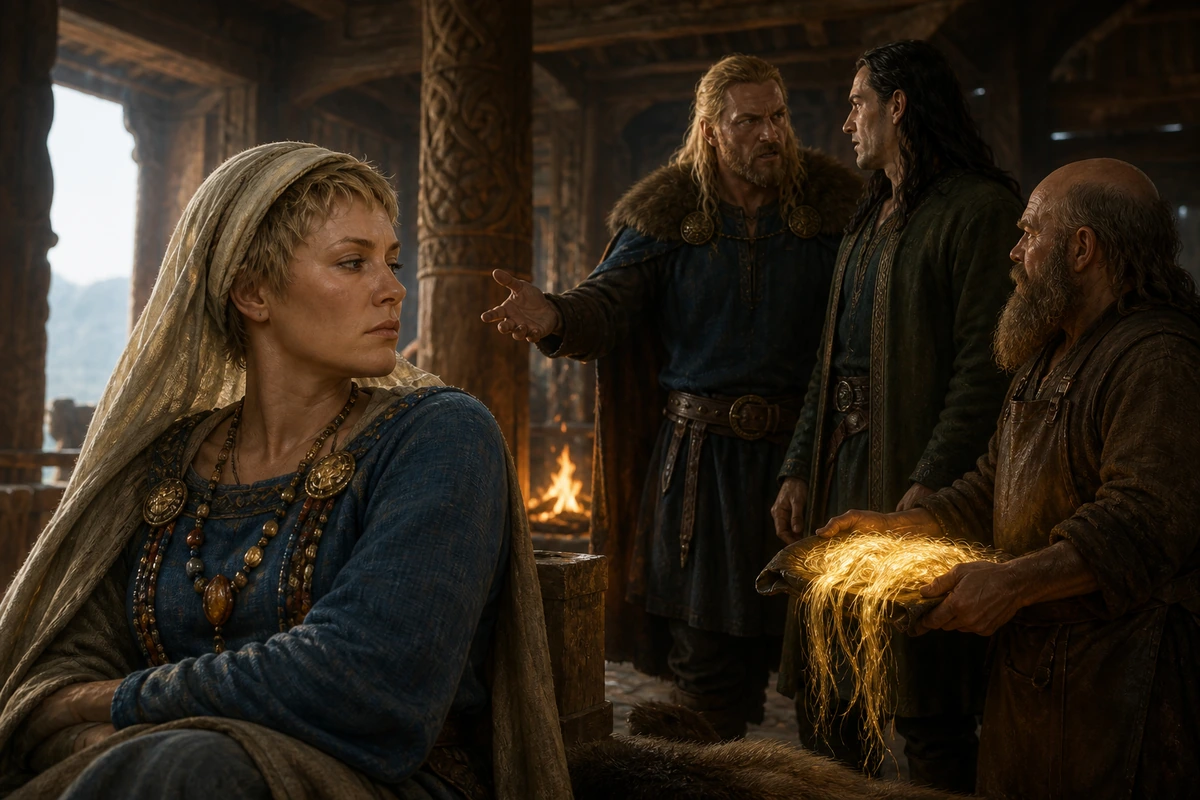
Snorri introduces the story while explaining poetic language for gold. Loki Laufeyjarson has cut off all Sif’s hair. Thor seizes him and threatens to break every bone in his body. Loki swears that he will persuade the dark elves or dwarfs to make hair of gold that will grow like other hair.
The prose moves quickly from the offense to the repair. It does not show Sif asleep, name the tool, describe Loki’s emotional state, or record a conversation between Loki and Sif. Those familiar details come from modern expansion.
Who is Sif in the medieval sources?
Sif is Thor’s wife and a goddess named in both poetic and prose material. Snorri calls her the mother of Ullr, making Thor Ullr’s stepfather, but does not identify Ullr’s biological father. Lokasenna gives Sif a speaking role when she approaches Loki with mead and asserts her own blameless conduct; Loki answers with an accusation. The exchange is hostile flyting, not neutral biography.
Surviving texts provide much less narrative about Sif than about Thor, Odin, or Loki. That scarcity makes it especially important not to present later novels, comics, or reconstructed symbolism as if they filled a missing medieval chapter.
The golden replacement
Loki goes to the sons of Ívaldi. They make strands of gold that will take root and grow on Sif’s head once placed there. They also forge Odin’s spear Gungnir and Freyr’s ship Skíðblaðnir. Loki then provokes a second group of smiths into a contest that produces Gullinbursti, Draupnir, and Mjölnir.
Sif’s new hair is therefore both restitution and the first object in a larger display of dwarven skill. Calling it a wig understates the supernatural property Snorri emphasizes: it becomes attached and grows like living hair.
What is explicit, and what is interpretation?
| Statement | Status | Reason |
|---|---|---|
| Loki cuts off all Sif’s hair | Explicit in Skáldskaparmál | The episode begins with this fact |
| Thor threatens Loki | Explicit | His threat forces the promise of repair |
| The replacement is gold and grows | Explicit | This is the hair’s defining magical property |
| Loki acts because he desires Sif | Unsupported | The source gives no motive |
| Sif’s hair certainly symbolizes ripe wheat | Speculative | Agricultural comparison is later and not explained by the text |
| Sif happily accepts the replacement | Unstated | No reaction from Sif is narrated in the prose episode |
Hair, harm, and restitution
Hair could carry social and aesthetic importance in medieval societies, but the text does not provide a legal commentary or explain how an Icelandic audience ranked this particular harm. It is reasonable to observe that the cutting changes Sif’s body without consent and provokes an immediate demand for redress. It is less responsible to invent a precise historical penalty and attach it to the myth without evidence.
The repair also raises an uncomfortable question: the story focuses on producing a wondrous substitute rather than on Sif’s voice. A modern retelling can restore her perspective, but should label that work as creative adaptation rather than recovered source material.
Is Sif an earth or grain goddess?
Sif’s golden hair has often been compared with ripe grain, and Thor’s weather associations have encouraged reconstructions of a paired sky-and-earth or storm-and-field symbolism. Such interpretations may be suggestive, but no surviving Norse text says, “Sif is the grain” or explains the haircut as a harvest myth.
The name Sif is related to a word for affinity or relationship, which may invite additional readings about kinship. Etymology can illuminate possibilities; it cannot replace missing narrative evidence.
How the episode changes the divine world
Thor’s demand successfully restores what Loki damaged, but Loki’s competitive boasting multiplies the result. Odin gains Gungnir and Draupnir. Freyr gains Skíðblaðnir and Gullinbursti. Thor gains Mjölnir, even though the fly’s interference leaves it with a short handle.
The gods judge the hammer the finest gift because it can defend them from hostile jötnar. In this way, an offense against Sif becomes the narrative cause of objects that shape divine warfare, travel, wealth, and kingship. That causal role should not erase the person harmed at the beginning.
Sources and connected stories
- Skáldskaparmál: “Loke’s Wager with the Dwarfs”, public-domain translation
- Project Gutenberg, The Younger Edda: full translation and glossary
- Lokasenna: Sif’s exchange with Loki
- Mythology Vault: the full contest and its six treasures