
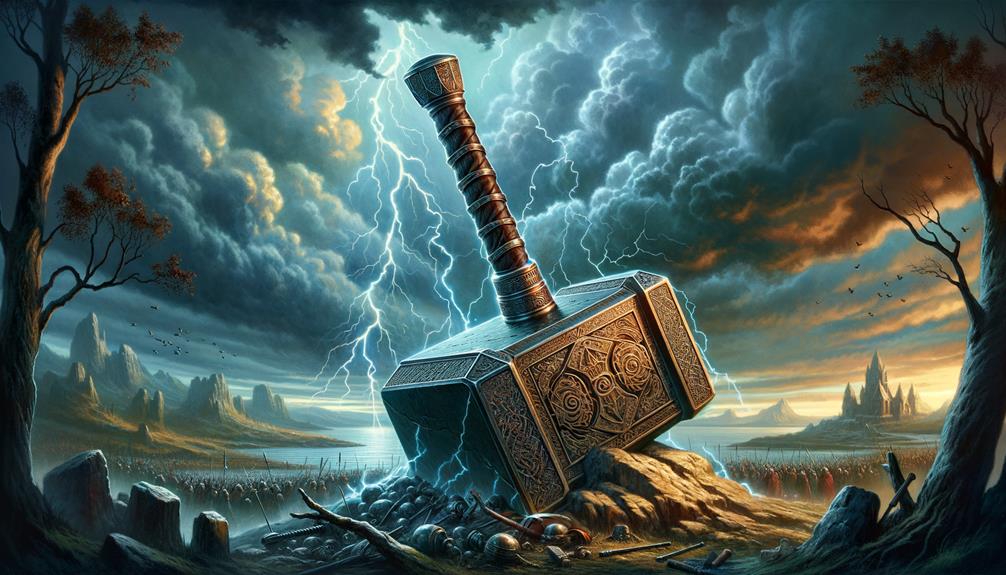
Thor’s stolen-hammer story survives most clearly in Þrymskviða, “The Lay of Thrym,” a compact Old Norse poem preserved in the Codex Regius manuscript of the Poetic Edda. The manuscript was written in Iceland during the late thirteenth century, although the poem may draw on older oral traditions. Its exact date of composition remains disputed, so it is safest to describe Þrymskviða as a medieval record of a story with earlier roots—not as a word-for-word survival from the Viking Age.
Mjölnir Disappears
The poem begins with Thor waking to discover that Mjölnir is missing. He shakes his beard and searches for the weapon before telling Loki that the gods face news known nowhere else in heaven or on earth: the hammer has been stolen. The poem never explains how the theft was accomplished. Instead, Loki borrows Freyja’s feather-cloak and flies to Jötunheim, the realm of the jötnar, to investigate.
There Loki meets Þrymr, usually anglicized as Thrym. The jötunn readily admits that he has hidden Thor’s hammer deep beneath the earth—at a distance that English translations often render as eight leagues. He will return it only if Freyja is brought to him as his bride. The demand is not a sincere courtship. It is extortion aimed at depriving the gods of their defender while forcing one of their most prominent goddesses into marriage.
Freyja Refuses Thrym’s Demand
When Thor and Loki ask Freyja to dress as a bride and accompany them, she refuses furiously. The hall of the gods shakes, and the poem says that her celebrated necklace, Brísingamen, breaks from the force of her anger. This detail matters: Freyja never consents to Thrym’s bargain, despite retellings that loosely describe the episode as “Freyja’s wedding.”
The gods and goddesses gather in council. Heimdall proposes an alternative: Thor should wear a bridal veil, a woman’s dress, keys at his side, jewelry on his chest, and Brísingamen around his neck. Thor initially protests that the disguise will expose him to severe ridicule. Loki answers that without Mjölnir, the jötnar may soon threaten Ásgarðr itself. Thor reluctantly accepts, while Loki dresses as his attendant.
The Strange Wedding Feast
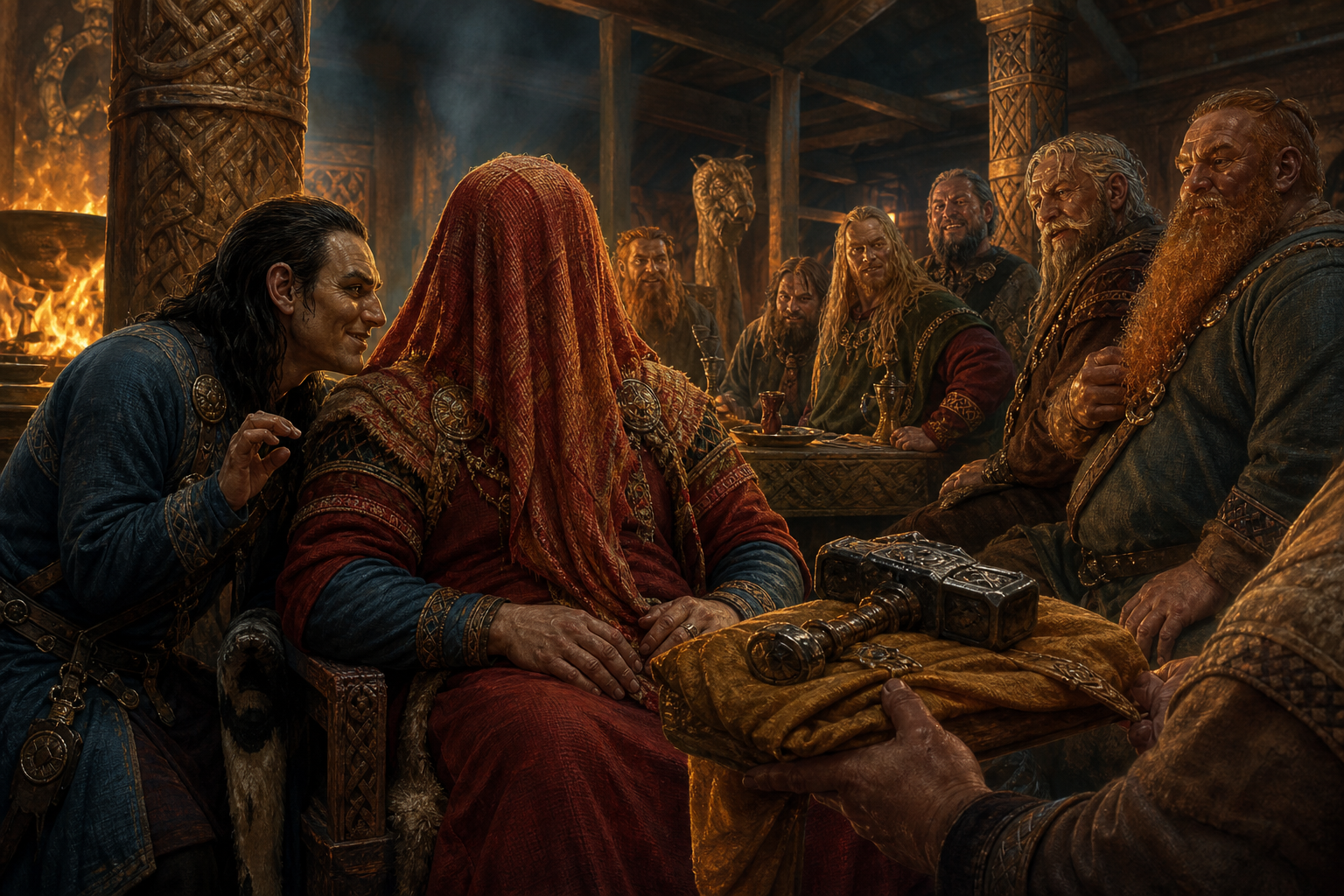
Thor and Loki travel to Jötunheim in Thor’s goat-drawn chariot, with the poem describing mountains breaking and the earth blazing beneath their journey. Thrym welcomes the supposed bride and orders a feast. The disguise nearly fails when Thor eats an entire ox, eight salmon, and other food before drinking three vessels of mead. Astonished, Thrym says he has never seen a bride consume so much.
Loki saves the deception with a quick explanation: “Freyja” has eaten nothing for eight nights because of her longing to reach Jötunheim. Thrym then tries to look beneath the veil but recoils from the bride’s fierce, burning eyes. Loki improvises again, claiming that Freyja has not slept for eight nights because she was so eager for the marriage.
Thor Recovers the Hammer
At the decisive moment, Thrym orders Mjölnir brought into the hall and placed in the bride’s lap to hallow the union. Thor’s heart laughs when he sees his weapon. He grips the hammer, strikes Thrym, and turns it against the assembled jötnar. The wedding deception ends not in marriage but in the recovery of the divine weapon and the destruction of the threat to Ásgarðr.
The scene in which Mjölnir is used to consecrate the proposed marriage suggests that the hammer could carry ceremonial as well as destructive meaning within the poem. Archaeological finds offer useful context: Viking Age hammer-shaped pendants occur in graves, hoards, and settlements, and the Swedish History Museum connects them with Thor and Norse religious practice. Their exact functions remain uncertain, however. Neither the poem nor the artifacts prove that every Norse wedding involved a hammer ritual.
Why the Tale Remains Memorable
Þrymskviða combines serious danger with deliberate comedy. Thor’s strength cannot solve the crisis until Heimdall devises the disguise and Loki controls the conversation. The feast exaggerates Thor’s appetite, while Thrym repeatedly accepts Loki’s implausible excuses. Scholars have consequently read the poem as more than a simple adventure: it plays with social expectations, gendered clothing, status, speech, and the temporary collapse of normal boundaries.
Later Icelandic poems and Scandinavian ballads retold the theft in different forms. Those versions show that the story remained popular, but their differences also caution against treating any modern reconstruction as a single, universal Norse myth.