
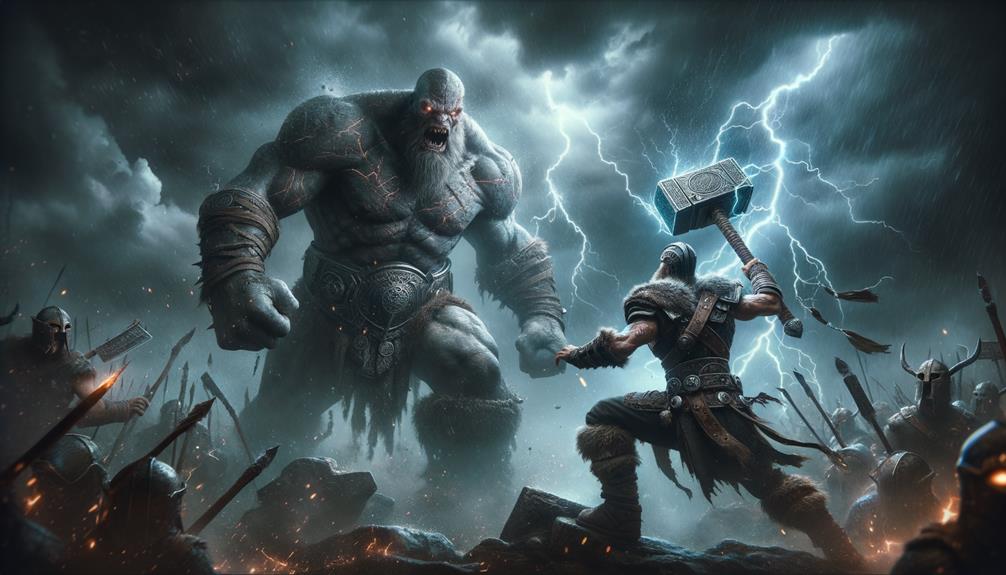
Thor’s encounters with giants are not one continuous campaign. They survive across Eddic poems, early skaldic verse, Snorri’s prose, and later saga material. Some are violent victories; others expose Thor to illusion, humiliation, or forces too large to defeat permanently. Together they define him as a defender of gods and humans without making him an invulnerable modern superhero.
Source note: “Giant” translates several Old Norse words imperfectly. The jötnar are a diverse mythic population: enemies, marriage partners, ancestors, hosts, wisdom figures, and rivals—not one species in a single army.
Hrungnir and the stone weapon
Snorri’s Skáldskaparmál gives a connected account of Hrungnir, while older skaldic kennings show that the fight was already well known. After a reckless ride into Asgard and a feast among the gods, Hrungnir agrees to meet Thor in formal combat. The giant has a stone head and heart and carries a whetstone; his companion Mökkurkálfi is made of clay.
Thor’s hammer and Hrungnir’s whetstone collide in the air. Mjölnir shatters the stone, but a fragment lodges in Thor’s head before the hammer kills Hrungnir. The victory leaves a permanent reminder of danger. A later healing attempt by the seeress Gróa fails when Thor distracts her with news about her husband Aurvandill.
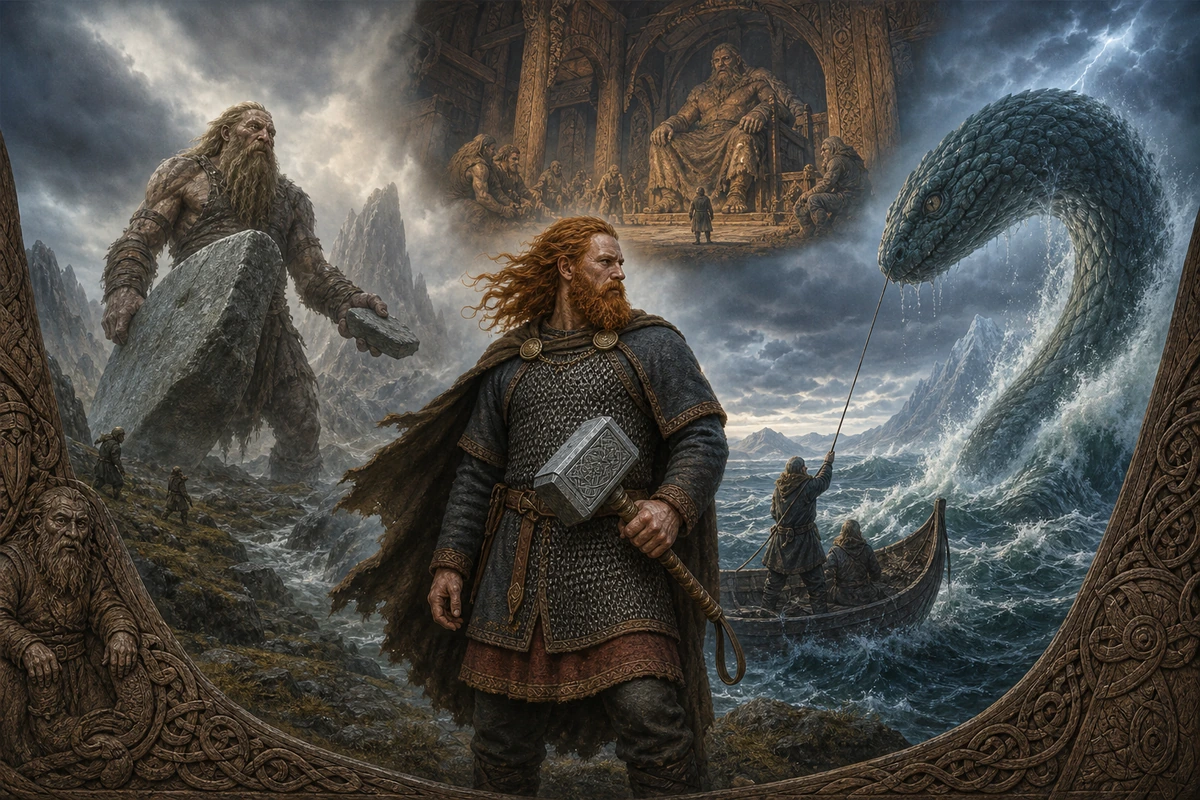
Geirröðr: Thor without Mjölnir
In the Geirröðr story, Loki is captured and promises to bring Thor to the giant without his hammer or usual power-belt. On the journey, the giantess Gríðr warns Thor and lends him a staff, iron gloves, and a belt of strength. These gifts let him cross a dangerous river and survive Geirröðr’s hall.
Geirröðr throws a glowing iron object at Thor. Thor catches it with the gloves and hurls it back through a pillar and into the giant. The episode complicates the image of solitary masculine strength: Thor succeeds because a giantess recognizes the trap and equips him. The hostile and helpful jötnar belong to the same broad mythic world.
Fishing for Jörmungandr
Hymiskviða, skaldic poetry, and Snorri all preserve versions of Thor’s fishing expedition. Thor rows with the giant Hymir, uses the head of an ox as bait, and hooks the world serpent Jörmungandr. The serpent rises from the sea while Thor braces with such force that his feet can break through the boat.
The ending varies. In Snorri, Hymir cuts the line and the serpent sinks before Thor kills it; some poetic and visual evidence has been read differently. The cosmic opponent is reserved for Ragnarök, when Thor will kill Jörmungandr but walk only nine steps before dying from its venom. A careful retelling distinguishes the fishing encounter from the final battle.
Útgarða-Loki and impossible tests
At Útgarða-Loki’s hall, contests expose limits through deception. Thor cannot empty a drinking horn because its far end opens into the sea, cannot lift a cat because the “cat” is Jörmungandr encircling the world, and cannot defeat an old woman because she is Old Age. His companions face similarly disguised challenges involving thought, wildfire, and illusion.
Thor appears to fail, yet the ruler later admits terror: Thor drank enough to lower the sea, raised the world serpent toward the sky, and nearly overcame age itself. The story honors him by measuring his effort against cosmic realities. Strength remains magnificent, but perception and knowledge determine what strength can accomplish.
| Episode | Principal evidence | Challenge | Result |
|---|---|---|---|
| Hrungnir | Skaldic allusions and Skáldskaparmál | Stone-headed champion with a whetstone | Thor wins but carries a fragment in his head |
| Geirröðr | Skaldic poem and Snorri’s prose | Journey without Mjölnir | Gríðr’s gifts make survival possible |
| Jörmungandr | Hymiskviða, skaldic verse, art, Snorri | World serpent hooked at sea | Versions differ; the final killing awaits Ragnarök |
| Útgarða-Loki | Gylfaginning | Cosmic forces disguised as ordinary contests | Apparent failures reveal astonishing strength |
What the giant stories mean
Thor protects the inhabited world against beings who threaten its boundaries, but the same stories refuse a simple good-versus-evil map. His mother Jörð is herself associated with giant ancestry; gods marry giant women; and giantesses such as Gríðr assist divine purposes. “Order” and “outside” are relational categories, not biological races.
The episodes also test different virtues. Hrungnir tests courage and force, Geirröðr tests readiness to accept aid, the fishing story scales physical strength against the world’s boundary, and Útgarða-Loki tests perception. Thor’s greatness lies not in winning every contest, but in confronting dangers whose true scale often exceeds what anyone first sees.