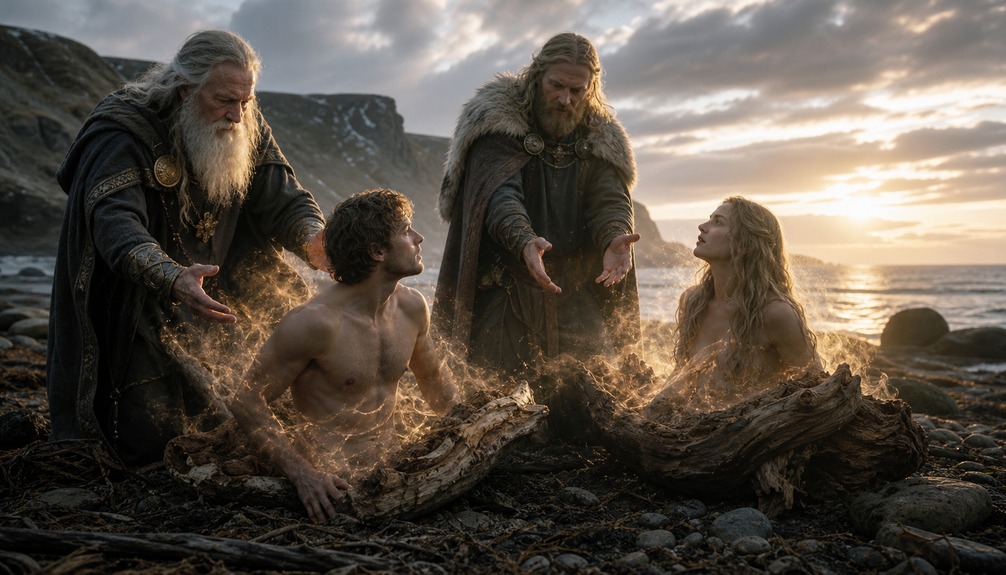
Ask and Embla are the first human pair in the principal surviving Old Norse creation accounts. They are not created by dwarfs. Völuspá names Óðinn, Hœnir, and Lóðurr as the divine figures who find and animate them, while Snorri Sturluson’s Gylfaginning credits three sons of Borr. The two accounts overlap, but their names and gifts are not identical.
Accuracy note: Dwarfs appear nearby in Old Norse creation narratives, which may explain the modern mix-up, but no principal source makes them the makers of Ask and Embla.
The scene in Völuspá
In Völuspá, three gods come upon Ask and Embla on the land. The pair lack the qualities that make a human life: breath or spirit, inspired consciousness, warmth, color, voice, and appearance. Óðinn, Hœnir, and Lóðurr provide these gifts. The poem is compact, and several of its key Old Norse words carry more than one possible sense, so reputable translations differ in the exact allocation.
That uncertainty should be preserved. Önd can be rendered breath or spirit; óðr can suggest mind, inspiration, or animating consciousness; and the gifts associated with Lóðurr have prompted translations involving blood, warmth, color, or good appearance. The passage describes human life as a combination of bodily animation, perception, and social presence rather than one god simply sculpting finished people.
Snorri’s sons of Borr
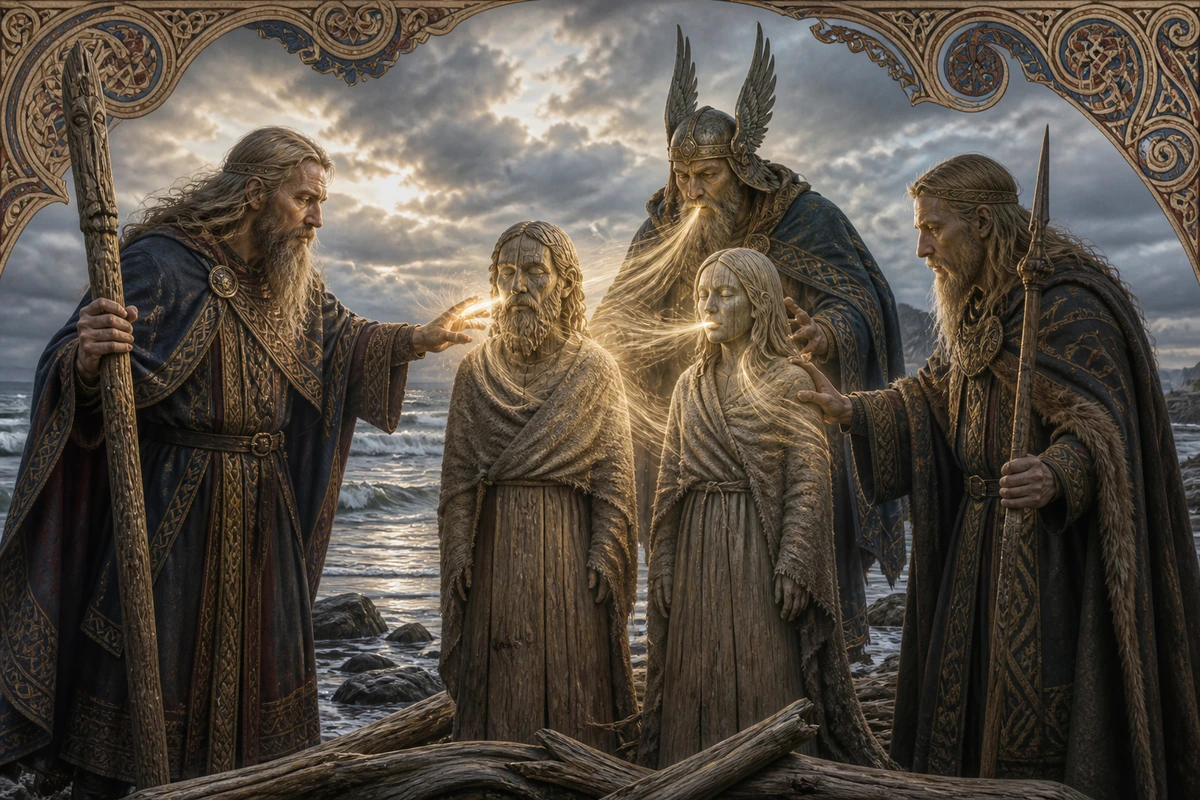
Gylfaginning tells a related prose story. The sons of Borr walk along the seashore, find two pieces of wood, and shape people from them. One gives breath and life, another understanding and movement, and the third speech, hearing, sight, and outward form. They name the man Askr and the woman Embla, provide clothing, and give them Midgard as a home.
In the standard expanded text, Snorri identifies the brothers with Óðinn, Vili, and Vé elsewhere in the creation sequence. The Uppsala manuscript preserves a shorter wording and does not distribute every detail in exactly the same way. This is a useful reminder that “Snorri’s Edda” survives in manuscripts with real variation rather than as one modern printed page handed down unchanged.
Were they literally trees?
Askr is the ordinary Old Norse word for ash tree, making the association strong. Embla’s name is harder to explain. Elm, vine, creeper, and other plant etymologies have been proposed, but none is certain enough to state as fact. Translations therefore range from two tree trunks to two pieces of wood or two lifeless forms.
The source does not describe a modern biological origin story. It uses wood, divine gifts, clothing, and the ordered space of Midgard to explain what makes humans human. The pair become ancestors not merely because they breathe but because they receive sense, movement, expression, and a place within the inhabited world.
| Source | Creators | What they find | Main gifts |
|---|---|---|---|
| Völuspá | Óðinn, Hœnir, Lóðurr | Ask and Embla lacking vital qualities | Breath or spirit, mind or inspiration, warmth/color, appearance |
| Gylfaginning | Sons of Borr, conventionally Óðinn, Vili, Vé | Two pieces or trunks of wood on the shore | Life, understanding, movement, speech, hearing, sight, form |
| Dwarf passages | Dwarfs arise or are listed separately | Ymir’s body and the created cosmos | No creation of Ask and Embla |
Where the dwarfs belong
Völuspá includes the famous catalogue of dwarf names in its creation sequence. Snorri also explains that dwarfs first quickened in Ymir’s flesh and were then given intelligence and human-like form. Because modern summaries often combine adjacent creation passages, the makers of treasures and skilled bodies can be mistakenly transferred into the Ask and Embla episode.
The distinction matters beyond trivia. Dwarfs are extraordinary craftspeople in many Norse stories, but the first humans receive life through a divine encounter. Correct attribution also keeps Hœnir and the enigmatic Lóðurr visible; both would disappear if the episode were reduced to “dwarfs carved the first people.”
Creation, capacity, and community
The story divides personhood among several gifts and several givers. Breath alone is insufficient, as are form, intelligence, and the senses by themselves. Human existence is assembled from capacities that allow people to move, perceive, speak, appear to one another, and inhabit Midgard. The collaborative pattern resembles other Old Norse creation scenes in which no single power acts entirely alone.
Ask and Embla are often compared with other first couples, but parallels should not erase their specific setting: a shore, pieces of wood, three gods, and a newly ordered world. Their myth is most accurately read on its own terms, with its poetic ambiguities intact.
Sources and further reading
- Völuspá, Henry Adams Bellows translation
- Viking Society for Northern Research, The Uppsala Edda
- Viking Society edition of Snorri’s Prologue and Gylfaginning