
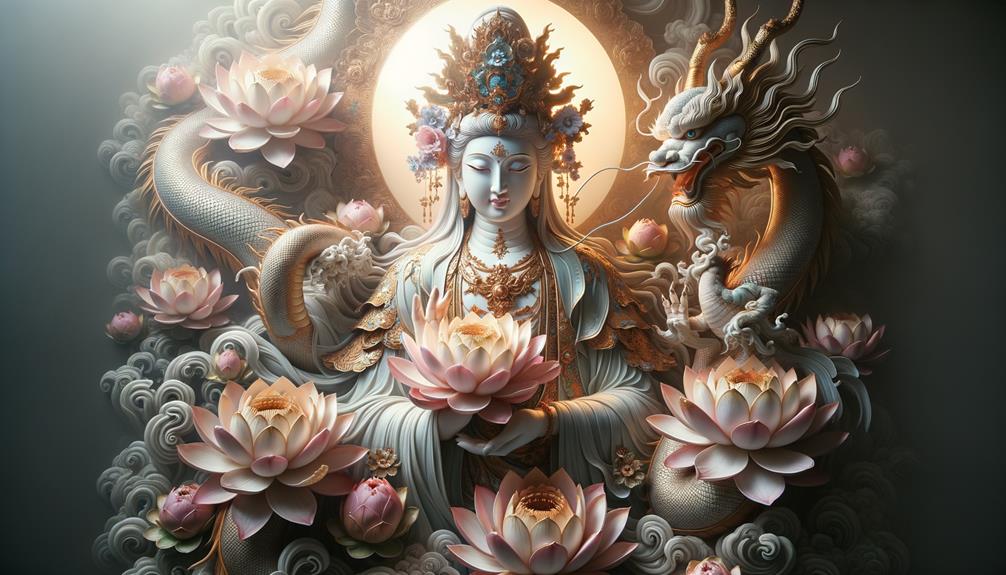
Guanyin (觀音) is the Chinese form of Avalokiteshvara, the bodhisattva of compassion in Mahayana Buddhism. The name is commonly understood as “Perceiver of Sounds” and evokes the ability to hear the cries of suffering beings. Calling Guanyin simply a Chinese goddess obscures that Buddhist history—and the remarkable transformation through which a bodhisattva often depicted as male or gender-fluid in India came to be widely represented in feminine form in China.
The bodhisattva who hears suffering
A bodhisattva seeks awakening while remaining available to help other beings. The “Universal Gateway” chapter of the Lotus Sutra describes Avalokiteshvara responding to those who call the bodhisattva’s name amid dangers and taking different forms suited to the person in need. This ability to manifest appropriately helps explain the extraordinary range of Guanyin images.
Devotees appeal to Guanyin for relief from fear and suffering, safe travel, healing, fertility, children, and protection at sea. These practices vary across temples, Buddhist schools, regions, and historical periods. They should not be collapsed into one list of guaranteed interventions.
From Avalokiteshvara to feminine Guanyin
Early Chinese images often retain masculine or androgynous forms familiar from Indian and Central Asian Buddhist art. Over the imperial centuries, feminine representations became increasingly common and eventually dominant in much of Chinese popular devotion. The change was gradual rather than a single official conversion from “male god” to “female goddess.”
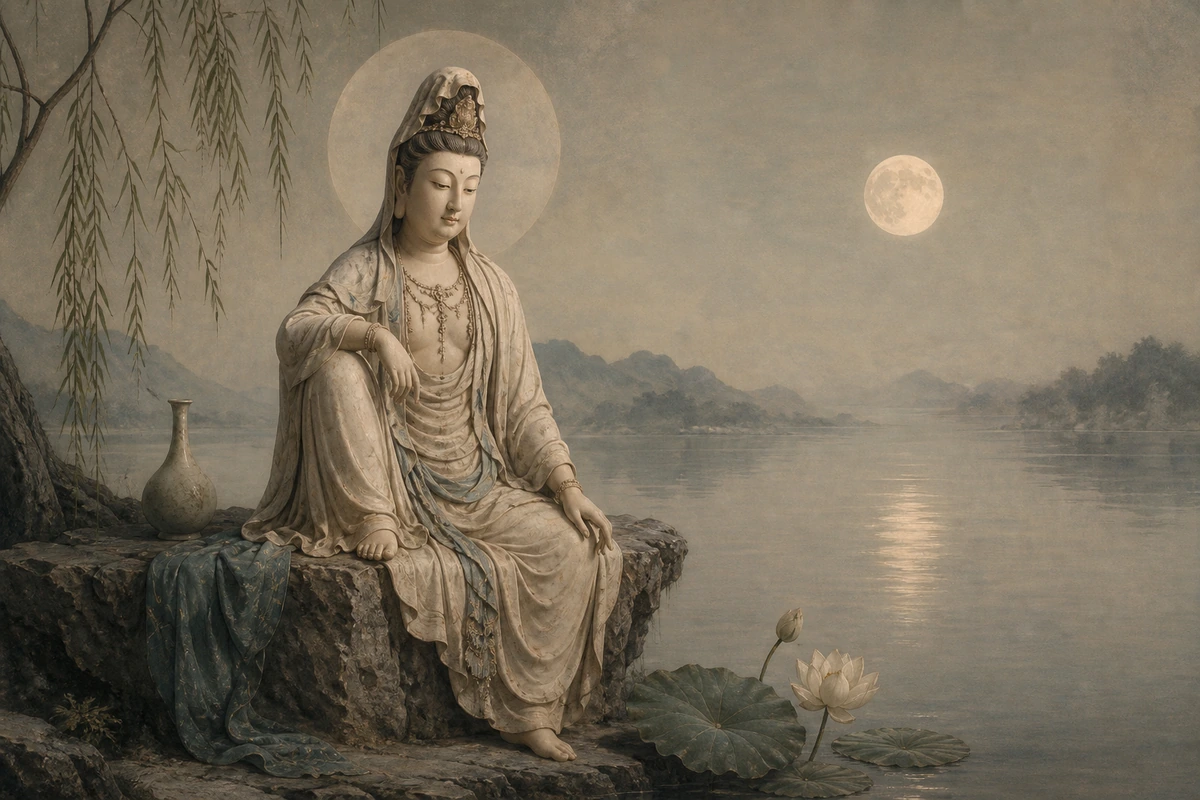
Different forms include the Water-Moon Guanyin seated in contemplative ease, the White-Robed Guanyin, a figure holding a vase and willow branch, a child-giving manifestation, and multi-armed forms whose many hands express limitless ability to help. Each has its own textual and artistic history.
The Princess Miaoshan legend
A famous Chinese narrative identifies Guanyin with Princess Miaoshan, who refuses an unwanted marriage and pursues religious practice despite her father’s persecution. When the ruler later becomes gravely ill, the princess gives what is required for his cure and reveals a compassion greater than his cruelty. Versions differ in the details of her suffering, transformation, and reconciliation.
Miaoshan became enormously important in Chinese devotion, but she is not the historical origin of Avalokiteshvara in India. The legend localizes a transregional bodhisattva through Chinese family ethics, filial tension, and sacred geography.
Compassion across many identities
Guanyin’s changing gender and appearance are not contradictions that must be solved. Buddhist scripture explicitly allows the bodhisattva to take forms appropriate to different beings. Art then made that flexibility visible across languages and societies. The central continuity is compassionate responsiveness, not one permanent body.
Guanyin differs from creator figures such as Nüwa and Daoist immortals such as Ma Gu. Similar feminine imagery does not erase their separate Buddhist, literary, and ritual histories.