
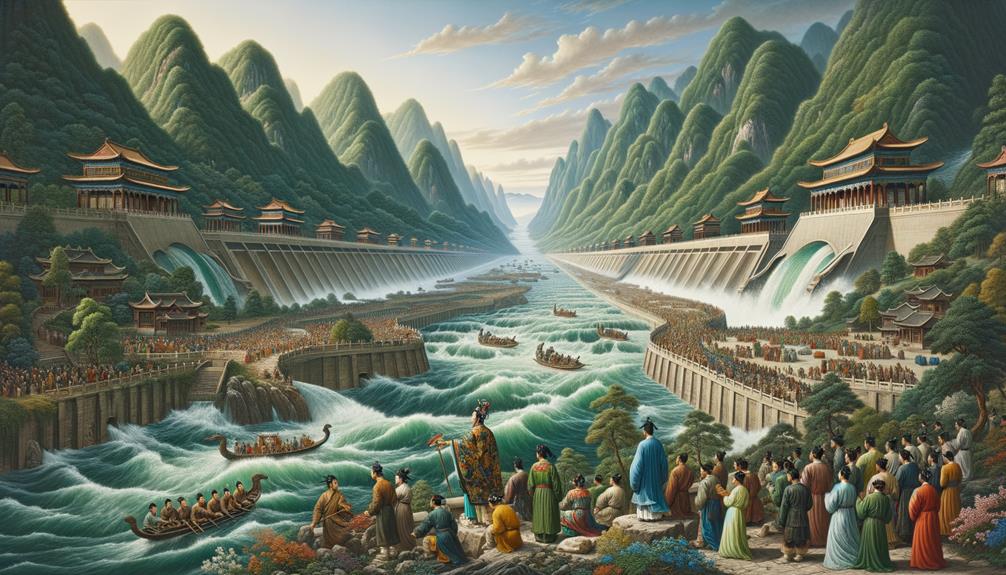
Yu the Great, also called Dayu, is the culture hero credited with bringing a catastrophic flood under control and establishing the conditions for ordered society. Tradition contrasts his achievement with the failure of his father, Gun. Where Gun tries to contain the waters, Yu directs them through channels, rivers, and the contours of the land. The story joins environmental knowledge, exhausting labor, and political legitimacy.
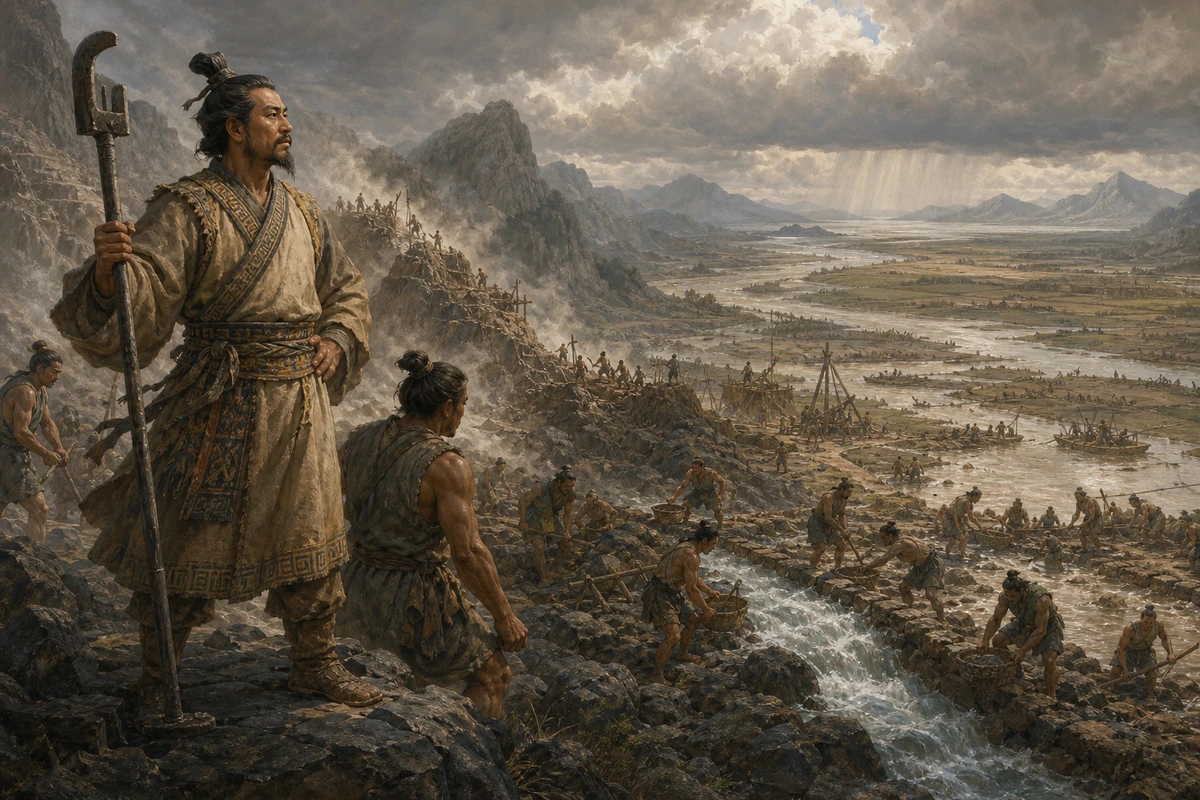
Gun, Yu, and two approaches to the flood
Early Chinese texts preserve more than one version of the flood tradition. In the best-known narrative pattern, Gun’s attempt to stop the disaster fails, and Yu takes up the work. Yu travels across the land, dredges waterways, cuts passages through mountains, and gives the water routes to the sea. The contrast is moral as well as technical: durable order comes from understanding conditions and working with them.
Later retellings add supernatural assistants, sacred soil, dragons, and maps. These variations should not be forced into a single timeline. Flood mythology accumulated across centuries and served different ritual, political, and literary purposes.
Labor, sacrifice, and the model ruler
A celebrated detail says Yu passed his own doorway three times without entering because the emergency could not wait. Whether read literally or as political exemplum, the image defines him through service. He becomes physically marked by years of travel and work, and later writers use his gait as a sign of extreme exertion.
Yu’s success authorizes more than hydraulic engineering. He surveys mountains and rivers, organizes the realm into regions, and establishes tribute. Later tradition names him founder of the Xia dynasty and treats him as the ruler who earned authority through public benefit. These claims belong to transmitted history and political memory; they are not all independently verified biographies.
Archaeology and the Great Flood debate
Research on prehistoric floods has renewed interest in the story. A 2016 Science paper linked evidence for a catastrophic outburst flood in the Jishi Gorge to later traditions of Yu and the Great Flood. Subsequent geological research challenged parts of that reconstruction and argued that the dammed-lake evidence did not establish the proposed relationship to the Xia dynasty.
This debate is a useful caution. A large flood can illuminate the environmental background from which collective memories developed, but it cannot prove every narrative detail or identify Yu as a documented individual. Mythic tradition, excavated evidence, and geological models answer different kinds of questions.
Why Yu’s story endured
The tale endured because it makes government tangible. Good rule is not presented as inherited splendor alone; it is the difficult work of making the world habitable. Yu listens to terrain, coordinates people, and accepts personal cost. Water is neither defeated nor erased. It is given a viable path.
That ethic places Yu beside other Chinese culture heroes such as Shennong, whose teachings organize agriculture and medicine, and Nüwa, whose repairs restore cosmic stability.