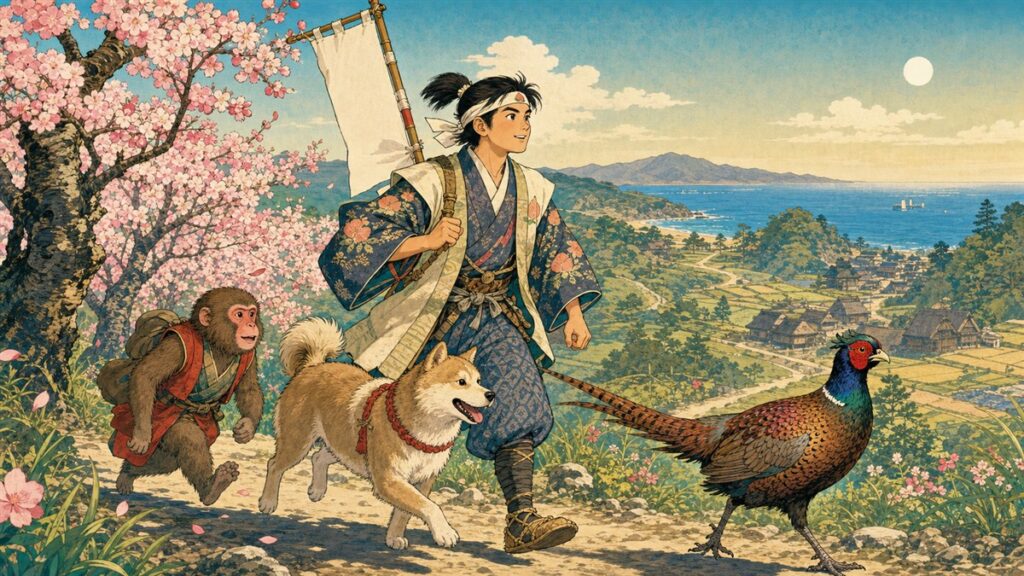
Momotaro traveling with a dog, monkey, and pheasant

Momotarō: Folktale, Moral Ambiguity, and Wartime Propaganda

Momotarō, the Peach Boy, is one of Japan’s most recognizable folktale heroes. In the familiar version, an elderly couple discovers a great peach floating down a river. When they open it, a boy appears; he grows into Momotarō and later travels to an island of oni with a dog, monkey, and pheasant. The plot seems simple, but its versions—and the purposes assigned to it—have changed dramatically.

Momotarō shares millet dumplings with his animal companions before the expedition to the oni’s island.

Birth from the peach

Not every telling begins identically. Some versions have the child emerge directly from the peach. In others, eating the peach restores the elderly couple’s youth, after which they conceive a son. Printed children’s books and school readers helped make the miraculous-birth version dominant, but oral and regional variants resist a single “original” script.

The peach itself already carried associations with vitality and protection in East Asia. The image gives the hero an extraordinary origin while placing his childhood in an ordinary household marked by age, labor, and longing for a child.

The companions and the millet dumplings

On the road, Momotarō recruits a dog, monkey, and pheasant by sharing kibi dango, usually translated as millet dumplings. The food creates an alliance, but versions differ in how freely the animals join and how Momotarō exercises command. The team’s contrasting abilities make cooperation one clear theme: victory depends on companions rather than the hero alone.

The expedition to the oni’s island

Momotarō attacks an island inhabited by oni and returns with treasure. Modern retellings often establish that the oni have raided the countryside, making the expedition righteous. Other versions are less comfortable. They can leave the provocation vague, show excessive violence, or allow the story to be retold from the oni’s perspective.

That ambiguity matters. “Courage” and “unity” are not timeless morals floating above the plot. The identity of the enemy, the justification for force, and the ownership of the treasure all depend on who is telling the story.

From folktale to national allegory

During the Meiji period, writers and educators helped standardize Momotarō as a model of loyalty, bravery, and leadership. Schoolbooks made him familiar across regions. His expedition could then be mapped onto modern warfare, with foreign enemies cast as oni and the animal companions recast as disciplined followers.

In the 1930s and 1940s, the tale became explicit imperial propaganda. The animated films Momotarō’s Sea Eagles (1943) and Momotarō: Sacred Sailors (1945) used the hero and his animals to represent Japanese military expansion. A Metropolitan Museum of Art undergarment from 1940–41 similarly combines Momotarō imagery with Axis flags and military motifs.

Parody, criticism, and continuing life

Momotarō was never controlled by one ideology. Writers parodied the hero, questioned the invasion from the oni’s viewpoint, and used him for antiwar or revolutionary arguments. Postwar books, advertising, mascots, tourism, manga, and animation continue to reshape the tale.

The most responsible way to read Momotarō is therefore historical as well as moral. The story can celebrate companionship and courage, but it also demonstrates how a beloved children’s hero can be recruited to define insiders, enemies, and obedience.

Sources and related reading

Scroll to Top