

Yōkai is a broad Japanese term for uncanny beings, strange transformations, inexplicable events, and supernatural presences. Some yōkai threaten people; others play tricks, provoke laughter, or simply make the familiar world feel unstable. They are not one species and do not belong to a single canon. The category grew through local storytelling, religious ideas, illustrated scrolls, printed books, theater, folklore study, and modern popular culture.
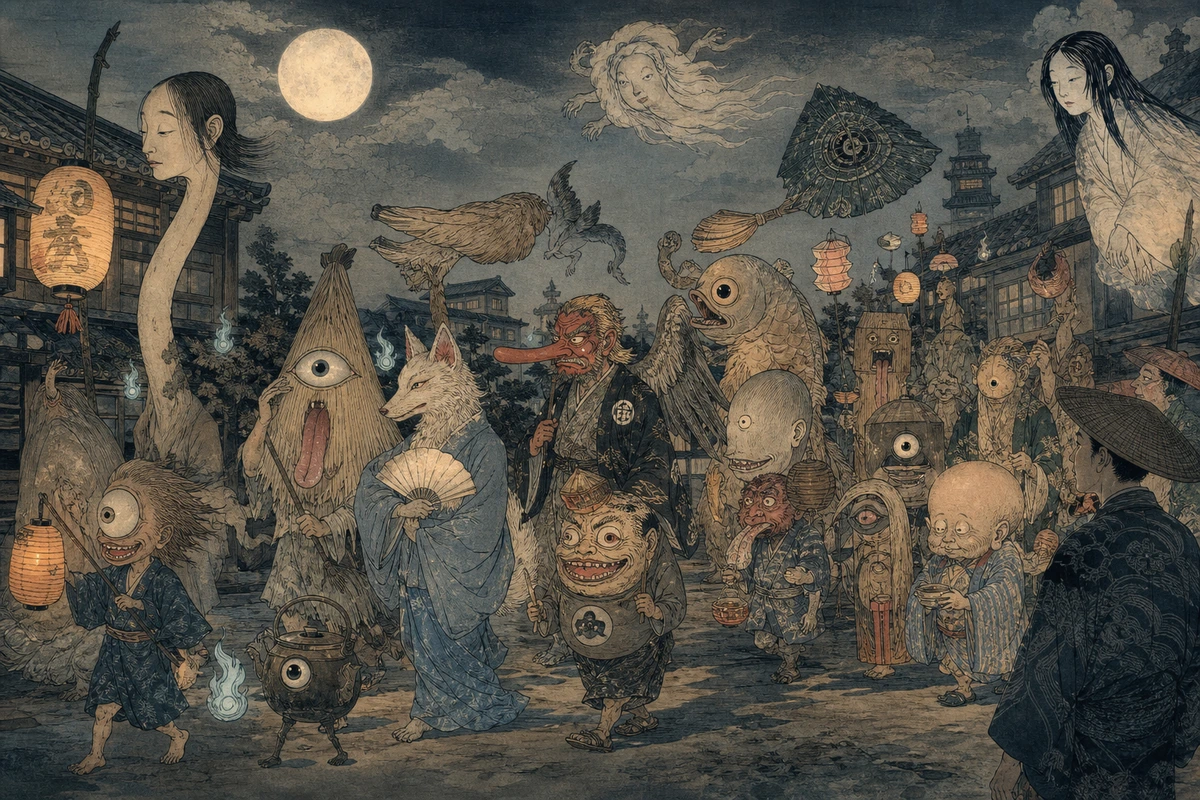
What counts as a yōkai?
The word can include creatures such as kappa and tengu, shape-changing foxes and raccoon dogs, animated objects, and named manifestations of odd sounds or natural events. Boundaries with kami, ghosts, demons, and monsters are porous. A being classified one way in a modern encyclopedia may have been understood differently in a local rite or an older text.
That flexibility is essential. “Yōkai” is useful as an umbrella, but it should not erase the histories of particular beings. The kappa’s river traditions, the tengu’s connections with mountains and Buddhism, and the fox’s relationship to Inari worship are not interchangeable.
From medieval scrolls to Edo print culture
Medieval picture scrolls already show processions of uncanny beings and transformed utensils. The celebrated “Night Parade of One Hundred Demons” became a visual framework in which artists could assemble a moving crowd of the strange. Such works do not document a literal census. They stage the pleasure and danger of encountering a world whose ordinary categories have come alive.
During the Edo period, commercial publishing brought yōkai to a much wider audience. Toriyama Sekien’s illustrated books, beginning with Gazu Hyakki Yagyō in 1776, presented named beings in an influential, catalog-like format. Sekien drew on earlier art and literature but also played with puns, commentary, and invention. His images helped standardize appearances that later readers sometimes assume are timeless folklore.
Animals, objects, and transformation
Foxes, cats, snakes, spiders, and tanuki can acquire extraordinary powers in stories, especially through age or unusual circumstances. Their transformations express fascination with disguise, desire, social status, and the unreliable surface of things. Yet there is no rule that every animal follows the same path.
Tsukumogami traditions imagine old tools and household objects becoming animate. The often-repeated claim that every neglected object automatically becomes a yōkai on its hundredth birthday is too rigid. Age, ritual disposal, resentment, and artistic humor combine differently across sources. The motif can encourage respect for objects, but it is also a vehicle for satire and visual play.
Explaining the uncanny
Some yōkai give form to danger near rivers, mountains, roads, or the household boundary. Others turn an unexplained sound, shadow, gust, or illness into a character that can be pictured and discussed. This does not mean premodern people used yōkai as a single “scientific” explanation for nature. Stories coexist with ritual, practical knowledge, entertainment, and metaphor.
Modern yōkai
In the twentieth century, folklorists collected regional accounts while artists and writers reshaped the category. Mizuki Shigeru’s manga made yōkai central to postwar popular culture, and later film, anime, games, and tourism introduced new designs to global audiences. Modern creators do more than preserve an ancient list: they select, combine, soften, frighten, and invent.
Yōkai endure because the category welcomes change. They let each generation picture what does not fit comfortably into ordinary life—sometimes as danger, sometimes as comedy, and often as both.