

Accuracy note: Zhang Guolao is a legendary immortal whose stories may preserve memories of a Tang-period recluse named Zhang Guo. Later miracles, the backward-ridden donkey, and his place among the Eight Immortals belong to evolving religious, literary, and artistic traditions—not a fully verifiable biography.
Zhang Guolao (張果老) is one of the Eight Immortals, or Baxian, familiar from Chinese popular religion, theater, literature, painting, porcelain, and auspicious decoration. He is usually portrayed as an elderly man carrying a yugu, a long bamboo tube drum played with two beaters. His most memorable companion is a white donkey, which he often rides while facing backward.
The image is humorous, but it is not merely a joke. Zhang Guolao embodies longevity, freedom from ordinary ambition, and the ability to reverse common expectations. His stories repeatedly place an elusive recluse against rulers who want to summon, classify, or control him.
Zhang Guo and the Problem of a Historical Beginning
Medieval records refer to an eccentric adept called Zhang Guo who was associated with the Tang period. Later writers added the honorific lao, meaning old or venerable. Accounts describe imperial efforts to bring him to court and his refusal of official life. One scholarly catalog of early Chinese painting notes the tradition that Emperor Xuanzong summoned Zhang and even offered marriage to an imperial daughter, only for the recluse to laugh off the proposal.
Such material suggests that a remembered hermit contributed to the legendary figure. It does not prove that the immortal’s entire later biography belongs to one historical person. Claims that Zhang lived for thousands of years, repeatedly died and returned, or performed spectacular transformations belong to hagiography and wonder tale.
The Backward Ride and Folding Donkey
Princeton University Art Museum identifies Zhang Guolao in a Qing painting by Wang Yuanxun as an embodiment of good fortune and long life. Its catalog also summarizes the famous donkey story: the animal could cover an impossible distance in a day, then be folded like paper and stored when the journey ended. Water restored it for the next trip.
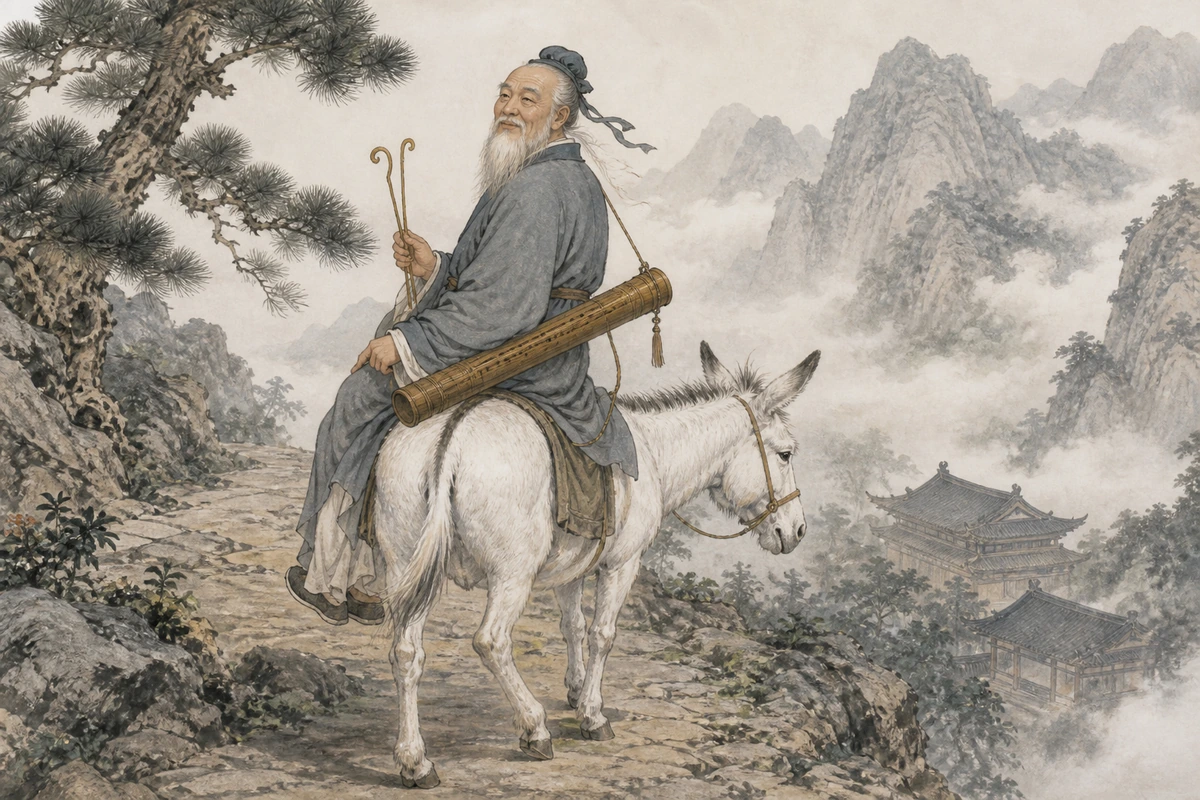
The backwards posture became a convenient artistic identifier. It also fits the broader character of an immortal who refuses to move through life in the expected direction. Modern explanations sometimes turn the image into one fixed moral slogan, but surviving art and stories support several overlapping associations: eccentricity, reversal, long life, and independence from conventional status.
The Yugu Bamboo Drum
The donkey is not Zhang’s only identifying attribute. The British Museum describes multiple porcelains showing him with a yugu, a cylindrical bamboo percussion instrument, and two hooked beaters. On an eighteenth-century cup, the instrument distinguishes him within a procession of all eight immortals. A Ming-period jar likewise presents Zhang among the group’s musical figures.
This repeated appearance across objects is important evidence for how audiences recognized the immortal. The yugu is not a staff, scroll case, or magical weapon. It belongs to performance and sound, connecting Zhang to the festive and theatrical life of the Eight Immortals in later art.
How the Eight Immortals Became a Group
The standard Eight Immortals are Zhang Guolao, Lü Dongbin, Zhongli Quan, Li Tieguai, He Xiangu, Han Xiangzi, Cao Guojiu, and Lan Caihe. They were not historical companions living at one moment. The Getty’s iconography record describes them as a heterogeneous legendary group whose members achieved immortality, while museum objects show how their individual attributes made the ensemble readable.
The unified group took shape gradually in medieval and later China. By the Ming and Qing dynasties, the Eight Immortals had become a widely recognizable auspicious subject. They appear crossing the sea, visiting the longevity god Shouxing, or traveling together through cloud-filled landscapes. Their variety helped the group represent different ages, social positions, and ways of life.
Longevity Without Obedience
Zhang Guolao’s old age connects him with longevity, but his stories do not celebrate age as passive respectability. He evades official summons, resists marriage and office, and remains impossible for court experts to measure. The immortal cannot be absorbed into the state’s ordinary categories.
That theme helps explain his enduring appeal. Zhang is recognizable through absurd impossibilities—a paper-folding donkey and a backward ride—yet those impossibilities dramatize a serious ideal: spiritual freedom cannot be reduced to rank, wealth, or service at court. His humor is a form of independence.
Zhang Guolao in Art and Popular Culture
A nineteenth-century porcelain figure in the Metropolitan Museum of Art demonstrates that Zhang continued to function as a stand-alone subject as well as a member of the Eight. On ceramics, screens, paintings, and temple decoration, viewers can identify him through some combination of advanced age, donkey, backward posture, and bamboo drum.
These objects do more than illustrate a fixed story. They show how artists selected and recombined attributes across centuries. A responsible account therefore distinguishes the possible Tang recluse, later immortal biographies, popular donkey tales, and the visual language of the Baxian instead of presenting every layer as eyewitness history.
Sources and Further Reading
- Metropolitan Museum of Art: Figure of Zhang Guolao
- Princeton University Art Museum: Zhang Guolao Riding on a Donkey
- British Museum: Eight Immortals stem cup
- British Museum: cup showing Zhang Guolao with the yugu
- Getty CONA: Baxian iconography record
- Mythology Vault: Eight Immortals Cross the Sea
- Mythology Vault: Ma Gu and traditions of long life