

Eris is the Greek personification of strife, conflict, and rivalry. She appears on battlefields, in divine genealogies, and in the story that leads to the Judgment of Paris. Yet Hesiod begins Works and Days with a surprise: there is not only one Strife. One drives ruinous war, while another can push neighbors and craftspeople into productive competition.
Source note: Greek poetry does not present a single standardized biography of Eris. Genealogy, moral function, and narrative role change with genre and author.
Hesiod’s two Strifes
At the opening of Works and Days, Hesiod corrects the idea that Strife has only one nature. The blameworthy Strife fosters cruel war and battle. Mortals do not love her, yet they are forced to honor her power. The other Strife was set by Zeus in the roots of the earth and can be beneficial to human beings.
This second Strife stirs even an idle person to work. A farmer sees a prosperous neighbor ploughing and planting; a potter competes with another potter, a carpenter with another carpenter, and a singer with another singer. Hesiod is not praising every rivalry. Envy can still wound, and competition can become destructive. His distinction recognizes that comparison may also produce skill, effort, and a well-ordered household.
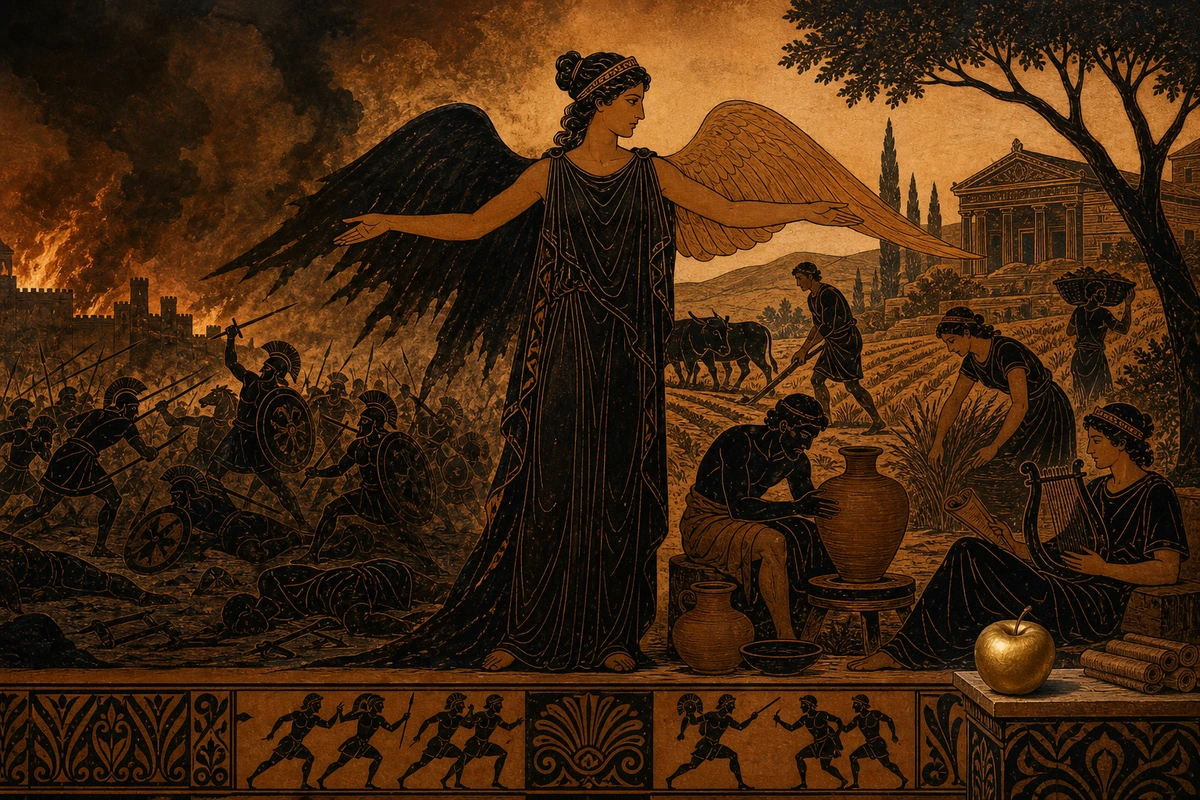
Eris as a daughter of Night
In Hesiod’s Theogony, Eris belongs to the children of Nyx, Night. Her own offspring are personified hardships and social evils: Toil, Forgetfulness, Famine, Pains, Battles, Murders, Quarrels, Lies, Disputes, Lawlessness, Ruin, and Oath. The genealogy maps destructive experience as a family, making abstract forces feel active and mutually reinforcing.
This Eris is not the productive rival praised in Works and Days. Scholars can debate how the two passages relate, but a general article should not erase the tension. Hesiod uses personification flexibly: the same word “strife” can be divided morally in one poem and placed in a dark genealogy in another.
Eris on Homer’s battlefield
In the Iliad, Strife moves among armies and enlarges combat. Homer describes her as small when she first rises but soon reaching heaven while walking the earth. She joins figures such as Terror, Rout, and the war god Ares, transforming battle from individual duels into a contagious collective force.
These scenes are not portraits of a goddess with a stable costume or temple biography. Personification gives warfare agency: strife enters, grows, shouts, and refuses to leave. The poetic technique makes escalation visible. Once conflict begins, it becomes larger than the people who first chose it.
The golden apple
Eris is best known today for the wedding of Peleus and Thetis. In later accounts, all the gods are invited except Strife. She throws or presents a golden apple as a beauty prize. Hera, Athena, and Aphrodite each claim it, and Zeus sends them to Paris—also called Alexander—to judge.
The goddesses offer gifts: power, victory, or Helen. Paris chooses Aphrodite, setting the conditions for Helen’s departure and the Trojan War. The broader Judgment of Paris was known early, and the lost Cypria connected Strife to the sequence. However, the fully developed golden apple with its famous inscription is clearest in later authors. Homer’s surviving epics do not narrate the wedding disruption from beginning to end.
| Source or tradition | Role of Eris | What should not be added automatically |
|---|---|---|
| Hesiod, Works and Days | Two Strifes: destructive war and productive rivalry | The golden apple episode |
| Hesiod, Theogony | Daughter of Night and mother of social evils | A claim that every competition is evil |
| Homer, Iliad | Battlefield force that magnifies conflict | A complete personal biography |
| Epic Cycle and later mythography | Wedding disruption, beauty contest, Judgment of Paris | The claim that Homer tells the full apple story |
Was Eris invited or excluded?
Retellings often state confidently that Zeus banned Eris because she always caused trouble. Surviving versions vary and are late in their details. Apollodorus’s epitome gives the apple as a prize among the goddesses and its notes preserve the familiar story that Strife was omitted from the wedding. Other texts concentrate on divine planning, the Judgment, or the promises to Paris.
The exclusion is narratively effective because it creates the very conflict it tries to prevent. Whether read as insult, cosmic plan, or moral fable, the wedding story shows that suppressing strife without addressing grievance may reproduce it in a more dangerous form.
Discordia in Rome and later culture
Roman authors identify Eris with Discordia, Latin “discord.” The Roman name appears in epic and political imagery, where civic discord can be imagined as a destructive force opposed to concord. Later art and literature freely combine Greek Eris, Roman Discordia, the golden apple, and allegories of war.
Modern works often make Eris a chaos goddess who seeks disorder for its own sake. That can be an entertaining adaptation, but the ancient evidence is more analytical. Strife may be a battlefield horror, a family of social harms, a spark in a divine rivalry, or even the competitive pressure that makes a craftsperson improve.
Why Hesiod’s distinction still matters
The two Strifes offer a vocabulary for separating competition from destruction. Rivalry can become obsessive, unfair, or violent; it can also reveal standards, motivate practice, and reward excellence. Hesiod’s farmer does not conquer his neighbor. He puts his own household in order after seeing good work nearby.
Eris therefore personifies more than “chaos.” She is the instability inside comparison and disagreement—the point at which tension can generate effort or spill into injury. Greek poets did not resolve that ambiguity into one moral lesson, and an accurate account should not resolve it for them.
Sources and further reading
- Hesiod, Works and Days 11–41, Perseus Digital Library
- Hesiod’s works in the Perseus catalogue
- Apollodorus, Epitome E.3.2, the apple and Judgment of Paris