

Accuracy note: The familiar flight of Daedalus and Icarus is best known from Ovid’s Metamorphoses. Ancient authors preserve related but varying traditions about the Labyrinth, Daedalus’s exile, his nephew, and his escape from Crete.
Daedalus is the brilliant maker who can solve almost any technical problem but cannot control the consequences of his inventions. Icarus is the son whose exhilarating flight ends in death. Their story is often compressed into “do not fly too close to the sun,” yet Ovid’s version is equally about parental fear, failed instruction, exile, grief, and an inventor forced to curse his own art.
Who was Daedalus?
Greek myth remembers Daedalus as an Athenian craftsman, architect, and inventor. Ancient accounts differ about his parentage and about the name of his talented nephew, called Perdix or Talos in different traditions. Jealous when the boy invents useful tools, Daedalus throws him from Athena’s sanctuary. Athena saves the youth by transforming him into a partridge, while Daedalus leaves Athens as a polluted exile.
On Crete, King Minos employs him to build the Labyrinth that confines the Minotaur. Daedalus also helps Ariadne with the thread or guiding device that allows Theseus to escape after killing the monster. Because his knowledge undermines the prison he designed, Minos prevents Daedalus from leaving Crete.
Making the wings
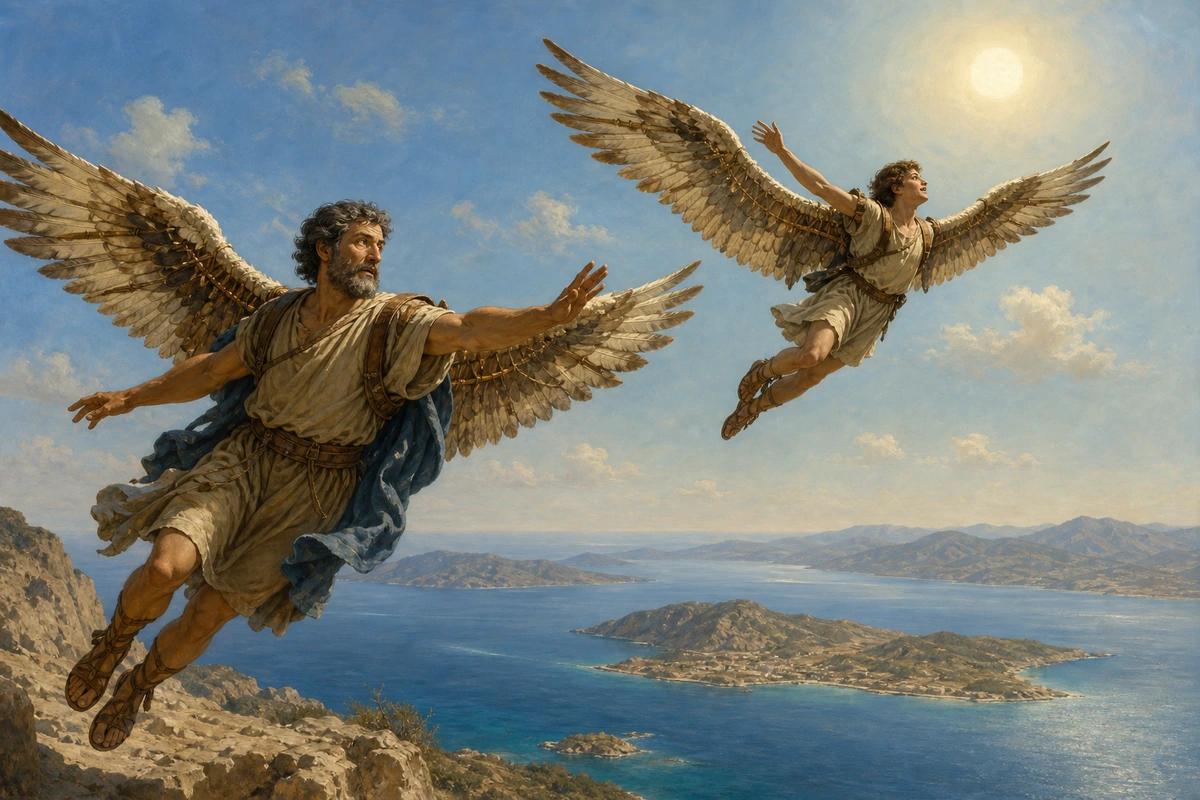
In Ovid’s Metamorphoses 8, Daedalus observes that Minos controls land and sea but not the air. He arranges feathers from short to long, binds their middle portions with thread, fixes their ends with wax, and curves the finished structures to imitate birds’ wings. The description makes the invention tactile and plausible within the poem’s fantasy.
Icarus plays with feathers and softens the yellow wax while his father works, unaware that he is handling the materials of his death. Before they launch, Daedalus tests the wings, fits a pair to his son, gives him a final kiss, and weeps. Ovid therefore signals the disaster before the flight begins.
The “middle way” warning
Daedalus does not only warn Icarus about the sun. He tells him to follow a middle course: if he flies too low, sea spray will weigh down the feathers; if he flies too high, the sun’s heat will damage them. He also tells the boy to follow his lead rather than navigate by the constellations.
The pair passes islands in the Aegean while fishermen, shepherds, and farmers stare upward and mistake them for gods. Icarus becomes delighted by flight, leaves his guide, and climbs. The heat softens the wax; the feathers detach; and he falls while calling his father’s name. Ovid explains the names of the Icarian Sea and the island Icaria through the death and burial.
What happens to Daedalus?
Daedalus reaches Sicily and finds protection with King Cocalus. Later stories describe Minos tracing him through a technical challenge: the Cretan king offers a reward to anyone who can pass a thread through a spiral shell. Daedalus solves it by attaching thread to an ant. Cocalus’s daughters then kill Minos when he attempts to reclaim the craftsman.
These episodes reinforce an unsettling pattern. Daedalus’s intelligence repeatedly saves him, but it also creates prisons, weapons, deceptive devices, and dangers that other people must endure. He is not merely a wise inventor or merely a punished father.
How should the myth be interpreted?
| Common reading | What the ancient narrative adds |
|---|---|
| Do not be overambitious | Icarus ignores a practical two-sided warning, not just a ban on height |
| Technology conquers nature | The invention works, but human judgment and material limits remain decisive |
| A disobedient child is punished | Ovid emphasizes Daedalus’s fear, love, responsibility, and grief |
| A simple moral fable | The wider cycle includes jealousy, imprisonment, complicity, and escape |
The myth supports readings about excess, but “hubris” should not become a shortcut that erases the poem. Ovid never gives Icarus a speech boasting that he will rival the gods. The boy is carried away by the experience of flight. The emotional center is the father searching the sea, seeing feathers on the water, and condemning the skill that could not save his son.
Primary sources and related reading
- Ovid, Metamorphoses 8.183–259: the wings, warning, flight, and fall
- Minos and Crete on Mythology Vault
- Theseus and the Minotaur on Mythology Vault