

Accuracy note: Hypnos is the Greek personification of sleep. Homer and Hesiod provide the core evidence; later Roman poetry adds other dream figures. Morpheus is not simply another name for Hypnos.
Hypnos occupies a striking place in Greek myth: sleep is gentle and universal, yet powerful enough to interrupt Zeus. Ancient poetry makes Hypnos a divine person rather than merely a metaphor, and Greek art repeatedly pairs him with his brother Thanatos, Death.
Hypnos in Hesiod’s genealogy
In the Theogony, Night (Nyx) produces Death, Sleep, and the tribe of Dreams without a partner. Later in the poem, Sleep and Death dwell near the house of Night at the remote meeting place of cosmic boundaries. Hesiod contrasts the brothers: Sleep moves kindly over earth and sea, while Death is pitiless and does not release anyone he seizes.
This genealogy creates a family resemblance without making sleep and death identical. Hypnos offers temporary release and return; Thanatos marks an irreversible boundary. Their closeness becomes especially visible in the story and imagery of Sarpedon.
Hera’s bargain with Sleep in the Iliad
In Book 14 of the Iliad, Hera wants Zeus asleep so that Poseidon can help the Achaeans. She asks Hypnos to close Zeus’s eyes, but he initially refuses. He remembers obeying Hera during Heracles’ return from Troy, when Zeus awoke in fury and nearly hurled him from heaven. Hypnos escaped only by taking refuge with Night, whom even Zeus was reluctant to offend.
Hera first offers a golden throne. Hypnos accepts only after she swears to give him Pasithea, one of the Graces, as his wife. He hides in a tree on Mount Ida, Zeus falls asleep after being beguiled by Hera, and Hypnos reports the opportunity to Poseidon.
The episode does not establish that Hypnos can casually defeat Zeus whenever he chooses. It stresses the danger, the elaborate deception, Hera’s oath, and Hypnos’s memory of Zeus’s previous anger.
Hypnos and Thanatos carry Sarpedon
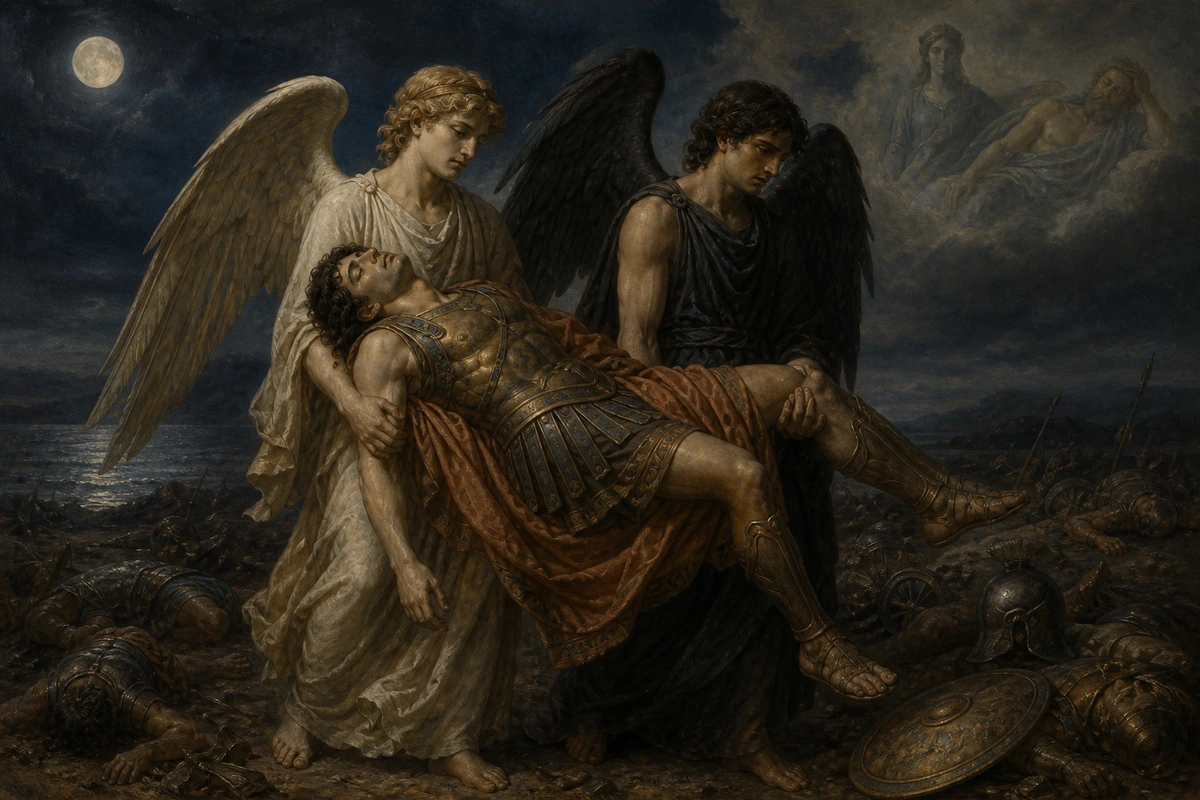
In Book 16, Zeus orders Apollo to remove the dead Sarpedon from battle, cleanse and anoint the body, and give it to the twin brothers Sleep and Death. They carry the warrior home to Lycia for burial. The subject became important in Greek vase painting, where Hypnos and Thanatos may appear as winged youths lifting the armored body.
Ancient art is evidence for how viewers imagined the brothers, but it does not give them one universal appearance. Some works distinguish Thanatos by darker coloring or a beard; others make the pair nearly symmetrical. Wings communicate their swift passage rather than defining a fixed biological anatomy.
Where does Hypnos live?
Greek authors do not provide one map. Hesiod locates Sleep and Death near Night’s house at the limits of the cosmos. Homer’s Hypnos can move among Olympus, Lemnos, Mount Ida, and the battlefield. Later accounts place sleep in caves or other remote settings. These locations should be treated as poetic alternatives, not parts of a single consistent geography.
Hypnos is not Morpheus
Morpheus is best known from Ovid’s Roman Metamorphoses, where he is one of the dream-shapers associated with Somnus, the Roman Sleep. Calling Morpheus a standard son of Hypnos in all Greek tradition collapses different periods and languages. Greek oneiroi are dreams; Hypnos is Sleep itself.
Cult and representation
Hypnos appears more often in poetry and art than in evidence for a large independent cult. Pausanias mentions images of Sleep and Death, while surviving pottery shows their role in carrying the dead. Modern depictions that make Hypnos a god of pleasant dreams alone miss his older connections with Night, death, vulnerability, and the temporary suspension of divine power.
Key distinctions
| Figure | Ancient role | Do not confuse with |
|---|---|---|
| Hypnos | Personification of sleep | A specific dream or Morpheus |
| Thanatos | Personification of death | Hades, ruler of the underworld |
| Oneiroi | Dreams or dream-figures | Sleep itself |
| Somnus | Roman name/personification of Sleep | A separate Greek genealogy in every source |