
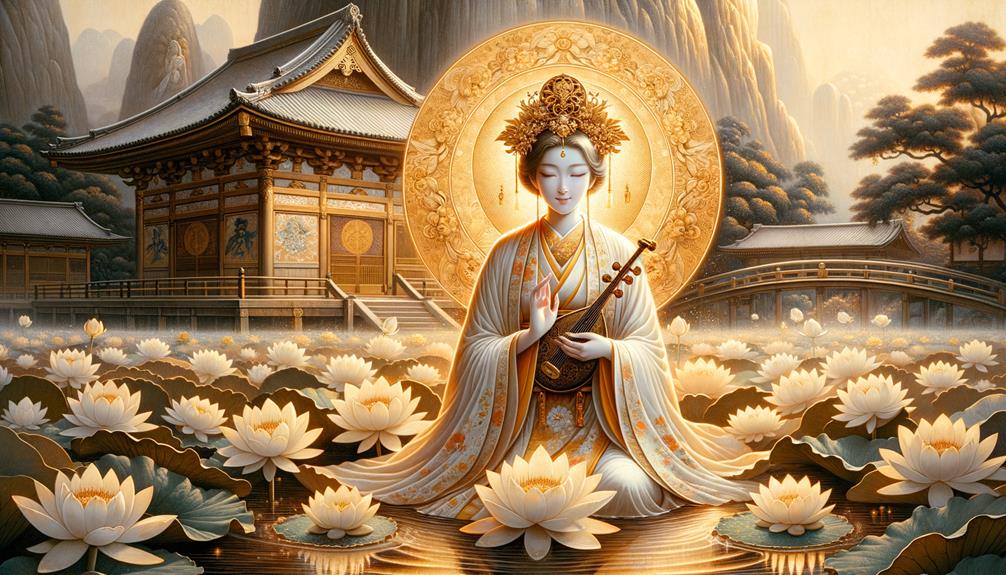
Benzaiten is the Japanese Buddhist form of the South Asian goddess Sarasvatī. Her history crosses languages, regions, and religious traditions: an Indian river and speech deity entered Buddhist scripture, traveled through China, and took new forms in Japan. Music, eloquence, water, protection, wealth, snakes, and good fortune became attached to her in different periods. “Goddess of beauty and knowledge” is therefore too narrow—and partly misleading.
From Sarasvatī to Benzaiten
Sarasvatī originated in South Asia with strong associations with river, speech, learning, and sacred sound. Buddhist texts transformed and transmitted her as a protective deity. In Japan, the name became Benzaiten or Benten, and her worship developed within Buddhist institutions while also blending with local kami, water cults, and later popular religion.
This history is better described as translation and syncretism than as a simple case of “Hindu missionaries bringing a goddess to Shinto.” Buddhism carried texts, images, ritual specialists, and cosmologies through Central and East Asia over centuries.
Two-armed musician and eight-armed protector
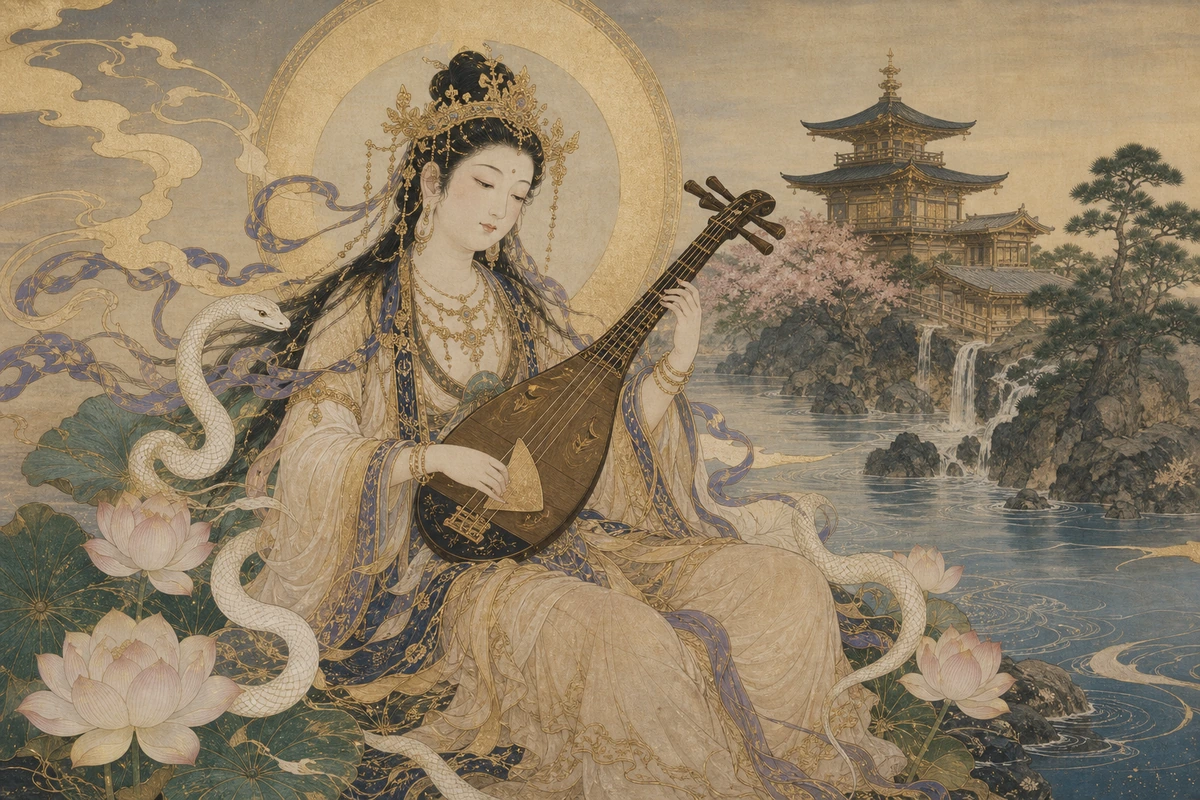
The best-known image shows a two-armed Benzaiten playing the biwa, a Japanese lute. It expresses her relationship with music, eloquence, and the arts. Other forms are more explicitly protective. The Nara National Museum preserves an image of an eight-armed Benzaiten; such forms can carry weapons and ritual objects rather than a musical instrument.
These are not contradictory personalities. Buddhist deities commonly have multiple iconographic forms suited to different texts and rites. Reducing Benzaiten to a beautiful musician erases her protective and esoteric dimensions.
Water, islands, and sacred places
Benzaiten is strongly associated with water, and many important sites stand on islands, lakeshores, or coasts. Enoshima, Chikubushima in Lake Biwa, and Itsukushima are often counted among major Benzaiten centers. Their traditions are not identical, and modern shrine arrangements reflect the nineteenth-century separation of Buddhism and Shinto as well as earlier centuries of mixture.
At Enoshima, Benzaiten is linked with a dragon tradition. Popular summaries sometimes turn this into a simple romance in which her beauty reforms a monster. Local narratives are more complex, and versions differ over the dragon, the island’s emergence, marriage, and moral transformation.
Ugajin, snakes, and fortune
In medieval Japan, Benzaiten became associated with Ugajin, a deity often represented with a human head and serpent body. White snakes and dragons consequently appear in later imagery and worship. The association deepened her connections with water, fertility, food, and prosperity.
Benzaiten also became the only female member of the popular Seven Gods of Good Fortune. Money-washing rites at particular shrines reflect this later prosperity tradition, not the whole meaning of the deity everywhere in Japan.
A deity of crossings
Benzaiten’s importance lies in her ability to cross boundaries without losing her history. She is Indian and Japanese, scriptural and local, musical and martial, Buddhist and deeply entangled with kami worship. Her changing forms offer a particularly clear example of how Japanese religion developed through adaptation rather than isolated, unchanging systems.