
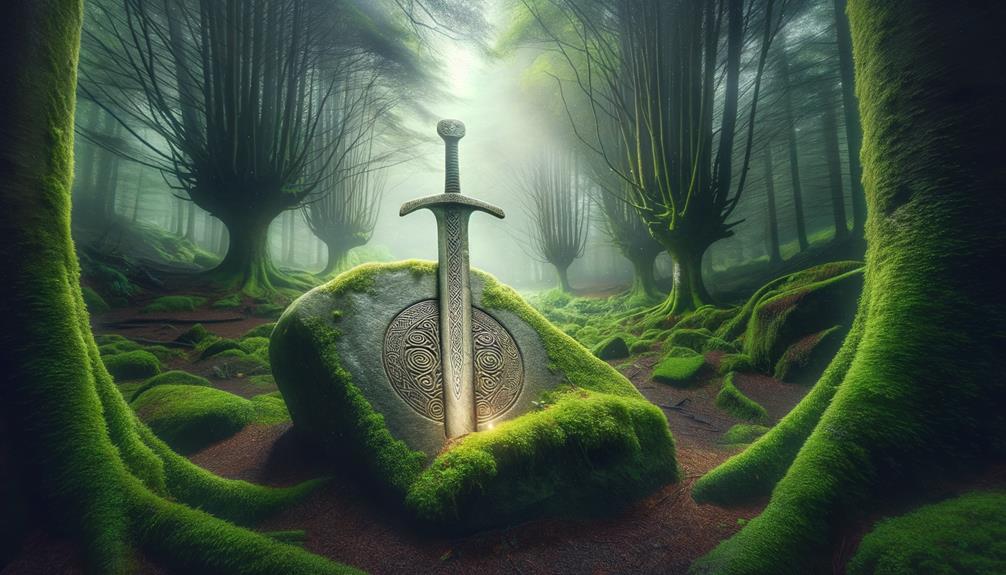
Fragarach—more precisely Freagarthach in Irish spelling—is a sword associated with Manannán mac Lir and Lugh in later Irish narrative tradition. It is often called “the Answerer” or “the Retaliator” in English. Modern summaries give it a long list of magical powers, but those powers, owners, and names do not all come from one early canonical text.
Where does Fragarach appear?
The clearest narrative association comes from Oidheadh Chloinne Tuireann, “The Fate of the Children of Tuireann.” The tale survives in relatively late manuscript forms, although parts of the Tuireann tradition are older. In its full romance, Lugh seeks compensation from the sons of Tuireann for the killing of his father Cian and sends them to obtain a deadly series of treasures.
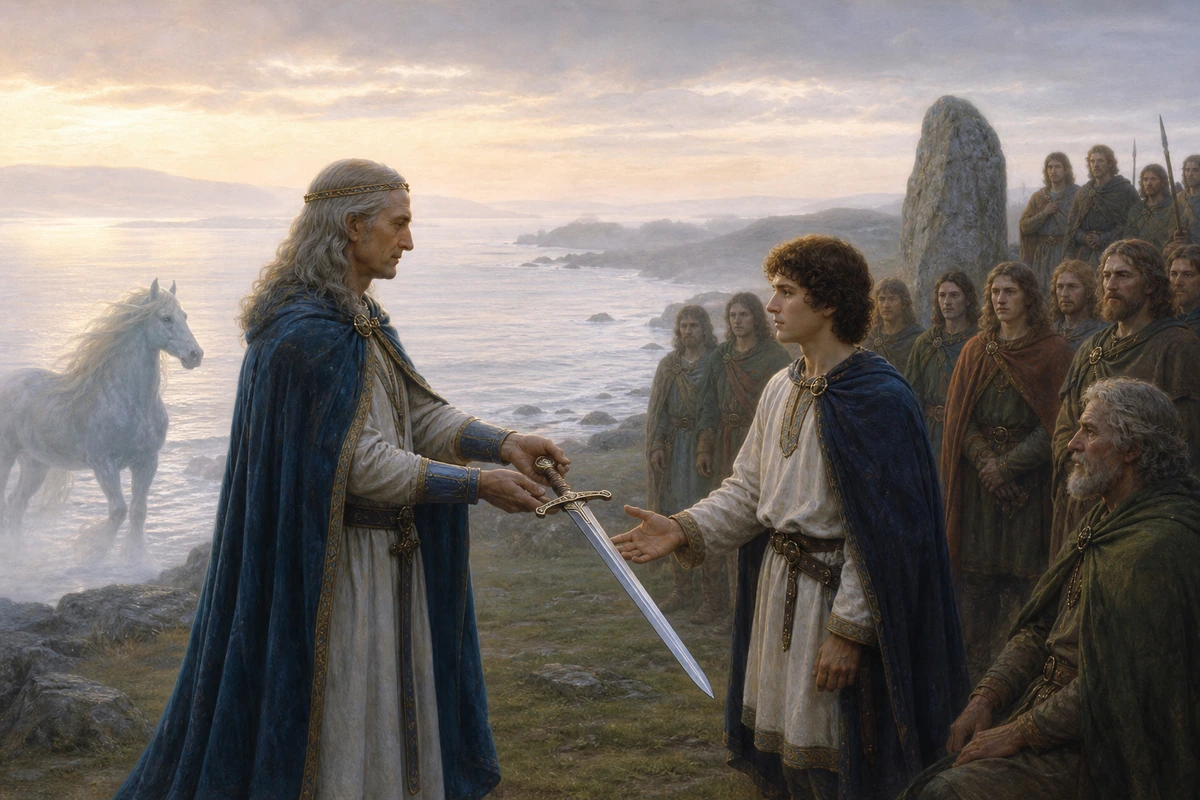
Before that quest, Lugh is equipped with objects belonging to Manannán: the horse Aonbharr, armour, a sea-going vessel in some versions, and the sword Fragarach. When the sons later ask to borrow the horse, Lugh refuses on the ground that it is already a loan. That detail makes the relationship clear: Manannán is the source of the equipment, while Lugh is its heroic user in this story.
“The Answerer” and the problem of translation
Freagarthach is related to Irish words for answering or responding, which explains the conventional translation “Answerer.” “Retaliator” is another interpretive rendering. A translated name is useful, but it should not be treated as a complete ancient description of the sword’s function.
Popular accounts sometimes claim that anyone held at Fragarach’s point must speak the truth. That idea suits the English title “Answerer,” yet the familiar formulation is much easier to find in modern myth dictionaries and fantasy retellings than in the cited Tuireann passage itself. The safest presentation separates the attested name and ownership from powers assembled later.
What powers are actually attributed to it?
Early twentieth-century retellings describe Fragarach as a sword that can cut through armour or mail. Other modern sources add wounds that cannot heal, command over wind, or the power to force an answer. These claims may draw on different Irish phrases, editorial glosses, and storytelling traditions. They should not be repeated as a single checklist guaranteed by one manuscript.
The source-grounded core is narrower: Fragarach is Manannán’s sword, carried by Lugh as part of the splendid equipment that marks his status before the Tuatha Dé Danann.
Is Fragarach one of the Four Treasures?
No surviving list of the Four Jewels of the Tuatha Dé Danann identifies Fragarach by that name. The traditional set consists of the stone of Fál from Falias, the spear of Lugh from Gorias, the sword of Nuada from Findias, and the cauldron of the Dagda from Murias.
Because that set includes both a famous sword and a weapon of Lugh, later charts sometimes merge Nuada’s sword with Fragarach or substitute Fragarach for it. The texts do not require that identification. Fragarach’s clearest ownership chain is Manannán to Lugh; Nuada’s treasure-sword belongs to a separate schematic tradition.
Not a “Sword of Air”
Assignments of the Four Treasures to the classical elements—sword as air, spear as fire, cauldron as water, stone as earth—are modern occult correspondences rather than a classification stated in the medieval Irish lists. Calling Fragarach the “Sword of Air” compounds two modern moves: it identifies the sword with Nuada’s treasure and then maps that treasure onto an elemental system.
Modern spiritual or fictional adaptations may use that system creatively. A historical account should label it as an adaptation, not evidence about medieval Irish religion.
Manannán, Lugh, and a late literary world
Manannán is a powerful Otherworld figure with strong maritime associations. Lugh is the many-skilled champion whose arrival transforms the struggle of the Tuatha Dé Danann. Giving Lugh Manannán’s horse, armour, and sword visually links the young hero to an older store of Otherworld power.
The late date of the full Tuireann romance does not make it worthless. It means the tale should be read as a layered work that preserves older names and motifs in a form shaped by later scribes and storytellers. Fragarach is most interesting when that textual history remains visible, rather than when every later power is projected backward into a single lost original.