
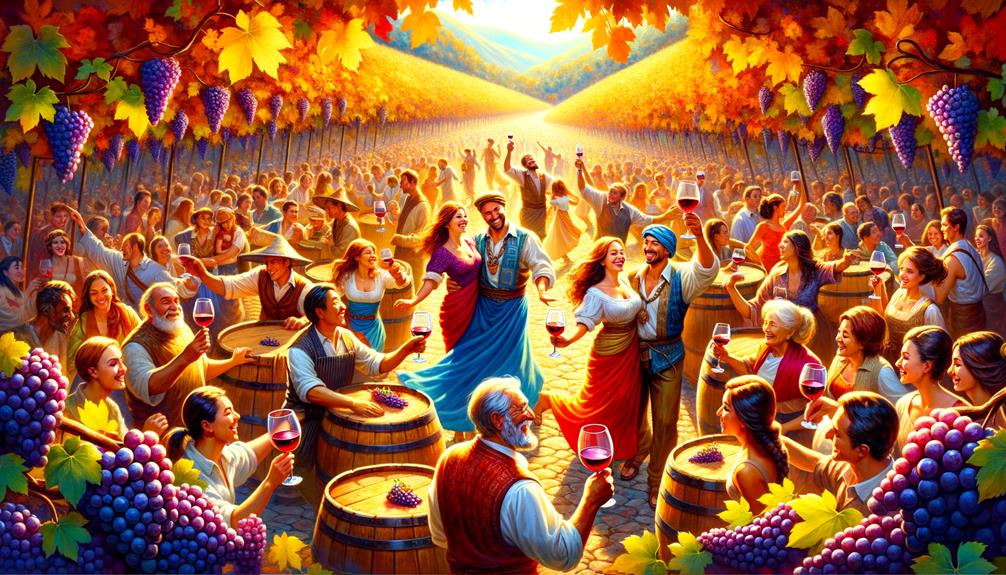
Liber Pater was an Italian and Roman god of fertility, vines, male maturation, and freedom who became closely identified with the Greek Dionysus and Roman Bacchus. That identification was powerful but not instantaneous. The Liberalia, the Aventine cult of Ceres-Liber-Libera, Bacchic mystery worship, and the Senate’s restrictions of 186 BCE preserve different strands of Roman religious history.
Liber before he was simply Bacchus
Liber’s name is connected with freedom and the adjective “free,” but ancient etymology and cult do not reduce him to an abstract god of political liberty. He belonged to agricultural productivity, wine, seed, and generative growth. The title Pater, “Father,” marked religious honour and authority.
Ceres, Liber, and Libera
Roman tradition associated Liber with Ceres and Libera in the temple dedicated on the Aventine in the early Republic. Greek Demeter-Dionysus-Persephone patterns influenced interpretation, yet the Roman triad also acquired civic and plebeian associations. Liber and Libera should not be treated merely as Latin spellings for two Greek gods.
The Liberalia on 17 March
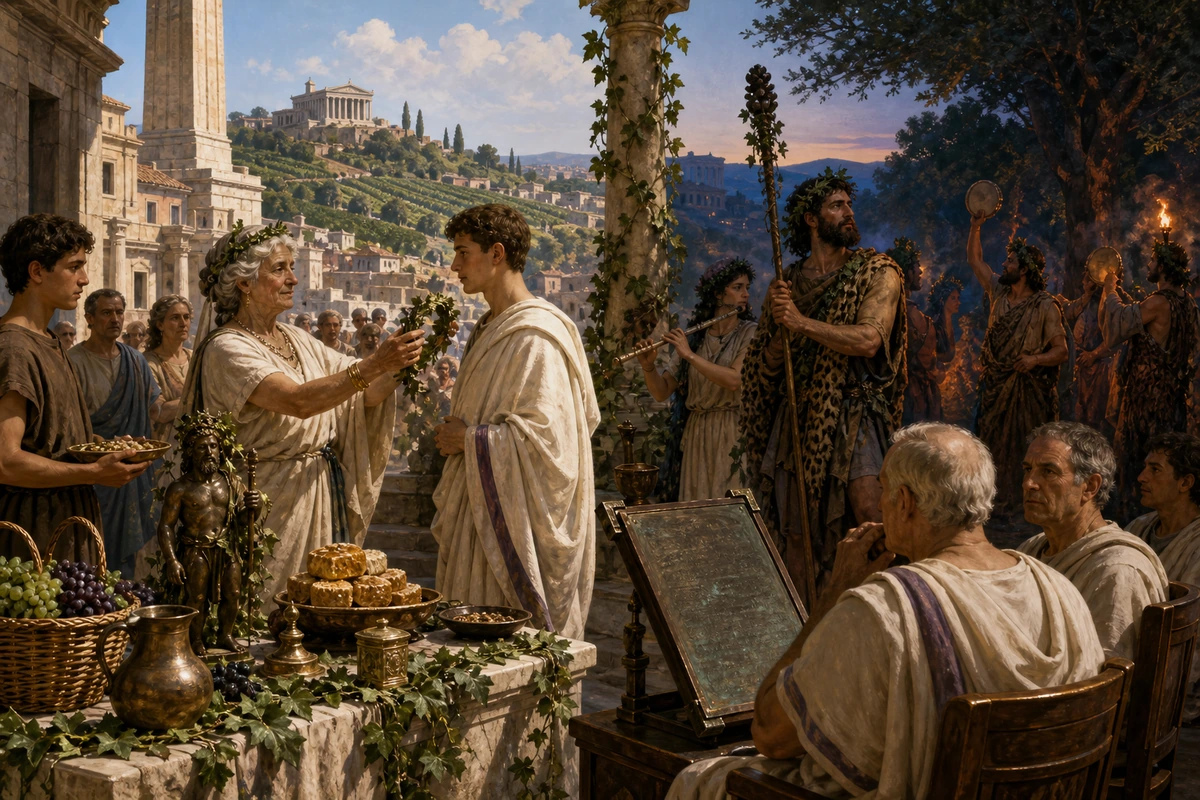
Ovid describes the Liberalia as a public festival with ivy, cakes made with honey and oil, and elderly women serving as priestesses beside portable altars. The day became associated with boys assuming the adult toga virilis. The transition linked household lineage and civic adulthood with Liber’s generative powers.
From Liber to Dionysus and Bacchus
As Greek culture shaped Roman literature, art, and worship, Liber absorbed stories and images of Dionysus: the thyrsus, ivy, ecstatic followers, triumphal travel, and the gift of wine. Bacchus, a Greek-derived cult name, could refer to the same divine field. Roman authors move among the names according to genre and context, but earlier Italian institutions did not vanish.
What were Bacchanalia?
Bacchanalia were rites for Bacchus or Dionysus, some organized in private associations. Our most detailed narrative comes from Livy, writing nearly two centuries after the crisis of 186 BCE. He portrays nocturnal gatherings, sexual disorder, forgery, and murder. His account reflects Roman moral and political storytelling as well as possible official allegations.
The decree of 186 BCE
The Senatus Consultum de Bacchanalibus survives in an Old Latin bronze inscription and is firmer evidence than Livy’s dramatic speeches. It did not simply ban every worshipper of Bacchus. It required authorization, restricted priests and leaders, limited common funds and oaths, and tightly controlled meetings and participation. The Senate targeted unsupervised organization as much as ritual content.
Religion, association, and state power
Roman officials feared groups that met privately across status and gender boundaries and created binding loyalties outside normal civic supervision. The repression demonstrates how religion, law, and political authority overlapped. Calling it a crackdown on “partying” misses the institutional issue; calling it pure invented panic ignores the surviving decree.
Wine as gift and danger
Wine connected agriculture, trade, sacrifice, dining, poetry, healing, and altered consciousness. Liber-Bacchus could represent release from ordinary constraint, but Roman worship also imposed form: festivals, priesthoods, offerings, processions, theatres, and legal rules. Ecstasy and civic order were not simple opposites.
Liber’s later Roman life
The cult continued after 186 BCE under regulation. Imperial art and literature freely identified Liber with Bacchus and Dionysus, while the name Liber retained Roman resonance. Sarcophagi, mosaics, villas, and public monuments used Bacchic imagery to speak about abundance, victory, theatre, death, and renewal—not only drunkenness.
Sources and further reading
- Livy, History of Rome 39, account of the Bacchanalian crisis
- Senatus Consultum de Bacchanalibus, Old Latin text
- Ovid, Fasti 3, the Liberalia
- John North, “Religious Toleration in Republican Rome,” on the Bacchanalian regulations