The discovery of Tutankhamun’s tomb in 1922 was not a single candlelit moment followed by a “mummy’s curse.” It began with Egyptian workers uncovering steps in the Valley of the Kings and became a decade-long project of recording, stabilizing, moving, and interpreting thousands of objects. The tomb is extraordinary precisely because archaeology preserved context that treasure hunting would have destroyed.
Who was Tutankhamun?
Tutankhamun ruled late in Egypt’s Eighteenth Dynasty, probably from about 1332 to 1323 BCE. He came to the throne as a child after the religious upheavals associated with Akhenaten. His reign restored the cult of Amun and moved the court away from Akhenaten’s city. He died at roughly nineteen; evidence supports several health problems, but no single cause of death has been proved.
The search in the Valley of the Kings
Howard Carter had worked in Egypt for decades before leading excavations financed by George Herbert, fifth Earl of Carnarvon. Theodore Davis’s earlier concessions had produced objects bearing Tutankhamun’s name, persuading Carter that the king’s burial remained nearby. Work from 1917 onward focused on ground obscured by later huts and excavation debris.
November 1922
On 4 November, members of the Egyptian workforce uncovered a cut step below the tomb of Ramesses VI. The popular claim that a water boy named Hussein Abd el-Rassul found it is important oral history but not securely documented in Carter’s contemporary notes. The team exposed a sealed doorway, refilled and guarded the entrance, and waited for Carnarvon to arrive from Britain.
“Wonderful things” and a careful pause
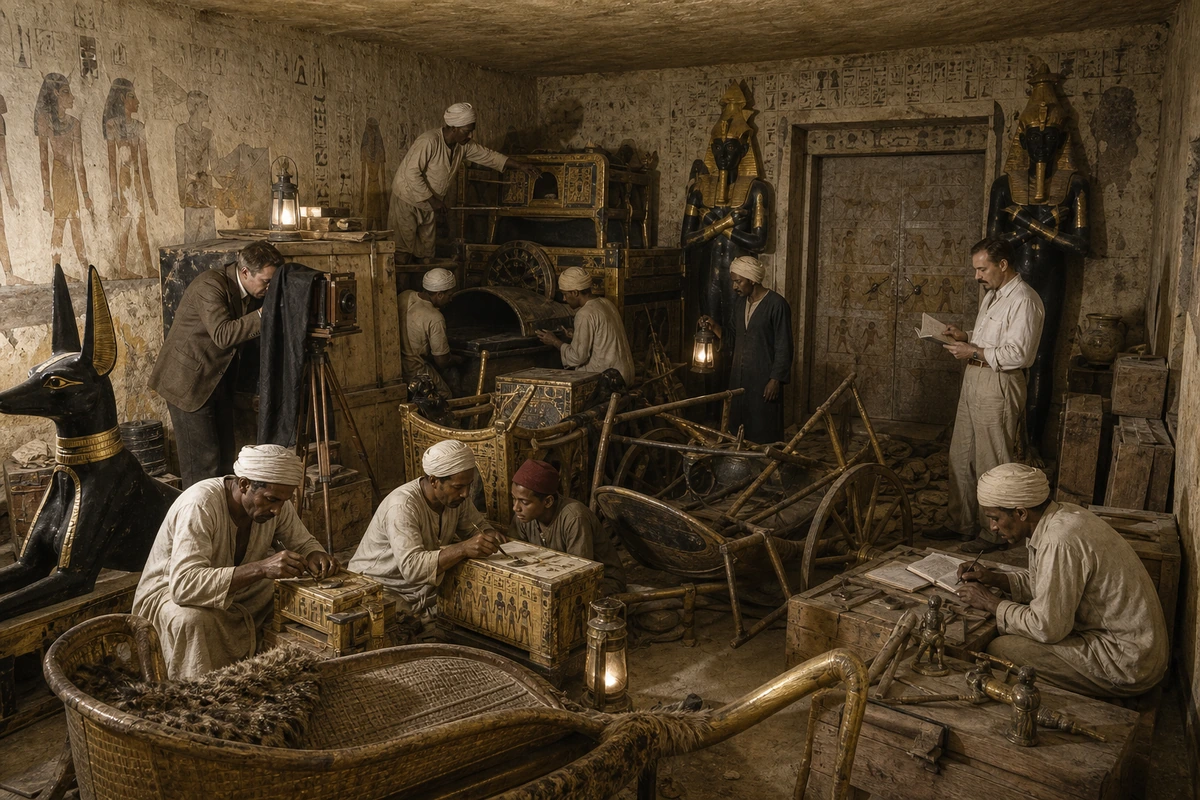
On 26 November, Carter made a small opening in the second sealed doorway and looked into the antechamber. Lamps revealed gilded couches, chariots, boxes, and two black guardian statues. The famous exchange about “wonderful things” comes from Carter’s later account. The burial chamber itself was officially opened in February 1923 after the antechamber had begun to be documented and cleared.
The tomb was not completely untouched
Ancient robbers had entered KV62 at least twice, and officials resealed and reorganized parts of it. Many objects were displaced. Yet the burial remained vastly more complete than most royal tombs in the valley. Its small size and hurried arrangement may reflect Tutankhamun’s unexpected death and the adaptation of a tomb not originally designed for such a burial.
Four rooms packed with evidence
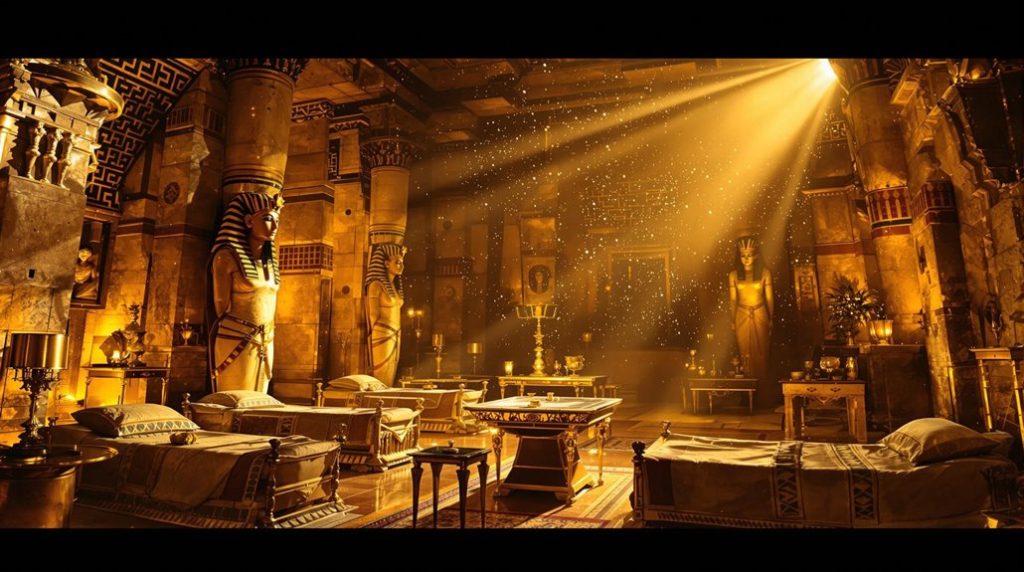
The tomb contains an antechamber, annex, burial chamber, and treasury. Nested gilded shrines surrounded a stone sarcophagus and three anthropoid coffins. Other finds included the gold mask, canopic equipment, chariots, bows, clothing, sandals, furniture, food, ritual objects, games, and tools. The wall paintings show funerary and divine rites, not a biography of scenes from the king’s daily life.
Documentation and conservation
Photographer Harry Burton recorded objects before and during removal. Carter’s team numbered finds, drew plans, made object cards, and relied on conservators such as Alfred Lucas to stabilize fragile wood, leather, textiles, and painted surfaces. Standards have changed, but the archive remains unusually detailed and allows scholars to reconstruct where objects stood.
Egyptian labour and colonial politics
Older popular accounts turn the discovery into a story about Carter and Carnarvon alone. Egyptian foremen, excavators, conservators, guards, officials, and workers made the project possible, even when their names were not recorded. The discovery also occurred as Egypt declared independence in 1922. Disputes with the Antiquities Service concerned access, press rights, working control, and whether objects could leave Egypt. The collection remained Egyptian state property.
The so-called curse
Carnarvon died in 1923 after an infected mosquito bite, and newspapers connected his death with supernatural vengeance. There was no curse inscription threatening everyone who entered the tomb, and many members of the team lived for decades. The curse became a durable media story because it combined celebrity, archaeology, colonial anxiety, and older fictional mummy tales.
Sources and further reading
- Griffith Institute Archive, home of Howard Carter’s complete Tutankhamun excavation records
- Tutankhamun Spatial Archive, Howard Carter and the excavation history
- Griffith Institute, Harry Burton’s excavation photographs
- Christina Riggs, Treasure: How Tutankhamun Shaped a Century