

Accuracy note: The churning of the ocean appears in the Mahābhārata and multiple Purāṇas. Mount Mandara, Vāsuki, amṛta, poison, and divine intervention recur, but the preparations, order of treasures, and identities involved change by source.
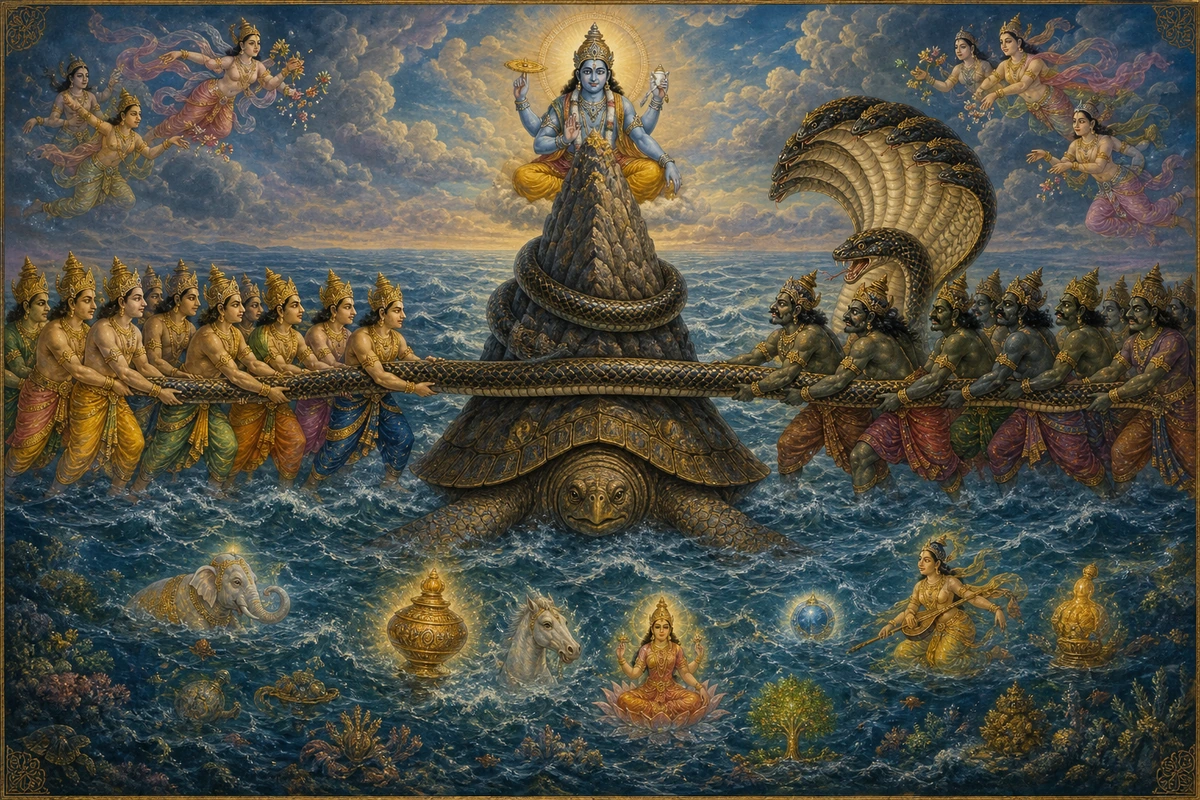
The Samudra Manthana is a myth of cooperation under conditions of rivalry. Devas and asuras cannot obtain the nectar of immortality by fighting for it directly. They must work together, using a mountain as a churning staff and a serpent as a rope, while Viṣṇu repeatedly stabilizes a process that threatens to destroy its participants.
Why is the ocean churned?
In the Mahābhārata’s Ādi Parva, the gods seek amṛta and enlist the asuras in the labor. Later Purāṇic versions often begin with the devas weakened by a curse or defeat. Viṣṇu advises them to make a temporary alliance, place medicinal plants in the Ocean of Milk, and promise the asuras a share of the nectar.
The alliance is strategic, not a reconciliation. Both groups want immortality, and Viṣṇu’s plan ultimately favors the devas. The story therefore resists a simple moral in which honest good beings defeat dishonest evil beings through pure cooperation.
Mandara, Vāsuki, and the tortoise
Mount Mandara serves as the churning staff. Vāsuki, king of serpents, is wrapped around it as the rope while the two groups pull from opposite ends. Texts disagree over who holds the head and who holds the tail. The serpent’s breath produces heat and smoke, adding exhaustion and danger to the labor.
The mountain has no stable base and begins to sink. In the epic account, a great tortoise supports it; Purāṇic theology explicitly identifies the support with Viṣṇu’s Kūrma, or tortoise, incarnation. Viṣṇu may also press or steady the mountain from above and enter the participants to sustain their strength. Art often combines these moments into one cosmic diagram.
The poison appears before the nectar
The first crisis is the terrible poison called Hālāhala or Kālakūṭa in different tellings. Its heat threatens gods, asuras, and the cosmos. Śiva contains the poison by drinking or holding it, while Pārvatī may stop it in his throat in later accounts. His throat becomes blue, producing the epithet Nīlakaṇṭha, “Blue-Throated.”
Versions differ over who requests Śiva’s aid, what happens to the remaining poison, and how Pārvatī participates. The broad sequence is stable: the quest for immortality releases lethal danger before it yields benefit.
What emerges from the ocean?
| Being or treasure | Common role in the tradition |
|---|---|
| Lakṣmī | Goddess of prosperity, who chooses or is united with Viṣṇu |
| Kaustubha | Precious jewel associated with Viṣṇu |
| Uccaiḥśravas | Extraordinary white horse, later tied to a wager involving the serpent mothers |
| Airāvata | Elephant associated with Indra |
| Varuṇī | Goddess or embodiment connected with liquor |
| Dhanvantari | Divine physician who appears with the vessel of amṛta |
Apsarases, the wish-granting tree, the cow Surabhi or Kāmadhenu, the moon, a bow, and other treasures appear in some lists. No universal “fourteen treasures” list governs every Sanskrit source. When an article gives a numbered inventory, it should identify the Purāṇa or later regional tradition behind it.
Mohinī and the distribution of amṛta
Once Dhanvantari appears with the nectar, the alliance collapses. The asuras seize it. Viṣṇu assumes the captivating form Mohinī and persuades or distracts them while distributing the nectar to the devas. Rāhu disguises himself and drinks, but Sūrya and Candra expose him. Viṣṇu cuts off his head before the nectar can pass through his whole body. The immortal head becomes associated with eclipses by pursuing the sun and moon.
The Mohinī episode is not equally developed in every version, and later traditions expand her identity in other narratives. Here the form solves a political problem through illusion and controlled distribution rather than battlefield force.
What the myth means
The churning has supported readings about disciplined effort, the mixing of opposites, the dangers released by ambitious projects, and the need for divine support. These are interpretations, not a single allegory decoded by the text. The narrative also contains morally difficult choices: unequal access to immortality, manipulation of allies, and a cosmic order maintained through both cooperation and deception.
Its most famous visual representation outside South Asia is the long relief at Angkor Wat, where the opposing teams pull the serpent across a vast stone composition. Such images show how widely the Sanskrit myth traveled and how local artists reorganized it within new political and religious settings.
Primary sources
- Mahābhārata, Ādi Parva, section XVII: the gods are advised to churn the ocean for amṛta
- Mahābhārata, Ādi Parva, section XVIII: Mandara, Vāsuki, the tortoise support, and the churning