
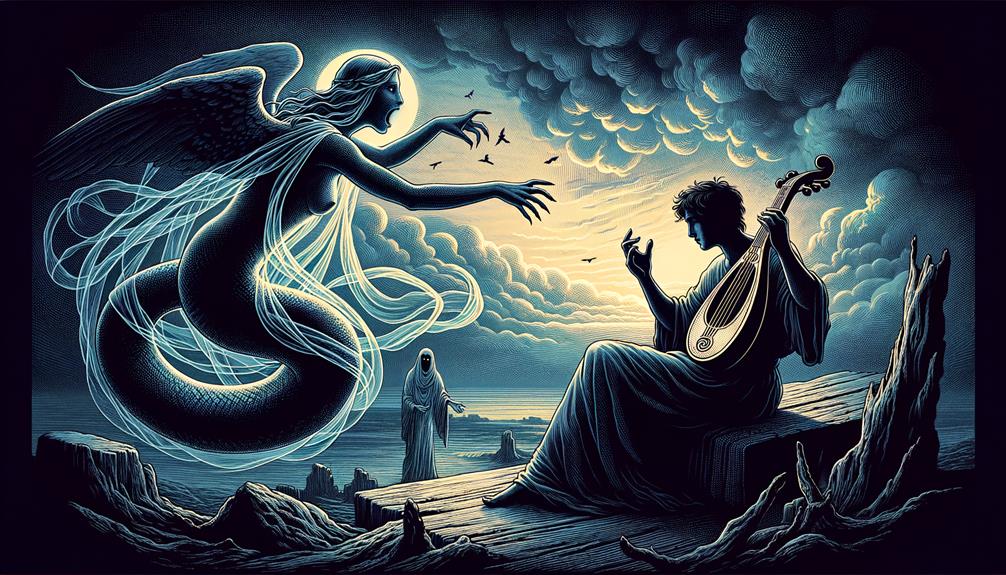
Orpheus and Eurydice are known through several ancient versions rather than one fixed story. Two of the most important surviving accounts appear in Virgil’s Georgics and Ovid’s Metamorphoses. Both describe Eurydice’s death, Orpheus’s descent to the underworld, and the condition that he must not look back. They differ in details and emphasis.
Orpheus in ancient tradition
Orpheus is a Thracian singer whose music can move people, animals, trees, stones, and even the powers of the underworld. His parentage varies. Calliope is commonly named as his mother, while Oeagrus or Apollo may be named as his father in different traditions. It is therefore too definite to call Apollo his father in every version.
Orpheus was also connected with the Argonauts and with religious poetry attributed to the legendary singer. His importance extends beyond the story of Eurydice, although that episode became his most famous myth.
Eurydice’s death

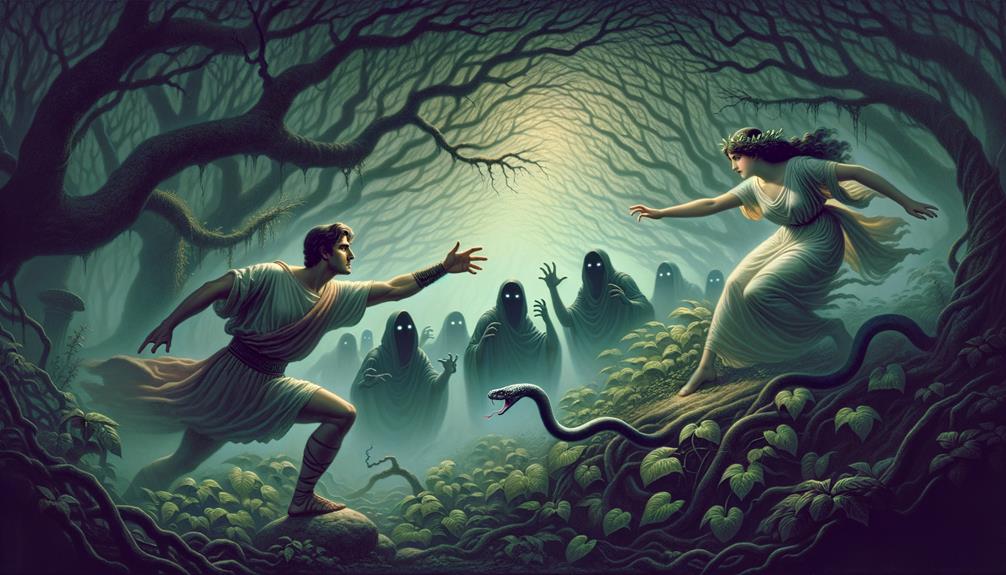
In Ovid’s version, bad omens mark the wedding. Eurydice is walking through grass with a group of naiads when a snake bites her ankle and she dies. Virgil adds a different detail: Eurydice steps on a snake while fleeing Aristaeus, who is pursuing her.
Neither account describes a long courtship or gives a detailed first meeting. Claims about the exact circumstances of their romance belong to later retellings unless they can be tied to a specific source.
The descent to the underworld
After mourning Eurydice, Orpheus descends through the Taenarian entrance to the underworld. His song moves the dead and suspends their punishments. Ovid says that Tantalus stops reaching for water, Ixion’s wheel stands still, and Sisyphus sits on his stone. Even the Furies weep.
Orpheus addresses both rulers of the dead. In Greek terms they are Hades and Persephone, while Ovid uses Roman names and titles. He asks for Eurydice only as a temporary return, arguing that all mortals must eventually come back to the underworld.
The rulers agree on one condition: Orpheus must not look behind him until he and Eurydice have left the underworld.
The fatal glance
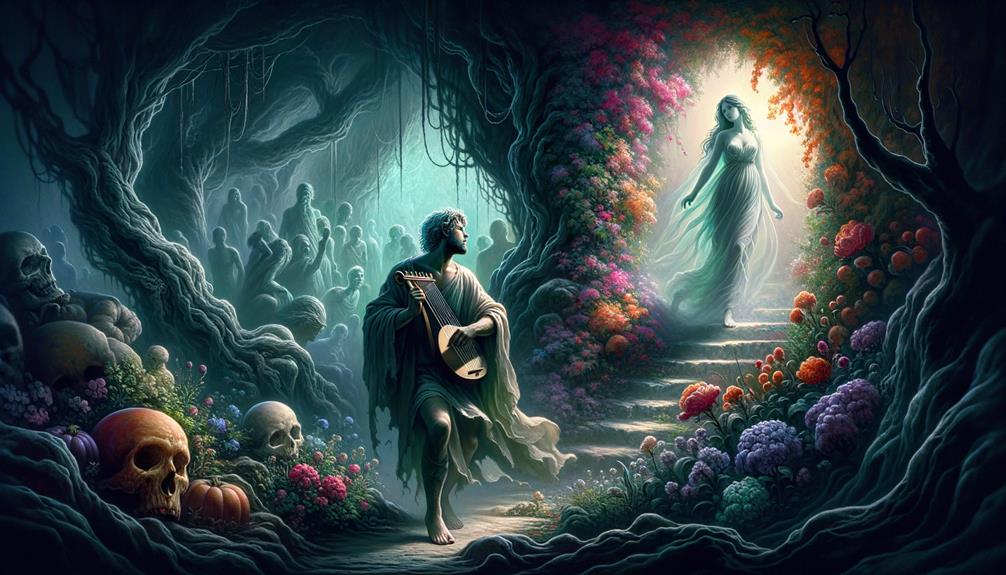
As the pair approach the upper world, Orpheus looks back. Ovid attributes the act to fear that Eurydice may be failing and to his desire to see her. Virgil stresses a sudden madness or failure of resolve. No ancient source gives an exact distance such as forty-six steps from the exit.
Eurydice is pulled back. In Ovid, she does not blame Orpheus because the act came from love. Orpheus tries to cross the river again, but the ferryman refuses him. He remains in grief for seven days before leaving the bank.
The episode is often treated as a lesson about trust or patience, but those are later moral readings. The ancient texts place equal weight on grief, human weakness, and the finality of death.
The death of Orpheus

Ovid continues the story in Book 11 of the Metamorphoses. Thracian Maenads attack Orpheus. The poem links their anger to his rejection of women after Eurydice’s death. His music initially charms the objects thrown at him, but the noise of flutes, horns, drums, and shouting overwhelms his song. The Maenads dismember him.
The claim that his mournful tunes simply made Dionysus’s followers angry does not match Ovid’s account. Nor does Ovid include advice from a singular Christian God. That language belongs to a much later religious framework.
Orpheus’s severed head and lyre travel down the Hebrus. His shade reaches the underworld and is reunited with Eurydice. Ovid closes the episode by allowing him to look at her without danger.
How the story has been understood
The myth has supported many interpretations because Orpheus succeeds and fails at the same time. His art crosses the boundary of death and persuades the underworld’s rulers, but it cannot cancel mortality. His backward glance may express doubt, love, fear, or the impossibility of recovering what has been lost.
Later poets, painters, composers, filmmakers, and playwrights have changed the motivation and ending. These adaptations are valuable works in their own right, but they should be distinguished from the surviving accounts by Virgil and Ovid.
Frequently asked questions
Who were Orpheus’s parents?
Ancient traditions vary. Calliope is commonly his mother. Oeagrus or Apollo may be named as his father.
How did Eurydice die?
She died from a snakebite. Ovid places her among naiads in the grass, while Virgil says she stepped on the snake while fleeing Aristaeus.
Why did Orpheus look back?
Ovid says he feared Eurydice might be weakening and wanted to see her. Virgil presents the glance as a sudden failure of resolve. The texts do not reduce the act to one simple moral.
Who killed Orpheus?
In Ovid’s account, Thracian Maenads kill and dismember him. His death is not caused merely by their dislike of sad music.
Sources
- Ovid, Metamorphoses, Book 10, translated by A. S. Kline
- Ovid, Metamorphoses, Book 11, translated by A. S. Kline
- Virgil, Georgics, Book 4