
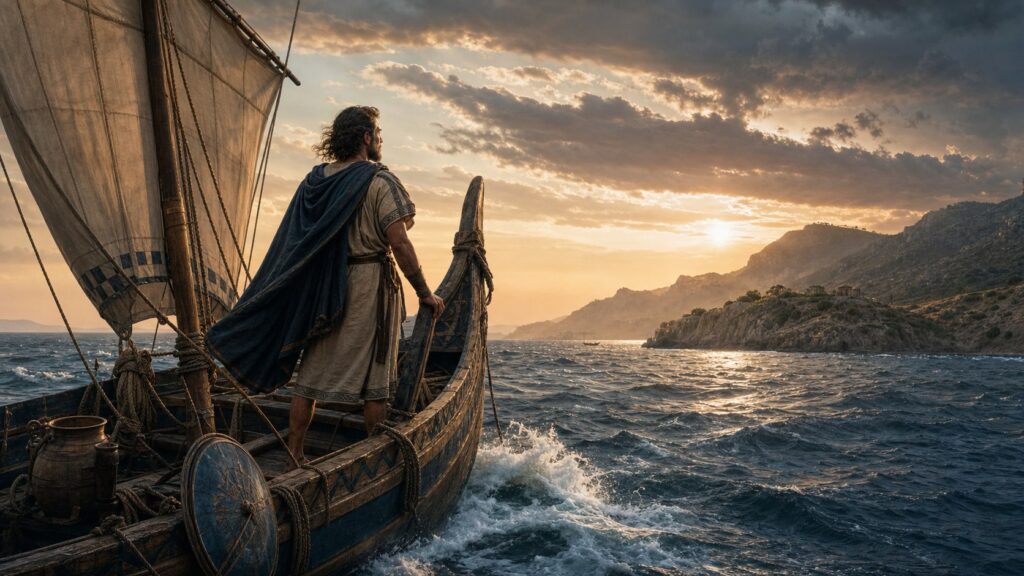
Homer’s Odyssey follows Odysseus as he struggles to return to Ithaca after the Trojan War. The poem is traditionally attributed to Homer and was shaped by a long oral tradition before it was written down. Its twenty-four-book division is ancient, but the poem begins near the end of Odysseus’s absence rather than at the start of his travels.
How long Odysseus was away
Odysseus is absent from Ithaca for twenty years, not sixteen. He spends ten years fighting at Troy and another ten years trying to return. Seven of the latter years are spent on Calypso’s island. The poem opens while Odysseus is still detained there.
The first four books concentrate on Telemachus, who travels to Pylos and Sparta for news of his father. Odysseus enters the main action after the gods decide that Calypso must release him.
How the poem tells the story
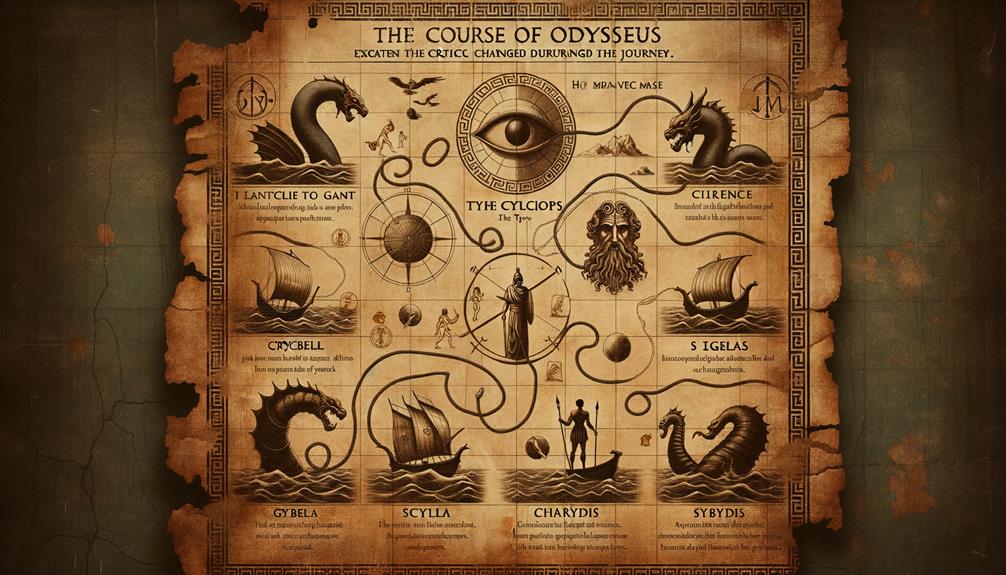
The Odyssey does not present every event in chronological order. Odysseus reaches the Phaeacians and then recounts much of his earlier wandering in Books 9 through 12. This embedded narrative includes the Cicones, Lotus-Eaters, Cyclops, Aeolus, Laestrygonians, Circe, the dead, Sirens, Scylla and Charybdis, and the cattle of Helios.
All of Odysseus’s surviving crew die after they slaughter the cattle of Helios despite a clear prohibition. Odysseus alone reaches Calypso’s island. The disaster is not simply a sequence of monsters defeated by an invincible hero. It also records failures of command, poor judgment, hunger, disobedience, and divine punishment.
Homecoming, identity, and disguise

The Greek idea of nostos, or homecoming, organizes the poem. Returning is not enough by itself. Odysseus must learn what has happened in Ithaca, test the loyalty of his household, conceal his identity, and decide when to reveal himself.
Athena disguises him as a beggar. Eumaeus offers him hospitality without knowing who he is. Telemachus, Eurycleia, Penelope, and Laertes recognize him at different points and through different signs. These scenes make identity something proven through memory, scars, shared knowledge, and conduct.
Hospitality and the suitors
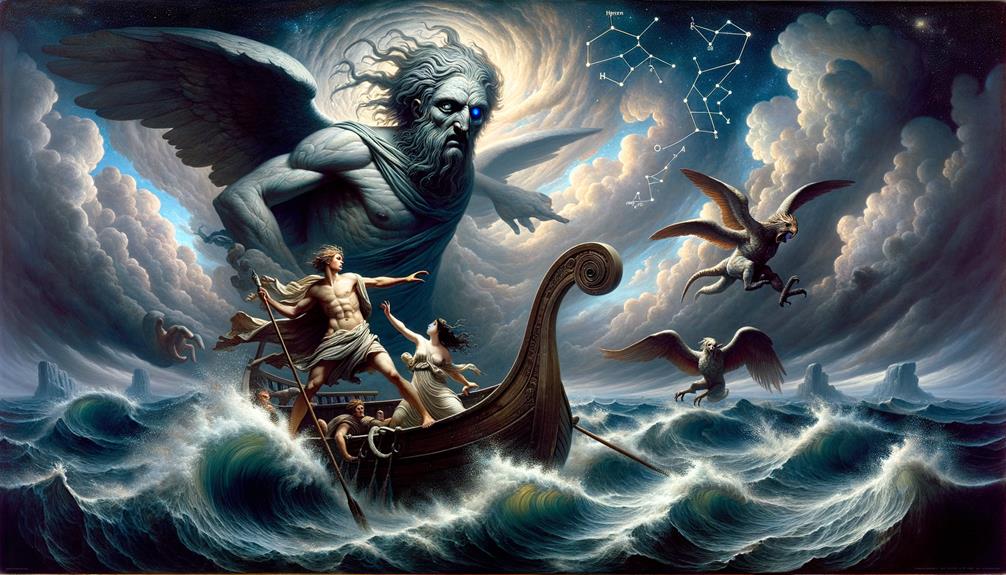
Hospitality, or xenia, is a central social and religious concern. Good hosts feed and protect strangers before demanding an identity. The Phaeacians and Eumaeus observe that duty. Polyphemus attacks his guests, while the suitors consume Odysseus’s household and abuse strangers under his roof.
The suitors are therefore more than romantic rivals. They violate the household, pressure Penelope, threaten Telemachus, and ignore warnings. Their deaths are presented as punishment, although the scale and violence of the killing remain ethically difficult for modern readers.
Odysseus’s intelligence and flaws
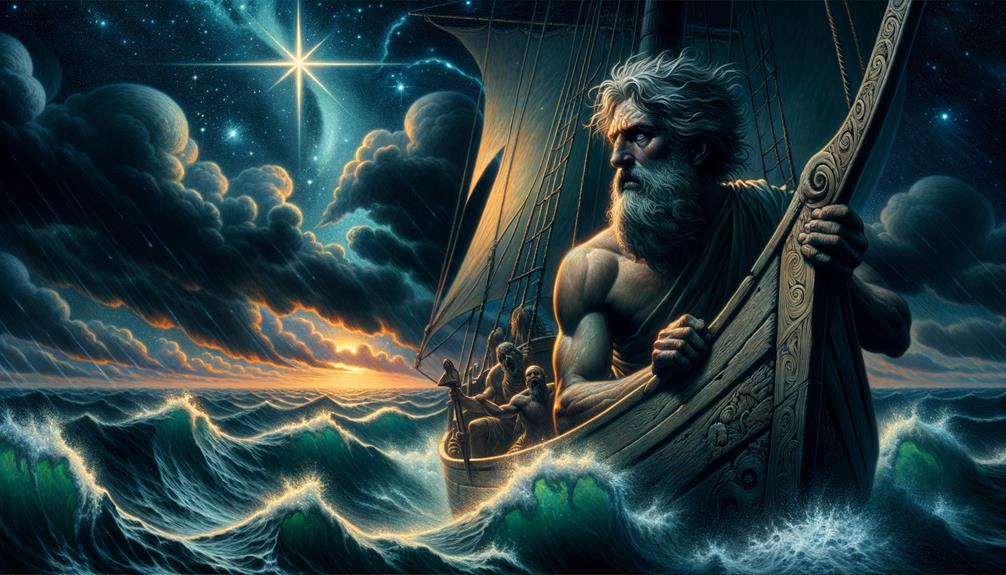
Odysseus is marked by metis, a form of practical intelligence involving planning, disguise, and verbal skill. He escapes Polyphemus by calling himself “Nobody” and hiding beneath the Cyclops’s sheep. Yet pride undercuts that success when he reveals his real name, allowing Polyphemus to call on Poseidon for revenge.
The poem does not make Odysseus a simple model of loyalty. He remains with Circe for a year and with Calypso for seven years under very different conditions. Penelope’s endurance and intelligence provide an important comparison. Her weaving strategy, guarded speech, and test of the marriage bed match Odysseus’s caution.
The ending of the Odyssey
After Odysseus kills the suitors, he and Penelope are reunited. The poem continues beyond that scene. Odysseus visits Laertes, and the relatives of the dead suitors prepare further violence. Athena, acting under Zeus’s direction, imposes peace in the final book.
The ending restores Odysseus’s household and kingship, but it does not treat revenge as self-limiting. Divine intervention is required to stop another cycle of killing.
Frequently asked questions
How many years did Odysseus take to return home?
His return from Troy takes ten years. Including the ten-year Trojan War, he is away from Ithaca for twenty years.
Is the Odyssey told in chronological order?
No. The poem begins late in the story, and Odysseus later narrates many earlier adventures to the Phaeacians.
What are the poem’s main themes?
Homecoming, hospitality, identity, intelligence, loyalty, divine power, storytelling, and the consequences of violence are central concerns.
Does the poem end when Odysseus reunites with Penelope?
No. It continues through his reunion with Laertes and a final conflict that Athena stops.