
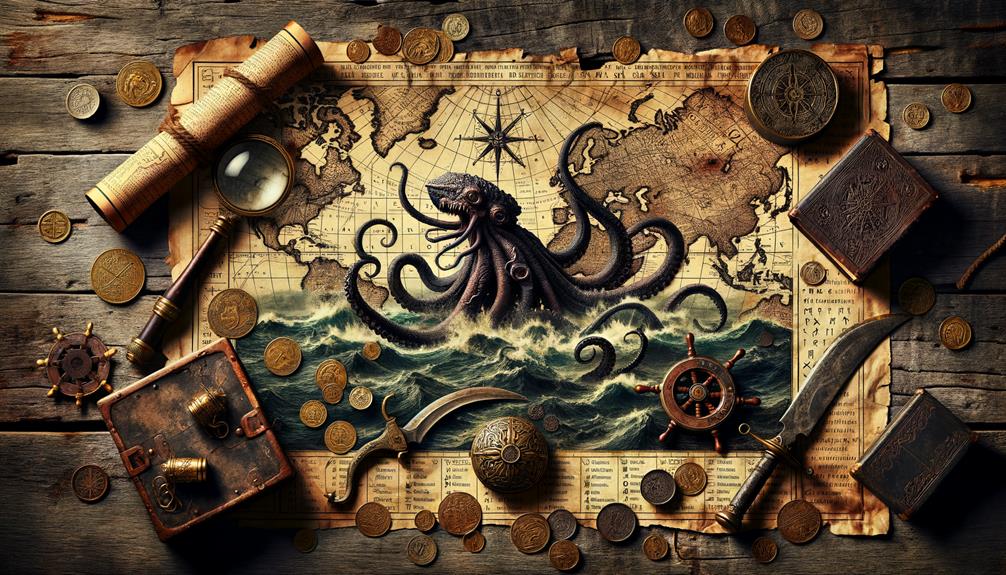
The kraken is a sea monster from Scandinavian tradition, especially accounts connected with Norway and nearby North Atlantic waters. Its history is often pushed back into “Norse mythology” without qualification, but the name and the familiar detailed description are best documented in early modern sources rather than the Poetic or Prose Edda.
The name and early modern accounts
The word kraken is the definite form of a Scandinavian term related to krake. Historical forms and regional names vary, so simple English translations such as “crooked” or “unhealthy animal” should be treated cautiously.
Italian traveler Francesco Negri described a huge marine animal in northern waters after journeys made in the seventeenth century. Norwegian writers also recorded coastal stories before the most influential published account. These references show that giant sea-creature lore circulated before the kraken became widely known to English readers.
Pontoppidan’s kraken
Erik Pontoppidan, bishop of Bergen, gave the kraken its most famous early modern description in his Natural History of Norway, published in Danish in 1752 and 1753 and in English translation in 1755. He called it the largest sea monster in the world and described a round, flat back with arms or branches.
In Pontoppidan’s account, the creature could be mistaken for a group of small islands when it rose near the surface. Fish gathered over it, drawing fishermen to the area. Its descent was said to create a dangerous whirlpool. These claims report folklore and eighteenth-century natural history, not verified measurements of a known animal.
Is the kraken the same as the hafgufa?
Medieval Norse texts describe a huge sea creature called the hafgufa. It could be mistaken for land and was associated with unusual feeding behavior. Modern writers sometimes identify it directly with the kraken.
The comparison may show continuity in North Atlantic stories about immense sea beings, but the names come from different texts and periods. It is safer to describe the hafgufa as a possible relative or predecessor in regional sea-monster lore, not simply as the kraken under another name. The kraken does not play a role in the Eddas comparable to named beings such as Jormungandr.
Giant squid and the legend
Giant squid are real deep-sea animals. The Smithsonian reports that the largest scientifically recorded specimen approached 43 feet, or 13 meters, in total length. Because these animals live in deep water and are rarely observed alive, most historical knowledge came from stranded bodies, remains, or accidental catches.
A large squid seen briefly at sea could have contributed to stories of tentacled monsters. That possibility does not prove that every kraken report began with a giant squid. Pontoppidan’s flat, island-like animal is not simply a precise account of Architeuthis, and his immense scale exceeds the evidence for living cephalopods. The modern octopus-like kraken combines folklore with later zoological imagery.
From reported animal to fictional monster
Eighteenth-century authors often discussed sea monsters within natural history because the deep ocean was poorly observed. Later literature and art made the kraken more distinctly squid-like or octopus-like. Alfred Tennyson’s poem “The Kraken” helped establish an image of an ancient creature sleeping in the abyss, while twentieth- and twenty-first-century films and games turned it into a ship-destroying monster.
These later works are adaptations, not records of an unchanged medieval belief. The visual form now recognized as the kraken owes much to modern cephalopod knowledge and popular art.
What the evidence supports
Historical sources support the existence of coastal stories and printed descriptions of a colossal sea creature. Zoology supports the existence of large squid, including species rarely seen alive. It does not support a creature the size of an island, one that routinely drags ships underwater, or one whose submergence creates vast whirlpools.
The kraken is best understood by keeping those categories separate: documented folklore, early natural-history claims, real deep-sea animals, and later fiction.
Sources
- Erik Pontoppidan, The Natural History of Norway, 1755 edition
- Biodiversity Heritage Library, Pontoppidan and the kraken
- Royal Collection Trust, The Natural History of Norway
- Smithsonian National Museum of Natural History, giant squid
- Store norske leksikon, history of the kraken tradition