
Achilles is a formidable Greek warrior, but “invincible” is a misleading description of the hero in Homer’s Iliad. The poem shows him wounded, grieving, dependent on divine help, and conscious that his life will end. His extraordinary power matters because it does not free him from loss.
The Iliad follows the consequences of his anger rather than telling his entire life. To understand its Achilles, start with the quarrel that keeps him out of battle, the death that brings him back, and the encounter that finally interrupts his vengeance.
Why does Achilles refuse to fight?
The dispute with Agamemnon concerns authority, public honor, and Briseis, a captive woman treated by the Greek leaders as a prize of war. Agamemnon takes her from Achilles, who withdraws his support. The harm is not confined to the two men: the army faces the consequences of their conflict, while Briseis’s own freedom has already been taken away.
In Book 9, an embassy offers Achilles gifts and urges him to return. His answer questions whether wealth can compensate for the risk of death. Cattle and valuables can be recovered; a human life, once lost, cannot.
The two possible futures
Achilles tells the embassy that his mother, the sea goddess Thetis, has described two fates. If he remains at Troy and fights, he will lose his homecoming but gain enduring renown. If he goes home, his life will be long, but that exceptional glory will be lost.
This is not an uncomplicated declaration that fame is always worth dying for. At this point in the poem, Achilles is weighing the value of life against the rewards of the heroic system. His later decisions take place under the pressure of bereavement, not in an abstract choice made without consequences.
Patroclus’s death changes the war
Patroclus goes into battle wearing Achilles’s armor. His death in Book 16, lines 777–857 is not simply an evenly matched duel with Hector. Apollo strikes and disarms him; Euphorbus wounds him; Hector delivers the final blow. The dying Patroclus himself names these successive contributions.
When Achilles hears the news in Book 18, he collapses in grief. The account dwells on his tears, dust-covered face, and anguish. Whatever interpretation a reader brings to their relationship, the force of this loss is central to the poem.
Thetis subsequently asks Hephaestus to make new armor for her son. The god’s elaborate shield includes cities, farming, a vineyard, and other scenes beyond the battlefield. Its imagined world is much larger than the immediate pursuit of revenge. Even its divine maker does not promise that the armor can keep Achilles from his destined death.
Can Achilles be wounded?
Yes. In Book 21, lines 161–166, Asteropaeus throws two spears. One hits Achilles’s shield; the other grazes his right forearm and draws blood. This is direct evidence against treating Homer’s hero as physically immune to injury everywhere except his heel.
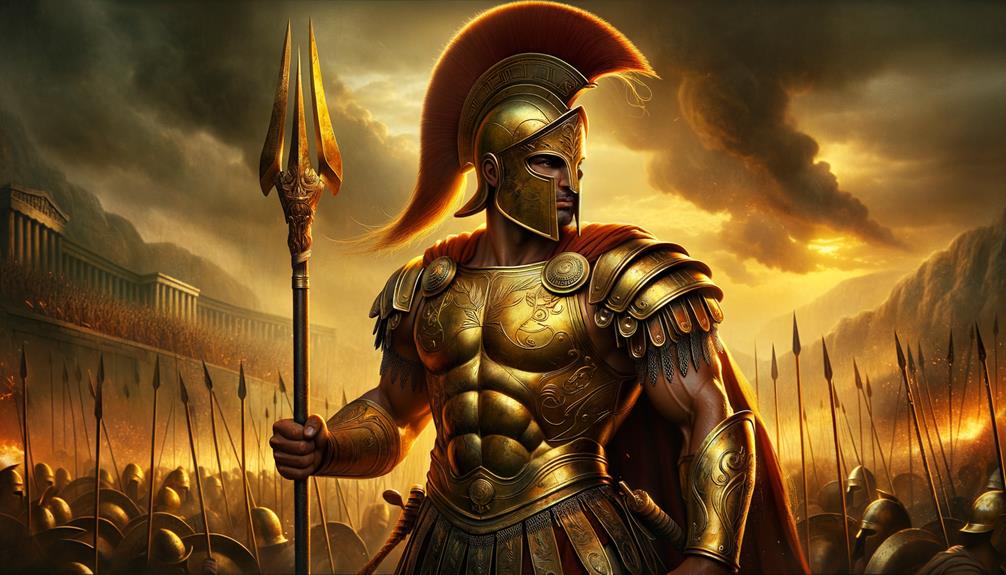
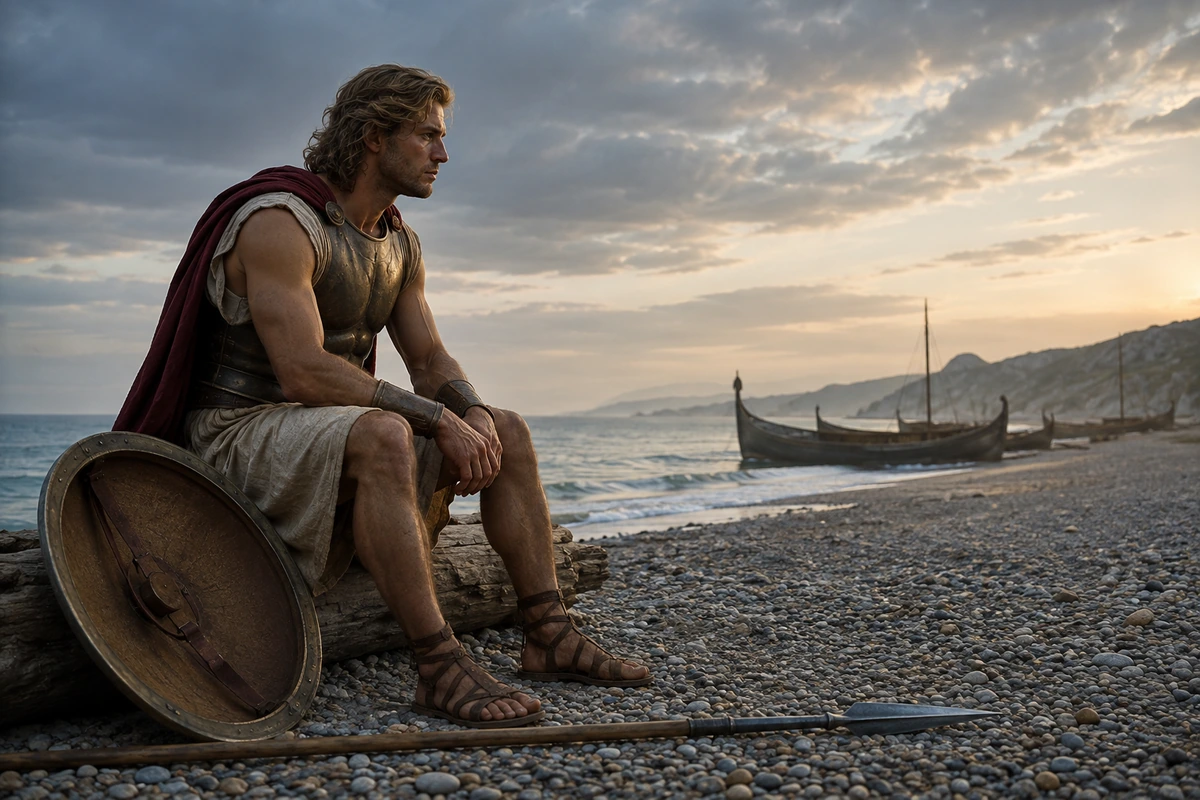
The article’s existing featured illustration is stylized fantasy art, not evidence for Homeric equipment: its multi-pronged weapon should not be mistaken for the ash spear described in the poem. The new illustration likewise conveys a theme rather than reproducing an excavated set of armor.
Hector’s death and Achilles’s own mortality
In Book 22, Achilles kills Hector and refuses his request for the return of his body. Before dying, Hector predicts that Paris and Apollo will kill Achilles at the Scaean gate. Achilles acknowledges that his own fate will come when the gods bring it about.
The Iliad therefore anticipates Achilles’s death without narrating the event. His victory over Hector is not a final escape from mortality, and the abuse of Hector’s corpse does not restore Patroclus.
Priam’s appeal and a limit to vengeance
In Book 24, lines 485–551, Priam enters Achilles’s shelter and asks him to remember his own father, Peleus. The old king seeks the body of Hector, the son Achilles has killed. Achilles weeps for Peleus and Patroclus while Priam weeps for Hector.
Achilles ultimately releases the body for burial. The encounter does not undo the killing or end the war, but it permits an act of care across the lines of enmity. Shared grief briefly changes what Achilles is willing to do.
That is why the hero is more compelling than the label “invincible warrior” suggests. His story exposes the cost of honor, the devastation of loss, and the possibility of recognizing another person’s suffering even after terrible violence.